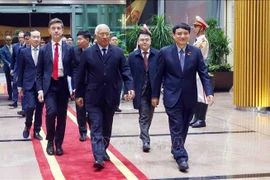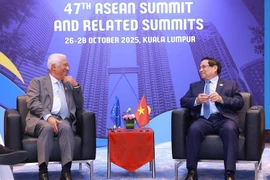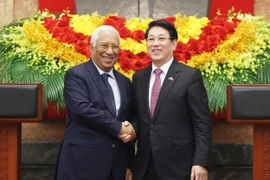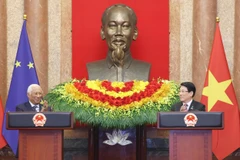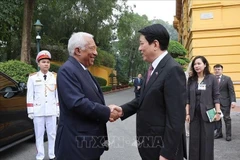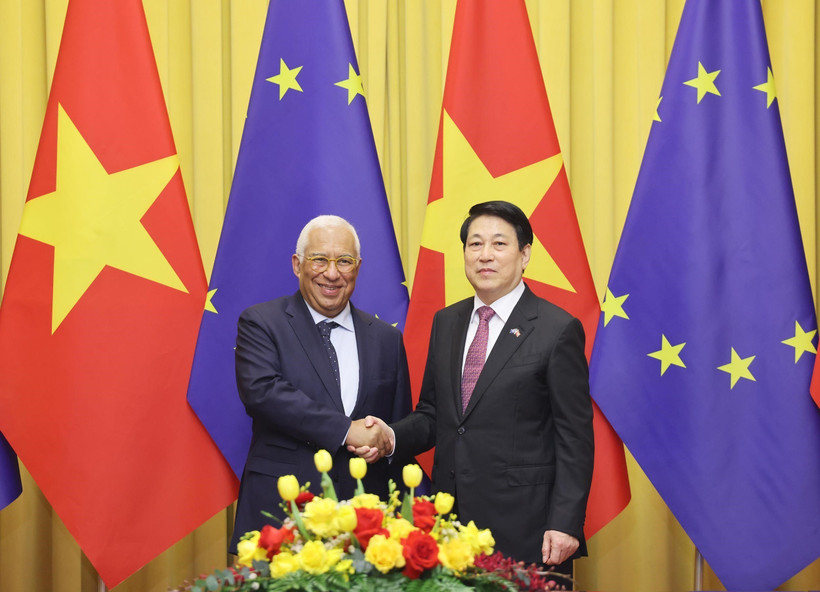
Hanoi (VNA) - President of the European Council António Costa paid an official visit to Vietnam from January 28-29, 2026 at the invitation of State President Luong Cuong. On this occasion, the two sides issued a Joint Statement on upgrading the relationship between the Socialist Republic of Vietnam and the European Union (EU) to a Comprehensive Strategic Partnership.
The Vietnam News Agency (VNA) respectfully introduces the full text of the Joint Statement.
JOINT STATEMENT
On upgrading relations between the Socialist Republic of Vietnam and the European Union to a Comprehensive Strategic Partnership
1. The Socialist Republic of Vietnam (Vietnam) and the European Union (EU) (hereinafter referred to as “Both sides”) confirm the importance of a partnership based on common interests and shared values of peace, security, and prosperity in a rules-based international order based on international law.
2. Both sides affirm and highly appreciate the strong relationship based on agreements and cooperation mechanisms such as the Framework Agreement on Comprehensive Partnership and Cooperation (PCA) between the Socialist Republic of Vietnam, on the one part, and the European Union and its Member States, on the other part; the Free Trade Agreement between the Socialist Republic of Vietnam and the European Union (EVFTA); the Agreement between the Government of the Socialist Republic of Vietnam and the European Union establishing a framework for the participation of the Socialist Republic of Vietnam in European Union crisis management activities (FPA); and the Just Energy Transition Partnership (JETP) between the Socialist Republic of Vietnam and the International Partnership Group; and dialogue and cooperation mechanisms such as the Vietnam - EU Joint Committee under the PCA, the Trade Committee under the EVFTA; the annual Vietnam - EU Security and Defence Dialogue, and the Vietnam - EU Human Rights Dialogue.
3. Based on the outstanding achievements of bilateral relations in all fields over the past 35 years, with open cooperation potential and firm belief in the bright future of bilateral relations, in order to meet the aspirations of the people of the European Union and Vietnam, both sides agreed to issue a Joint Statement upgrading Vietnam - EU relations to a "Comprehensive Strategic Partnership".
4. The new partnership will elevate relations to new heights bilaterally, regionally and multilaterally. Within the framework of the Comprehensive Strategic Partnership, both sides will continue to deepen cooperation in the following areas to deliver practical outcomes, while contributing to peace, stability, cooperation and prosperity in both regions and the world, in line with existing agreements.
STRENGTHENING POLITICAL COOPERATION
5. Both sides aim to continue promoting political cooperation between the Socialist Republic of Vietnam and the EU through contacts at all levels, especially at senior level; and enhance diplomacy and people-to-people relations to implement measures to promote Vietnam - EU relations.
6. Both sides reaffirm their commitment to effectively implement agreements; proactively promote consultation and policy coordination, especially on strategic issues; and make full use of dialogue mechanisms such as the Joint Committee under the PCA and its Subcommittees, the Trade Committee under the EVFTA, the Security and Defence Dialogue, and the Vietnam - EU Human Rights Dialogue.
7. Both sides will enhance inter-parliamentary cooperation, including regularly and effectively maintaining the exchange mechanism between the Vietnamese National Assembly and the European Parliament (EP) on inter-parliamentary cooperation, including the implementation of the EVFTA.
STRENGTHENING ECONOMIC, TRADE AND INVESTMENT RELATIONS
8. Both sides affirm the strategic importance of economic, trade and investment cooperation as a core foundation for sustainable and inclusive growth. Both sides will further strengthen dialogue on economic and trade policy issues, as well as on relevant legal regulations, to achieve this goal. Both sides emphasise the importance of prioritising the resolution of difficulties and emerging issues through open and constructive dialogue.
9. Both sides emphasise the benefits that Vietnam and the EU have gained from the EVFTA, reaffirming the need for its full and effective implementation to reach the mutually beneficial potential of the agreement, and their will to strengthen cooperation in areas of mutual interest and to deepen collaboration in multilateral fora, in order to achieve tangible outcomes for shared prosperity and growth.
The EU recognises Vietnam’s efforts to modernise its economy and attract foreign investment, and confirms its readiness to engage constructively with Vietnam in its transition towards a more advanced economy.
10. Both sides recognise the importance of fully and effectively implementing their trade and sustainable development commitments under the EVFTA and their close cooperation in multilateral and bilateral fora, and through projects. Both sides give priority to cooperation in the field of labour, and to protection of workers’ rights and interests in accordance with their commitments taken under the EVFTA.
Both sides emphasise the importance of ILO standards and of implementing them effectively, and reaffirm their commitments under the EVFTA.
11. Both sides will explore, develop and deepen trade and investment opportunities in sectors of mutual interest. These include, but are not limited to, critical raw materials, energy, including safe and sustainable, low-carbon energy and technology, circular economy, logistics, transport and infrastructure, including secure and trusted communications infrastructure, semiconductors, artificial intelligence, and digitalisation, including critical infrastructure and cybersecurity, resilience and diversification of supply chains, as well as sustainable agriculture, forestry and fisheries. Both sides agreed, building on their existing engagement, to step up cooperation, making full use of available financial tools and working together to create a clear, open, attractive, robust and trusted regulatory and investment framework, sharing experience and exploring possibilities for cooperation on financial sector development in Vietnam.
Both sides intend to continue developing cooperation on critical raw materials, including through identifying opportunities, fostering responsible business partnerships, and promoting trade and investment in goods, services and technologies that support sustainable mining and processing.
12. Both sides will aim to mobilise investments and create a favourable environment by ensuring transparent regulations (including procurement regulations), predictable market access and regulatory conditions, and open procurement frameworks. This would promote mutually-beneficial EU investment in high-tech, high-value-added projects associated with business opportunities, technology transfer, human resources development, participation in global production and supply chains.
The EU will provide Vietnam with technical support to improve its capacity to adapt to new EU policies and regulations on green and sustainable trade.
13. Both sides reaffirm their commitment to a transparent and rules-based international trading system, to their cooperation to strengthen and reform the World Trade Organisation, and to explore closer coordination on issues related to the Comprehensive and Progressive Agreement for Trans-Pacific Partnership.
14. Both sides recognise the importance of institutional structures under the EVFTA, such as the Trade Committee and of the EU - Vietnam task force (which both sides will establish in the coming period) to promptly address trade and investment obstacles, to ensure the full and effective implementation of all EVFTA commitments, to guide the work on future cooperation on sectors of mutual interest, and coordinate their cooperation on the WTO and other relevant fora, such as the dialogue with the CPTPP. These priority areas may include items raised in the Trade Committee under the EVFTA for action.
Both sides identify priority areas for action to expand market access for goods, services and public procurement, create business opportunities, in order to capitalise on each side’s strengths, needs and conditions, on the basis of openness, transparency and fairness, including the early publication and consultation on regulatory proposals and supporting cooperation, as well as regular and transparent exchanges, results-oriented communications and effective working methods.
15. Both sides affirm the importance of advancing the ratification of the Investment Protection Agreement (EVIPA) between the Socialist Republic of Vietnam and the EU and its Member States, and ensuring its effective implementation once in force, with a view to encouraging high-quality investment into each other's markets.
STRENGTHENING COOPERATION ON PEACE, DEFENCE AND SECURITY
16. Both sides emphasise the vital importance of peace and international security, and will endeavour to maintain it. Both sides support the promotion of multilateralism and respect for international law, including the Charter of the United Nations.
Both sides will strengthen security and defence cooperation through the Vietnam - EU Security and Defence Dialogue mechanism. Both sides acknowledge the contributions of Vietnam and the EU in peacekeeping operations, as well as ongoing cooperation in crisis management.
17. Both sides will aim to strengthen cooperation in building human resources participating in peacekeeping operations. Both sides intend to explore further cooperation with security forces and police, especially in search and rescue and fire prevention, including through strengthened cooperation in urban search and rescue, chemical and environmental incident response, and the implementation of specialised and simulation-based training programmes. The EU will continue cooperation on helping Vietnam address some of its war legacy issues, as well as explore potential for exchanges in research, development and, where appropriate, non-sensitive technology and know-how transfer in areas relevant to security- and defence-related and industries, in accordance with the respective laws and regulations of both sides.
Both sides are determined to uphold the rules-based international order in accordance with international law built on respect for, inter alia, the rule of law, the principle of sovereign equality, territorial integrity, political independence of states, and will enhance cooperation and coordination in regional and international fora such as the United Nations, as well as within the framework of the ASEAN - EU Strategic Partnership and the ASEAN Regional Forum.
18. Both sides consistently reaffirm their respect for the independence, territorial integrity and sovereignty of all states, non-interference in internal affairs, the peaceful settlement of disputes, and the non-use or threat of use of force.
Both sides emphasise the importance of achieving a comprehensive, just and sustainable peace in Ukraine, in accordance with international law and the fundamental principles of the UN Charter.
19. Both sides reaffirm their interest in enhancing security cooperation. They will advance cooperation in collaboration with EU law enforcement agencies to combat terrorism and transnational organised crime, such as human trafficking, drug-related crime, economic crime (money laundering, smuggling, trade fraud, origin fraud), wildlife trafficking, cybercrime and environmental crime. They will also collaborate to combat irregular migration and migrant smuggling.
Cooperation will also be explored in areas such as energy security, including strengthened exchanges on mechanisms for crisis preparedness. Both sides identify maritime safety and security, cybersecurity and crisis management as key areas for further cooperation, based on mutual respect for each side’s interests and priorities, while taking into account potential cooperation within initiatives such as the EU’s Enhancing Security Cooperation In and With Asia (ESIWA+), Critical Maritime Routes in the Indo-Pacific (CRIMARIO II) and the Global Ports Safety (GPS) projects. Both sides (with the EU in its capacity as a signatory of the Convention or without prejudice to procedures of EU member states) make efforts to complete their respective internal procedures regarding the United Nations Convention against Cybercrime. The early entry into force of the Convention would further contribute to strengthening regional and international cooperation in this area.
20. Both sides emphasise the importance of maintaining peace and stability in the South China Sea.
Both sides reaffirm their full respect and adherence to international law, the settlement of disputes through peaceful means in accordance with international law, especially the UN Charter, without the threat or use of force.
Both sides stress the importance of the maintenance of peace, security, stability, safety and freedom of navigation and overflight, and unhindered commerce in the seas in accordance with international law, especially the 1982 UN Convention on the Law of the Sea (1982 UNCLOS). Both sides reaffirm that 1982 UNCLOS sets out the legal framework within which all activities in the oceans and seas must be carried out. Both sides reaffirm the importance of respecting these principles and freedoms in the South China Sea.
Both sides underscore the importance of the full and effective implementation of the 2002 Declaration on the Conduct of Parties in the South China Sea. Both sides also welcome further progress towards the early conclusion of an effective and substantive Code of Conduct that is consistent with international law, including the 1982 UNCLOS.
Both sides will study the possibility of expanding cooperation in the fields of strategic research, maritime security, and data protection.
Both sides envisage cooperating on the prevention of sanctions circumvention in accordance with the Charter of the United Nations and the international treaties of which both sides are members.
STRENGTHENING SCIENCE AND TECHNOLOGY COOPERATION AND PEOPLE-TO-PEOPLE CONNECTIONS
21. Both sides intend to deepen and expand cooperation in science and technology, research and innovation, including enhanced research capacities and exchange of information on the Horizon Europe Framework Programme for Research and Innovation and other research programmes; and promote cooperation in creative and cultural industries, people-to-people connections and cultural exchanges.
22. Both sides acknowledge that enduring prosperity requires strengthening and investing in human capital. They reaffirm their willingness to further deepen and expand cooperation in education and training, including under programmes such as Erasmus+; to explore options to build capacities of academic individuals and institutions, support the mobility of students and academic staff, and exchange experiences and best practices.
23. Both sides will explore the possibility of developing and implementing joint vocational training and skills development initiatives, including in areas which could include green transition, digital transformation and smart manufacturing. Both sides will step up research, science, technology and innovation cooperation, including through a Letter of Intent in these fields.
24. Both sides agree on the need to explore and implement measures to further facilitate exchanges and travel between citizens.
25. Both sides will encourage business-to-business exchanges, including Business Summits and cluster matchmaking events.
STRENGTHENING INCLUSIVE AND SUSTAINABLE DEVELOPMENT COOPERATION
26. Both sides will implement the 2030 Agenda for Sustainable Development in its different components and objectives, from human development to good governance, as well as socio-economic inclusion and environmental protection, and cooperate in the context of the Sustainable Development Subcommittee mechanism (within the framework of the Joint Committee implementing the PCA) to enhance cooperation in building a policy framework on sustainable development.
27. Both sides intend to work together in the framework of the EU’s Global Gateway to create a more conducive environment to attract quality, sustainable investments and infrastructure to connect Vietnam to global markets and accelerate its integration in the Mekong sub-region, ASEAN, the region and the world.
28. Both sides aim to work together on enhancing the existing regulatory and administrative framework for investment and Official Development Assistance (ODA) in Vietnam, to facilitate public and private investment flows; and to speed up the implementation of projects serving sustainable development goals.
29. Both sides will strengthen cooperation between the EU and the Mekong sub-region, and actively coordinate to implement tripartite cooperation projects between Vietnam - Laos/Cambodia - EU in the Mekong sub-region, including focusing on the areas of climate change response, biodiversity protection, digital economy, transboundary water resources management, infrastructure connectivity, safe and sustainable low-carbon energy, decarbonisation of the power sector, smart agriculture, and green and sustainable tourism.
30. Both sides will strengthen cooperation to effectively implement their commitments in accordance with the United Nations Framework Convention on Climate Change (UNFCCC), the Paris Agreement, the Convention on Biological Diversity and the Kunming-Montreal Global Biodiversity Framework and will cooperate to achieve the goal of stopping deforestation and restoring forests by 2030.
31. Both sides target the most vulnerable segments of society and their full enjoyment of rights, promote the full, equal and meaningful participation and leadership of women, and leave no one behind, while ensuring an inclusive approach towards human and social sustainable development.
STRENGTHENING COOPERATION ON AGRICULTURE, BLUE ECONOMY, OCEAN CONSERVATION AND SUSTAINABLE USE
32. Both sides will promote green and sustainable development in the agricultural sector.
33. Both sides recognise the urgent need to address plastic pollution in the marine environment, including by reducing the production and consumption of single-use plastics, and by promoting circular economies and ocean governance.
34. Both sides highlight the importance of sustainable fisheries and commit to promoting cooperation in this area, noting Vietnam’s efforts in combating Illegal, Unreported and Unregulated (IUU) fishing, and the timely lifting of the EU’s Yellow Card.
35. Both sides will explore the potential for further cooperation in developing a sustainable blue economy, acknowledging the ocean’s vital role in regulating climate, sustaining biodiversity and marine biodiversity, and supporting livelihoods.
36. Both sides intend to strengthen cooperation in developing a green economy and sustainable development of the fisheries sector, including sustainable aquaculture and fisheries exploitation, protection, regeneration and development of aquatic resources.
37. Both sides affirmed their determination to promote cooperation in developing a circular economy, sustainable forest management, ensuring biodiversity and marine biodiversity conservation and restoration, and disease prevention from animals to humans.
38. Both sides aim to strengthen cooperation in training and research, especially the application of new technology and biotechnology in agriculture between research and training facilities of both sides.
39. Both sides are willing to promote the development of organic agriculture with low greenhouse gas emissions; and strengthen cooperation in transforming food systems.
STRENGTHENING ENVIRONMENTAL, SAFE AND SUSTAINABLE LOW-CARBON ENERGY TRANSITION AND CLIMATE COOPERATION
40. Both sides recognise the increasingly severe consequences of climate change, as evidenced by science, and will improve the effectiveness of cooperation in responding to climate change, including exploring options to enhance the dialogue on climate resilience in the Mekong sub-region. Both sides will pursue efforts to limit the increase in the global average temperature to 1.5°C above pre-industrial levels, in line with the Paris Agreement; engage in rapid and sustained reductions in global greenhouse gas emissions; implement their new Nationally Determined Contributions (NDC) consistent with the Intergovernmental Panel on Climate Change (IPCC) emissions trajectories and the 2023 Global Stocktake, towards reaching net zero greenhouse gas emissions in Vietnam and in the EU by 2050, based on the principle of common but differentiated responsibilities and respective capabilities, in the light of different national circumstances.
41. Both sides underscore the importance of decarbonising the power sector, including by transitioning away from fossil fuels in energy systems, in a just, orderly and equitable manner, boosting safe and sustainable low-carbon energy, energy efficiency and grid development in line with globally agreed commitments and the UAE Consensus. They take note of the opportunities offered by the EU’s Global Gateway, the Global Energy Transitions Forum, the Just Energy Transition Partnership, and the revised 8th Power Development Plan, which will together contribute to the achievement of Vietnam’s net-zero commitment by 2050. Both sides will explore and encourage all forms of safe and sustainable low-carbon energy.
42. Both sides recognise the importance of regulatory reforms, transparent environment for investment, the provision of concessional financing and the identification of priority projects to accelerate progress and investment in the EU’s and Vietnam’s energy transitions.
43. Both sides recognise the importance of the development of the ASEAN Power Grid (APG) as a key driver of energy market integration and energy infrastructure connectivity and sustainability in the region. This effort will be supported by the Global Gateway Strategy and in line with the JETP efforts.
44. Both sides intend to explore options to cooperate on: developing environmental standards and policies, climate change response and greenhouse gas emission reduction, transboundary water resource management, protecting biodiversity and the environment, restoring land, forest and ocean ecosystems; developing and enforcing laws on environmental protection and sustainable use of environment; controlling pollution (in particular plastic pollution), managing air quality, and managing waste.
45. Both sides also highlight the importance of domestic and international carbon markets and carbon pricing, including Emissions Trading Schemes, as a tool to foster green transition to meet the ultimate objective of the UNFCCC, the Kyoto Protocol and the Paris Agreement, and confirm their intention to cooperate on this matter, including through exchanges within the institutional structure of the EVFTA.
46. Both sides may work together to enhance the competitiveness of the EU’s and Vietnam’s clean industry and circular economy business models, to promote understanding on the international dimension of circular economy policies and to cooperate to raise and promote convergence in environmental standards worldwide.
47. Both sides may consider establishing a working group on environment and climate change, covering inter alia: water resources; biodiversity; carbon pricing; air quality; waste management; and circular economy.
ENHANCING GOOD GOVERNANCE, RULE OF LAW, HUMAN RIGHTS AND JUDICIAL COOPERATION
48. Both sides reiterate their commitment to respect, protect, fulfil and promote human rights in line with the international treaties to which the EU Member States and Vietnam are parties. They will further enhance cooperation in legal and judicial matters, and exchange experience in the development and refinement of the rule-of-law state, and the conduct of legal and judicial reform. They intend to make full use of the Subcommittee on Good Governance, Rule of Law, and Human Rights under the PCA.
49. Both sides will share experience in the consideration of, participation in and implementation of the Hague Conference Conventions on Private International Law; enhance cooperation in the field of international adoption and enhance capacity for the implementation and enforcement of the Law on Adoption and the 1993 Hague Convention in Vietnam.
STRENGTHENING DIGITAL, CONNECTIVITY AND SUSTAINABLE TRANSPORT COOPERATION
50. Both sides recognise the potential of secure digital technologies in addressing non-traditional security challenges and accelerating sustainable development, and intend to promote a human-centric approach to digital transformation as well as convergence of international standards in the digital domain. Both sides identify secure, trusted and resilient digital connectivity, digital trust services, and supply-chain security as areas of potential future cooperation. Cooperation may include exchanges on 5G and satellite connectivity, semiconductor supply chains, artificial intelligence and digital trust services.
51. Both sides express their willingness to strengthen cooperation in building policies, laws and solutions in the fields of digital transformation, digital economy and digital society; and implement programmes, projects and plans to develop digital government, digital economy, digital society and digital technology enterprises. Both sides will exchange information and experience in telecommunications management, deploying 5G, artificial intelligence, data and digital governance, safe and secure digital connections, and supply chain security.
52. Both sides identify transport as a potential area of cooperation contributing to connectivity and emissions reduction. Under the EU’s Global Gateway Strategy, both sides will study the potential of cooperation in decarbonising the transport sector.
53. Both sides will strengthen cooperation in sustainable transport, seaports and maritime routes between Vietnam and Europe; promote ASEAN - EU aviation cooperation and, under the auspices of the ASEAN - EU Comprehensive Air Transport Agreement, promote the opening of more direct flights between Vietnam and EU Member States; and aim to exploit the potential for cooperation in the promotion of railways, maritime transport and decarbonising the aviation sector, particularly through the production and uptake of Sustainable Aviation Fuels.
ENHANCING FINANCIAL AND LABOUR COOPERATION
54. Both sides will strengthen cooperation and information exchange in the field of banking regulation, inspection and supervision between Vietnam and EU Member States.
55. The two sides will strengthen cooperation in anti-money laundering and countering the financing of terrorism, including exchanges of information on anti-money laundering and counterterrorism financing, and possible signing of cooperation agreements.
56. Both sides will promote Vietnam-EU dialogue on labour and gender equality; support capacity building in policy-planning and implementation; research, propose and promote negotiations on cooperation documents on labour and social issues.
STRENGTHENING HEALTHCARE COOPERATION
57. Both sides will engage in multilateral cooperation around pharmaceuticals, vaccines and medical devices though existing multilateral fora.
STRENGTHENING REGIONAL AND MULTILATERAL COOPERATION
58. Both sides will increase exchanges, consultations and coordination of actions on international and regional issues, and in areas of common interest, to uphold multilateralism for peace, cooperation and development to ensure the interests and promote the role of Vietnam and the EU in international fora and organisations.
Both sides will further enhance coordination and cooperation in regional and international fora, including through the ASEAN - EU Strategic Partnership. Both sides commit to supporting ASEAN community-building efforts towards the realisation of the ASEAN Community Vision 2045 and its Strategic Plans; as well as promoting an ASEAN-centered, open, inclusive, transparent and rules-based regional architecture that upholds international law.
59. Both sides intend to continue to work together to enhance ASEAN - EU cooperation on Disaster Risk Management and preparedness.
60. This document is approved in Hanoi on January 29, 2026, in the Vietnamese and English languages, both texts having equal validity./.