Laos’s inflation rate reduces in June

Laos saw its inflation rate fall sharply from 38.86% in May to 28.64% in June, according to the Lao Statistics Bureau.
Laos’s inflation rate reduces in June ảnh 1Visitors at a tourist attraction in Vientiane. (Photo: VNA)

Vientiane (VNA) – Laos saw its inflation rate fallsharply from 38.86% in May to 28.64% in June, according to the Lao StatisticsBureau.

Depreciation of the domestic currency, the kip, is one of the main factors drivinginflation, which makes it challenging for the Lao government to curb the risingcost of goods and services.

In June, the cost of food and non-alcoholic beverage category rose by 42.73% year-on-year while transportation costs increased by10.96%. 

Costs of educational, postal, and events/entertainmentservices increased the least with rates of 0.2%, 0.44%, and 0.5%respectively.

Laos's central bank - the Bank of Laos (BOL) - has recently introduced a policy to stimulate the economy and increase the value of the kip. Under the policy, BOL allows commercial banks more flexibility in setting exchange rates based on the daily reference rate it sets, thereby narrowing the gap between the official market rate and informal one.

Although the inflation rate in the country is still high, itseconomy in the first six months of 2023 achieved a growth of 4.8%, Lao Ministerof Planning and Investment Khamjane Vongphosy said, adding that the servicesector, especially wholesale and retail activities, tourism, and transportationare a main factor that drives the economic growth./.

VNA

See more

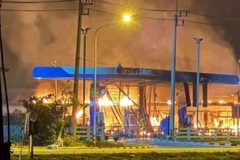
Fire destroys one of the 11 PTT petrol stations that were attacked across three southern border provinces on January 11 (Photo: bangkokpost.com)

Thailand imposes curfew in southern province

The Thai military confirmed that multiple petrol stations in Thailand's southern border provinces were hit by arson attacks and explosions on late January 11, leaving one police officer injured, with five petrol stations in Narathiwat among the targeted sites.

A photo of Lirang Island in the newly designated marine conservation area by the Ministry of Marine Affairs and Fisheries in the waters of West Wetar (Photo: antaranews.com)

Indonesia establishes new marine protected area

This area forms part of a vast ecosystem and serves as an important migratory corridor for many large marine species. The move aims to safeguard high-value biodiversity while ensuring the long-term sustainability of local coastal livelihoods.

Semiconductor wire production at an industrial park in former Hoa Binh province (now Phu Tho province). (Photo: VNA)

Vietnam’s GDP growth impressive amid global headwinds: Chinese media

It said with these results, the Vietnamese Government still has ample room to adjust monetary policy, unleash market vitality, and push ahead with institutional reforms. This, the paper noted, could enable Vietnam to achieve double-digit economic growth during the 2026-2030 period.

A voter casts her ballot in the general election at a polling station in Yangon, Myanmar. (Photo: Xinhua/VNA)

Myanmar begins second round of general election

This is the first election in Myanmar since the military government assumed power five years ago. A total of 57 political parties are participating in the election, including six parties running nationwide, with around 5,000 candidates vying for seats in the parliament.

A healthcare worker performs a swab test on a patient during influenza symptom screening at a community health centre in Banten, on January 7, 2026. (Photo: antaranews.com)

Indonesia reports first death related to so-called super flu

Yovita Hartantri, head of the New and Re-emerging Infectious Diseases Team at Hasan Sadikin Regional Hospital in Bandung, said the hospital treated 10 patients with influenza A subclade K between September and November last year. The patients exhibited a range of symptoms, with at least three developing severe complications.

Thailand enters technical deflation: Expert

Thailand enters technical deflation: Expert

Associate Professor Thanavath Phonvichai, President of the University of the Thai Chamber of Commerce and Chairman of the Centre for Economic and Business Forecasting, attributed the current bout mainly to lower production costs, particularly cheaper fuel and persistently low agricultural prices.