Lawmakers discuss governance framework tailored to AI sector

The bill aims to institutionalise the Party and State's viewpoints, create a breakthrough legal corridor for AI, provide a favourable legal environment for innovation and national competitiveness enhancement, manage risks, and safeguard national interests, human rights, and digital sovereignty.

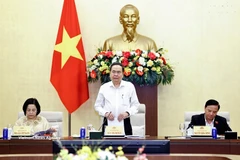
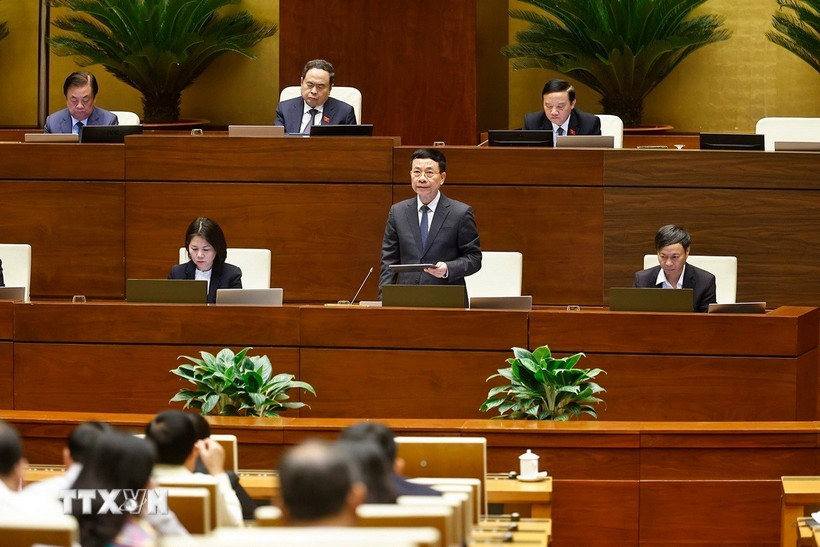
Minister of Science and Technology Nguyen Manh Hung presents the draft Law on Artificial Intelligence. (Photo: VNA)

Hanoi (VNA) – The National Assembly (NA) on November 27 is set to discuss three draft laws, namely the amended Law on Investment, the Law on Thrift Practice and Wastefulness Combat, and the Law on Artificial Intelligence (AI), as part of its ongoing 10th session.

According to the Government’s proposal, the bill aims to institutionalise the Party and State's viewpoints, create a breakthrough legal corridor for AI, provide a favourable legal environment for innovation and national competitiveness enhancement, manage risks, and safeguard national interests, human rights, and digital sovereignty.

The draft Law on AI comprises eight chapters with 36 articles, regulating the promotion of activities related to the research, development, provision, deployment and use of AI systems; the rights and obligations of relevant organisations and individuals; and state management over AI activities in Vietnam.

The draft also includes provisions on risk levels of AI systems; classification and notification of AI systems; transparency, labelling, and explanation responsibilities; and responsibilities for AI incident management and response, among others.

The bill sets the maximum administrative fine at 2 billion VND (over 75,800 USD) for violating collectives and 1 billion VND for individuals. For serious violations, the maximum fine may reach up to 2% of the violating collective’s revenue in the preceding year.

The NA Committee on Science, Technology and Environment agreed on the necessity for adopting the Law on AI to supplement and improve the existing legal framework. It emphasised the need for a unified, coherent, comprehensive, and flexible management mechanism suited to the specific characteristics of the sector, thereby promoting integration and mutual recognition of technology. This will help enhance Vietnam’s position in global value chains and expand international cooperation in the AI field.

The committee recommended further study and improvement of the law’s scope of regulation to avoid overlap with existing legislation. It proposed expanding the scope and adding provisions concerning intermediary entities to ensure comprehensive management of the AI value chain and prevent risks arising from the supply of platforms and foundational models./.

VNA
See more

Minister of Foreign Affairs Le Hoai Trung receives Non-Resident Ambassador of Nepal to Vietnam Dhan Bahadur Oli in Hanoi on December 13, 2025. Photo courtesy of the Ministry of Foreign Affairs.

Vietnam, Nepal seek to promote deeper, substantive cooperation

Nepalese leaders attach great importance to relations with Vietnam and wish to learn from its experience and development models in socio-economic development and international integration, said Non-Resident Ambassador of Nepal to Vietnam Dhan Bahadur Oli.

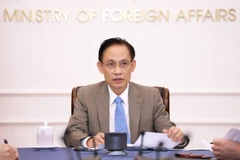
Vietnamese Minister of Foreign Affairs Le Hoai Trung (Photo: VNA)

Vietnamese, Lao foreign ministers hold online talks

The two ministers agreed to maintain close coordination in the time ahead and to expand cooperation under the new framework and orientation, underscoring the significance of the two countries’ “great friendship, special solidarity, comprehensive cooperation, strategic cohesion”.

State President Luong Cuong (fourth from left, first row) and newly-appointed foreign ambassadors in Hanoi on December 12, 2025. (Photo: VNA)

State President receives newly-appointed foreign ambassadors

Receiving Egyptian Ambassador Hany Mostafa Mohamed Mostafa Hassan, President Cuong affirmed that Vietnam highly evaluates Egypt’s role, position, and contributions to regional peace and stability. He also congratulated the African country on its achievements in implementing the 2030 Vision.

An overview of the seminar on the Party’s leadership in ensuring macroeconomic stability, renewing the growth model, restructuring the economy and promoting international integration (Photo: VNA)

Vietnam, Cuba exchange theoretical views on Party’s leadership in macroeconomic stability

The two sides explored in depth the Party’s role in leadership, orientation, oversight and strategic coordination in economic management; approaches to implementing economic restructuring programmes alongside the renewal of the growth model; measures to respond to global economic volatility, inflationary pressures and shifts in global trade; and the building of effective strategic advisory bodies to ensure the Party’s comprehensive leadership in a changing context.

Vietnam’s Ambassador to Australia Pham Hung Tam (Photo: VNA)

Australia–Vietnam Policy Institute serves as bridge for bilateral relations

Established in 2022, AVPI serves as a forum for exchanging ideas among businesses, government agencies, non-profits, universities, and scholars in Australia on Vietnam. The institute acts as a platform for policy dialogue, focusing on research and insights on strategic relations and bilateral economic ties.

General Secretary and Chairman of the NA Office Le Quang Minh chairs the press conference announcing the results of the NA's 10th session (Photo: VNA)

10th session helps strengthen public trust in personnel work, NA’s supreme oversight

Personnel consolidation carried out at the NA's 10th session helps ensure continuous, unified, effective, and efficient leadership of the state apparatus; guarantee smooth and uninterrupted direction and governance; and prevent any leadership gaps in critical areas. All positions elected or approved by the legislature meet the key criteria required within the organisational structure.