NA Standing Committee debates draft Law on Artificial Intelligence

NA Chairman Tran Thanh Man noted that while the Law on Digital Technology Industries already includes a chapter on AI, a comprehensive legal framework is still needed to facilitate the research, development, deployment, and use of AI and a comprehensive AI ecosystem.

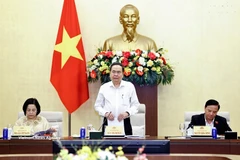
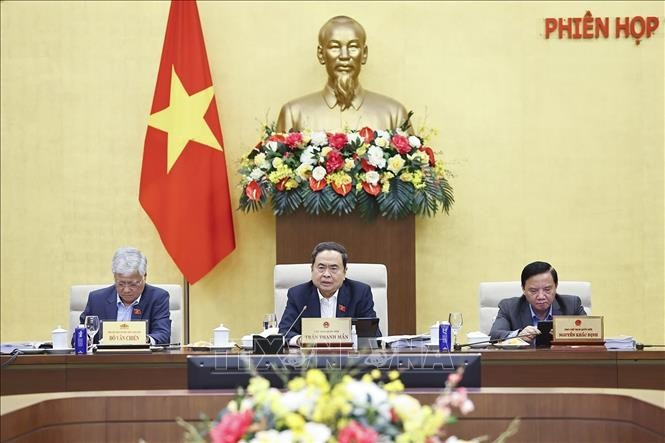
NA Chairman Tran Thanh Man (centre) speaks at the session. (Photo: VNA)

Hanoi (VNA) – The draft Law on Artificial Intelligence was among items under consideration of the National Assembly (NA) Standing Committee at its ongoing 51st session on November 17.

The bill notes that AI is becoming a key technology of the Fourth Industrial Revolution, creating major opportunities but also raising urgent questions on governance, ethics, and safety that the current legislation has yet to fully cover.

The proposed law, comprising eight chapters with 36 articles, aims to institutionalise the Party and State’s policy direction, create a breakthrough legal corridor for AI, provide an enabling legal framework for innovation and national competitiveness enhancement, manage risks, and safeguard national interests, human rights, and digital sovereignty.

The NA Committee on Science, Technology and Environment deemed the draft largely consistent with the Constitution and existing legislation but recommended further review to ensure alignment with several laws such as the Civil Code, the Law on Product and Goods Quality, and the Law on Technical Standards and Regulations.

NA Vice Chairman Tran Quang Phuong stressed the need for a risk-based regulatory approach suited to Vietnam's conditions, with a clear coordination role of the Government and a management role of relevant ministries. He also warned of potential cognitive impacts on people, especially children, if AI tools are overused.

NA Chairman Tran Thanh Man noted that while the Law on Digital Technology Industries already includes a chapter on AI, a comprehensive legal framework is still needed to facilitate the research, development, deployment, and use of AI and a comprehensive AI ecosystem.

He emphasised that AI, if applied responsibly, can become a core driver for socio-economic development, national defence, and security safeguarding. However, as opportunities are accompanied by challenges, timely regulations are essential to manage risks and ensure human rights.

He confirmed that the Law on Artificial Intelligence is expected to be adopted at the ongoing 10th session of the NA.
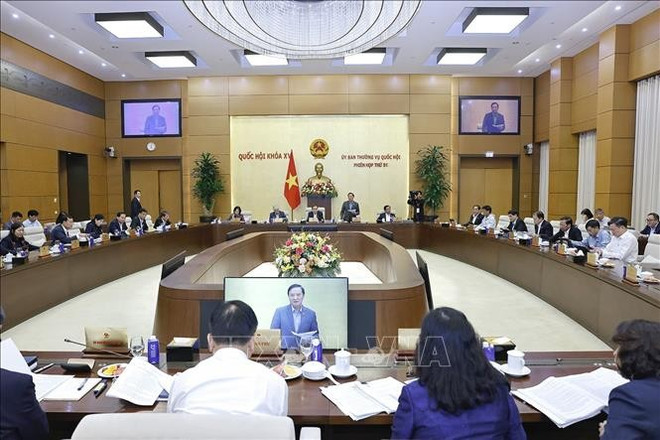
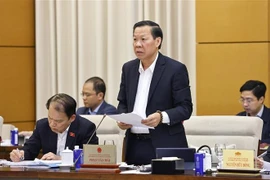
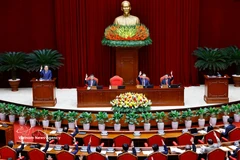
An overview of the discussion (Photo: VNA)

An overview of the discussion (Photo: VNA)

At the meeting, Minister of Education and Training Nguyen Kim Son presented a proposal for the national target programme on modernising and improving the quality of education and training for 2026–2035, saying the scheme needs to mobilise about 580.13 trillion VND (22 billion USD) .

Its targets for 2035 include ensuring all preschools and general education institutions meet infrastructure standards, are fully equipped to teach English as a second language, and use smart-school models applying AI and big data. All public universities included in the plan are expected to meet the required standards.

Delivering a verification report, Chairman of the NA Committee for Cultural and Social Affairs Nguyen Dac Vinh underscored the need to invest in the programme to institutionalise the Party’s policies on developing and fundamentally and comprehensively reforming education and training.

The committee urged the drafting body to review the programme to avoid overlaps with existing or forthcoming national target programmes, and to focus on two overarching objectives – comprehensively modernising the national education system and ensuring equitable access to education.

Briefing participants on the proposal for a national target programme on health care, population and development for 2026–2035, Minister of Health Dao Hong Lan reported that the programme will require around 88.63 trillion VND.

It targets improving physical and mental health, life expectancy, and quality of life. Targets for 2030 include ensuring 90% of communes, wards, and special zones meet national healthcare criteria; universal electronic health records; and 100% provincial-level centres for disease control capable of testing high-risk infectious agents and monitoring water quality.

It also aims for all local healthcare stations to fully implement prevention, management and treatment procedures for selected non-communicable diseases by 2030 and beyond; to reduce stunting among children under five to below 15% by 2030 and below 13% by 2035; and to increase by 70% (by 2030) and 90% (by 2035) the number of vulnerable people accessing social care services compared with 2025 and 2030, respectively.

The NA Committee for Culture and Social Affairs supported the programme but urged a more realistic assessment of local budget capacity and clearer and results-based targets. It called for prioritising core components, tightening coordination, and ensuring measurable indicators for effective evaluation./.

VNA

See more

Vietnam sends congratulations to Singapore on 61st National Day

Vietnam sends congratulations to Singapore on 61st National Day

General Secretary of the Communist Party of Vietnam (CPV) Central Committee and State President To Lam has sent a congratulatory message to Secretary-General of the People's Action Party (PAP) Lawrence Wong and President of Singapore Tharman Shanmugaratnam on the occasion of the country's 61st National Day (August 9, 1965–2026).

Vietnam sends condolences over passing of Lao NA President

Vietnam sends condolences over passing of Lao NA President

In the message, the Vietnamese side described Comrade Saysomphone Phomvihane as an outstanding leader of the Lao Party, State and people, and a steadfast communist who devoted his life to the revolutionary cause of the LPRP and to building and developing a peaceful, independent, united and prosperous Laos.

National Assembly Chairman Tran Thanh Man leads a high-ranking delegation of the Party and State of Vietnam to pay tribute to Politburo member and President of the National Assembly of Laos Xaysomphone Phomvihane. (Photo: VNA)

Vietnamese top legislator pays tribute to Lao NA President

Writing in the book of condolences, the Vietnamese leader expressed his profound sorrow over the passing of Comrade Xaysomphone Phomvihane, describing it as a great loss to the Lao Party, State, NA and people, as well as to Vietnam, which had lost a great friend and loyal comrade who made important contributions to strengthening and developing the great friendship, special solidarity, comprehensive cooperation and strategic cohesion between the two countries.

General Secretary of the Communist Party of Vietnam (CPV) Central Committee and President To Lam on August 9 departs Hanoi for state visits to Australia and New Zealand. (Photo: VNA)

Top leader departs for state visits to Australia, New Zealand

General Secretary of the Communist Party of Vietnam (CPV) Central Committee and President To Lam's visits, from August 9-14, are made at the invitations of Governor-General of Australia Sam Mostyn and Governor-General of New Zealand Cindy Kiro.

General Secretary of the Communist Party of Vietnam Central Committee To Lam (R) hosts Australian Governor-General Sam Mostyn in Hanoi on September 10, 2025. (Photo: VNA)

New impetus for deeper Vietnam–Australia ties

Party General Secretary and State President To Lam's state visit comes as the Vietnam–Australia Comprehensive Strategic Partnership is booming. Leaders expect it will inject new momentum, making ties deeper, more substantive and more effective.

Vice Chairman of the National Assembly Nguyen Doan Anh (standing) presides over the session on August 8. (Photo: VNA)

National Assembly reviews bill on WMD non-proliferation

Most deputies agreed on the need for the law, saying it will help complete the legal framework for implementing Vietnam’s international commitments and proactively prevent, detect and stop the proliferation of nuclear, chemical and biological weapons and related delivery systems.

The ASEAN flag hoisting ceremony held in Hanoi on July 31, 2026 to mark the 59th founding anniversary of ASEAN and the 31st anniversary of Vietnam's accession to the bloc. (Photo published by VNA)

Vietnam to remain active player in shaping ASEAN’s future: minister

Entering a new era of national development with the aspiration of building a strong and prosperous country, the mindset of "growing alongside ASEAN" will guide Vietnam’s more proactive, positive, and substantive contributions to the ASEAN Community and the co-creation of the region’s shared future, noted Minister of Foreign Affairs Le Hoai Trung.

National Assembly Chairman Tran Thanh Man (R) and President of the National Assembly and Speaker of the House of Representatives of Thailand Sophon Zaram in Hanoi during the latter's official visit to Vietnam from August 5-7, 2026. (Photo: VNA)

Thailand's parliamentary leader concludes official visit to Vietnam

Thailand attaches great importance to its Comprehensive Strategic Partnership with Vietnam, and the two countries share a solid foundation of friendship, many common strategic interests and significant potential for cooperation, said President of the National Assembly and Speaker of the House of Representatives of Thailand Sophon Zaram.

Politburo member and Minister of Foreign Affairs Le Hoai Trung speaks at the 33rd Diplomatic Conference's closing session in Hanoi on August 7, 2026. (Photo: VNA)

33rd Diplomatic Conference wraps up in Hanoi

Foreign relations are no longer viewed simply as relations with the outside world but as an integral component of national comprehensive strength and a responsibility shared by the entire Party, people, armed forces and political system.

Lawmakers in a group discussion (Photo: VNA)

Lawmakers seek legal reforms to promote telecom infrastructure data sharing

A deputy of Ha Tinh province said there is currently no clear legal basis for sharing technical infrastructure data. While the issue may be less apparent under normal circumstances, it could hamper local coordination and response during storms, floods and other disasters when detailed infrastructure data is not readily available.