Lawmakers mull over sweeping package of education reforms

The 15th National Assembly is discussing a sweeping package of education reforms during the ongoing 10th session in Hanoi on November 20, which is being broadcast live on radio and television.

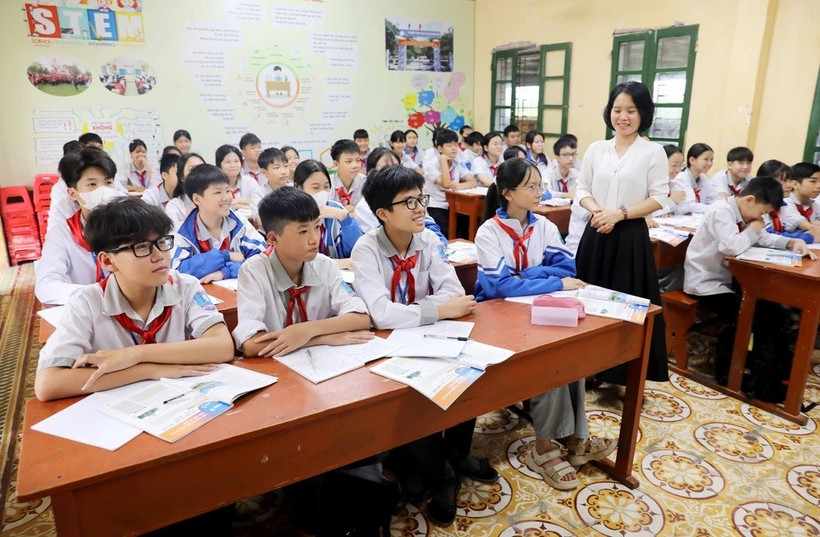
A literature classroom at a secondary school in Hung Yen province (Photo: VNA)

Hanoi (VNA) – The 15th National Assembly is discussing a sweeping package of education reforms during the ongoing 10th session in Hanoi on November 20, which is being broadcast live on radio and television.

The proposals under discussion include draft Law on amendments and supplements to several articles of the Law on Education, the amended Law on Higher Education, the draft revised Law on Vocational Education, and a draft resolution outlining special mechanisms and policies to realise the Politburo’s Resolution 71 on breakthrough development in education and training.

The draft amendments to the Law on Education focus on decentralisation of authority to local levels and formally incorporate vocational upper-secondary education into the national system. They also clarify definitions of diplomas and certificates while scrapping the lower-secondary graduation diploma, replacing it with a principal-issued completion certificate. A revised Article 32 mandates a single unified textbook series nationwide, with the Government tasked to regulate free textbook supply and encourage society-sourced funding to ensure long-term sustainability and quality improvements.

The draft amended Law on Higher Education introduces several major breakthroughs compared with the current law. It establishes universities as national pioneers in innovation, elite talent cultivation, and quality workforce supply for domestic and global needs. It also affirms institutional autonomy as a legal right, expanding universities’ proactive role while strengthening their accountability.
hy.jpg
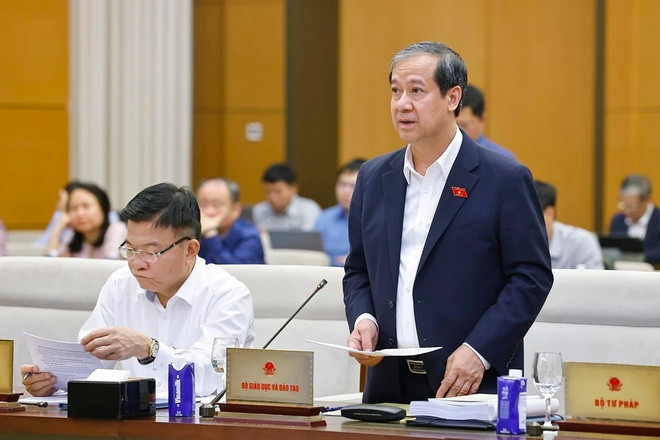
Minister of Education and Training Nguyen Kim Son speaks at the meeting (Photo: VNA)

The draft amended Law on Vocational Education consists of nine chapters and 42 articles with many new rules. It broadens the system’s scope, beneficiaries, and structure; specifies state management functions; and clearly defines the rights, obligations, and responsibilities of all stakeholders. New concepts such as a “vocational education database” and “vocational upper-secondary schools” is introduced for clarity. Structurally, a key innovation is the addition of a vocational upper-secondary tier that blends general and skills-based training, while permitting universities to deliver specialised vocational courses.

The draft Resolution sets out a number of special, breakthrough mechanisms and policies to advance education and training, allowing temporary departure from existing legal regulations within specified scopes, entities, and timelines. It also provides mechanisms for oversight, evaluation, and review to facilitate eventual codification. Drawing on the Resolution No. 71 and practical needs, the Ministry of Education and Training proposed focus on core, high-impact, and feasible policy groups, including education workforce management and development, educational development mechanisms, digital transformation, sci-tech and innovation, global integration; and finance, incentives, and investment.

The package as a whole seeks to translate the Party’s guidelines and State’s policies into binding regulations covering faculty development, systemic overhaul, digital and sci-tech adoption, international cooperation and integration, financial mechanisms, investment, and incentives for education; organisation and governance of education system./.
VNA

See more

Prime Minister Pham Minh Chinh visits the operational system of the Nhon Trach 3 and 4 power plants (Photo: VNA)

Nhon Trach 3 and 4 thermal power plants reflect Vietnam’s determination, expertise: PM

The Nhon Trach 3 and 4 power thermal plants, invested by Petrovietnam Power Corporation, have a total investment of around 1.4 billion USD. With a combined capacity of 1,624 MW, the plants are expected to supply over 9 billion kWh annually once fully operational, adding substantial baseload power to the system, particularly in the southern region.

Minister of Foreign Affairs Le Hoai Trung receives Non-Resident Ambassador of Nepal to Vietnam Dhan Bahadur Oli in Hanoi on December 13, 2025. Photo courtesy of the Ministry of Foreign Affairs.

Vietnam, Nepal seek to promote deeper, substantive cooperation

Nepalese leaders attach great importance to relations with Vietnam and wish to learn from its experience and development models in socio-economic development and international integration, said Non-Resident Ambassador of Nepal to Vietnam Dhan Bahadur Oli.

Vietnamese Minister of Foreign Affairs Le Hoai Trung (Photo: VNA)

Vietnamese, Lao foreign ministers hold online talks

The two ministers agreed to maintain close coordination in the time ahead and to expand cooperation under the new framework and orientation, underscoring the significance of the two countries’ “great friendship, special solidarity, comprehensive cooperation, strategic cohesion”.

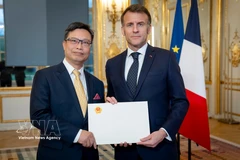
State President Luong Cuong (fourth from left, first row) and newly-appointed foreign ambassadors in Hanoi on December 12, 2025. (Photo: VNA)

State President receives newly-appointed foreign ambassadors

Receiving Egyptian Ambassador Hany Mostafa Mohamed Mostafa Hassan, President Cuong affirmed that Vietnam highly evaluates Egypt’s role, position, and contributions to regional peace and stability. He also congratulated the African country on its achievements in implementing the 2030 Vision.

An overview of the seminar on the Party’s leadership in ensuring macroeconomic stability, renewing the growth model, restructuring the economy and promoting international integration (Photo: VNA)

Vietnam, Cuba exchange theoretical views on Party’s leadership in macroeconomic stability

The two sides explored in depth the Party’s role in leadership, orientation, oversight and strategic coordination in economic management; approaches to implementing economic restructuring programmes alongside the renewal of the growth model; measures to respond to global economic volatility, inflationary pressures and shifts in global trade; and the building of effective strategic advisory bodies to ensure the Party’s comprehensive leadership in a changing context.

Vietnam’s Ambassador to Australia Pham Hung Tam (Photo: VNA)

Australia–Vietnam Policy Institute serves as bridge for bilateral relations

Established in 2022, AVPI serves as a forum for exchanging ideas among businesses, government agencies, non-profits, universities, and scholars in Australia on Vietnam. The institute acts as a platform for policy dialogue, focusing on research and insights on strategic relations and bilateral economic ties.