Innovating, improving education quality holds special significance: State President

Expressing his gratitude to the contributions of senior educators, and generations of teachers across the country, the President noted that the Party and State have always accompanied parents in creating the best conditions for students who continue and promote the nation’s tradition of valuing education, for a strong and humane Vietnam in the future.

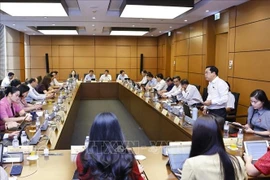
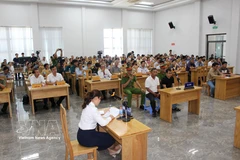
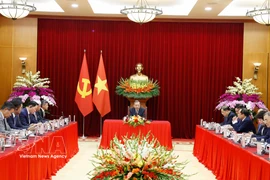
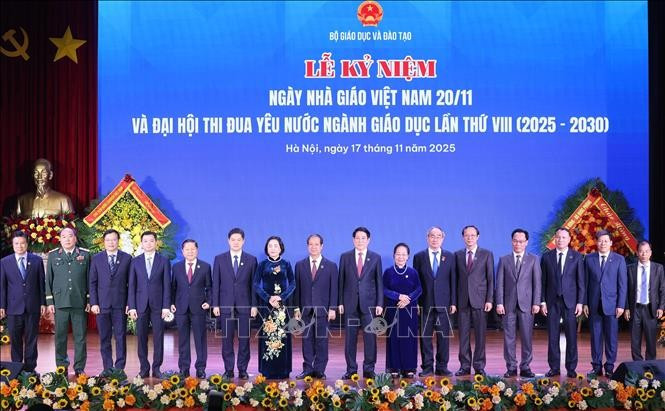
State President Luong Cuong (eighth from right) and other delegates at the ceremony to celebrate Vietnamese Teachers’ Day (November 20) and the 8th Patriotic Emulation Congress of the education sector. (Photo: VNA)

Hanoi (VNA) - State President Luong Cuong attended a ceremony on November 17 at Hanoi National University of Education to celebrate Vietnamese Teachers’ Day (November 20) and the 8th Patriotic Emulation Congress of the education sector, during which he emphasised that innovating and improving the quality of education is an urgent requirement.

This work holds special significance within the strategic vision for national development, which requires perseverance and determination for the lifelong cause of educating people, President Cuong said.

Expressing his gratitude to the contributions of senior educators, and generations of teachers across the country, the President noted that the Party and State have always accompanied parents in creating the best conditions for students who continue and promote the nation’s tradition of valuing education, for a strong and humane Vietnam in the future.

He urged the education sector to continue to thoroughly implement the Party’s guidelines, policies, and viewpoints, as well as late President Ho Chi Minh’s education ideology, and most recently, the Politburo’s Resolution No. 71-NQ/TW on groundbreaking development in education and training.

The sector should focus on completing legal regulations to promptly remove institutional and policy bottlenecks, and promote innovation and development in education and training, while advancing decentralisation and delegation of authority linked with resource allocation, enhancing autonomy and accountability of educational institutions, and building an open, interconnected education system that fosters lifelong learning and a learning society.
luong-cuong-2.jpg
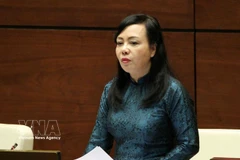
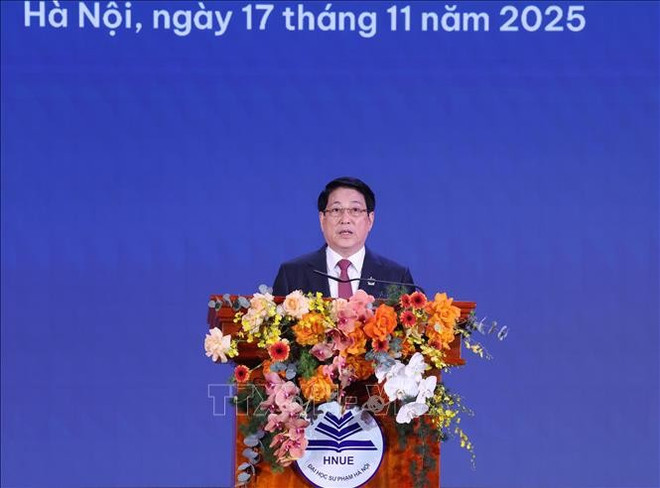
State President Luong Cuong speaks at the ceremony. (Photo: VNA)

The President also called for effective implementation of the Law on Teachers, the development of appropriate policies to attract talented individuals outside the teaching workforce to participate in teaching and training at educational institutions, and the persistent cultivation of a school culture and quality culture that emphasises practical learning and professional skills, combined with the exemplary responsibility of the teaching staff.

It is necessary to clearly define the roles, responsibilities, and coordination mechanisms between families, schools, and society in educating ethics, character, and the value system of Vietnamese people, and uphold the responsibilities of state management agencies, Party committees, and local authorities, he stressed.

In addition, due attention should be paid to comprehensive digital transformation, with widespread adoption and strong application of digital technology and artificial intelligence (AI) in education and training, President Cuong said, adding that vocational education should be modernised to create breakthroughs in developing a highly skilled workforce, while and vocational education institutions should be reorganised and streamlined to ensure efficiency, meet national standards, and reach international levels.

The State leader called for the modernisation and elevation of higher education to create breakthroughs in developing highly skilled human resources and talents, and to lead research and innovation.

Regarding the promotion of extensive international cooperation and integration, he highlighted the need to advance negotiations and sign agreements on cooperation in education, training, science, and technology; and actively participate in organisations that ensure quality and develop international education.

President Cuong reiterated the goal of Vietnam to have a modern, equitable, and high-quality national education system that ranks among the top 20 countries in the world by 2045.

Minister of Education and Training Nguyen Kim Son said at the ceremony that the entire sector currently has about 27 million students, with a network of 62,839 educational and training institutions across the country.

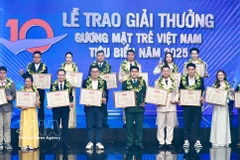
On this occasion, the minister awarded the emulation flags to 11 collectives and certificates of merit to 141 collectives and 174 individuals for their outstanding achievements in the “Innovation and Creativity in Management, Teaching, and Learning” emulation movement during the 2020–2025 period./.
VNA

See more

Candidates familiarise themselves with the computers before sitting the Vietnamese language proficiency assessment in Osaka on August 15, 2026. (Photo: VNA)

Vietnamese language celebrated as first computer-based proficiency test held overseas

For Vietnamese communities overseas, Vietnamese is not merely a means of communication but also an important part of cultural identity and a bond connecting people with their homeland. For foreigners who have developed an affection for Vietnam, learning the language opens another door to a deeper understanding of the country's culture, history and people.

A police officer introduces a foreign visitor to the “Smart police station” kiosk, making it easier for international visitors to access police support services. (Photo: VNA)

Pilot "Smart police station" kiosk launched in Hanoi

During the pilot phase, the "Smart police station" provides five core functions: crime/incident reporting; SOS emergency calls; crime alert; finding the nearest police stations and administrative offices; and legal Q&A.

A public servant at the Public Administrative Service Centre of Vinh Yen ward, Phu Tho province, guides residents through the marriage registration process on the online public service portal. (Photo: VNA)

Digital literacy campaign lays foundation for digital citizens in Phu Tho province

After nearly a year, the “Digital Literacy for All” campaign in Phu Tho is demonstrating its effectiveness through tangible results. Residents who were once hesitant about technology are becoming increasingly familiar with VNeID, online public services, cashless payments, and digital platforms for learning, production, and business.

Firefighters and rescue personnel deploy specialised equipment to rescue two truck drivers trapped in their cabins. (Photo: VNA)

Road accident fund to provide support from September

Under Decree No. 279/2025/ND-CP and Circular No. 126/2026/TT-BCA, injured victims with bodily injury rates of over 31% to below 81% may receive up to 10 million VND (381 USD) per case, while families of deceased victims may receive up to 20 million VND.

Ha Thanh, Chairwoman of the Ho Chi Minh City Union of Friendship Organisations and head of the advisory council for international integration, people-to-people diplomacy and overseas Vietnamese affairs under the Vietnam Fatherland Front Committee of the city (Photo: VNA)

New resolution seeks to unlock OV resources for national development

Ha Thanh, Chairwoman of the Ho Chi Minh City Union of Friendship Organisations and head of the advisory council for international integration, people-to-people diplomacy and overseas Vietnamese affairs under the Vietnam Fatherland Front Committee of the city, said Resolution No. 23 builds on the fundamental viewpoints of the Politburo's Resolution No. 36-NQ/TW issued in 2004, reaffirming that overseas Vietnamese are an inseparable part of the nation and a bridge connecting Vietnam with the world.

The Vietnamese Embassy in London's Education Section and representatives from the Department of Higher Education (Ministry of Education and Training) visit and hold a working session at Queen Mary University of London. (Photo published by VNA)

Vietnam-UK education cooperation: From market to partnership

In the 2024/25 academic year, about 3,725 Vietnamese students studied in the UK, while 13,285 enrolled in UK programmes delivered in Vietnam. Both flows are growing, but the balance is increasingly shifting towards UK education being delivered to learners in Vietnam. If managed strategically, this could enable Vietnam to expand access to international education at home while improving the quality of its workforce.

A bus picks up passengers on National Highway 22 (Le Quang Dao Street), near An Suong Bus Station. (Photo: VNA)

Free bus fares drive sharp rise in ridership in Ho Chi Minh City

As of August 12, the city’s bus network had served nearly 12 million passenger trips, up about 44% year on year. On August 12 alone, around 306,000 passengers used free buses, an increase of roughly 55%, despite students having yet to officially return to school.

Officers and soldiers bring martyrs’ remains to the sampling station at Binh Xuyen commune Martyrs’ Cemetery in Phu Tho province (Photo: VNA)

More than 1,700 war martyrs’ remains recovered

The national steering committee will continue verifying information on suspected martyrs’ graves in key areas, including Tan Son Nhat Airport in Ho Chi Minh City, Quan Y Bac Son Hill in Dong Nai, the Con Tien base area in Quang Tri and former Vi Xuyen battlefields in Tuyen Quang.