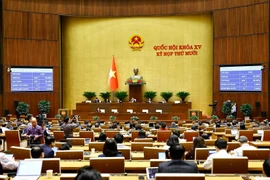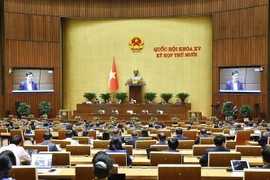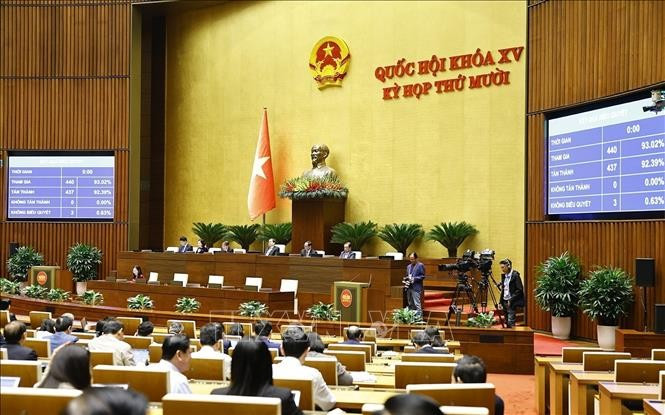
Hanoi (VNA) – The 15th National Assembly (NA) on December 10 adopted the Cybersecurity Law; the amended Law on Protection of State Secrets; the law amending and supplementing certain provisions of 10 laws related to security and order; another amending and supplementing some articles of the Law on National Defence and Security Industry and Industrial Mobilisation; and the amended Law on Drug Prevention and Control with a majority of votes.
With 434 out of the 443 deputies present voting in favour, accounting for 91.75% of the total deputies, the legislature passed the draft Cybersecurity Law, which is built on the merger of the 2018 Cybersecurity Law and the 2015 Law on Cyber-information Security.
It consists of eight chapters with 45 articles, and will come into effect on July 1, 2026, aiming to establish a solid legal framework to enhance the capacity to protect national sovereignty in cyberspace and promote the sustainable development of the digital economy.
The law clearly stipulates that the Ministry of Public Security is responsible for leading and coordinating the implementation of state management over cybersecurity. The Ministry of National Defence is responsible for managing the military information system, while the Government Cipher Committee is responsible for managing the cryptographic system. This provision aims to address overlapping responsibilities and ensure unified command and coordination in the face of global cybersecurity threats.
With support from 434 out of the 436 deputies casting votes, accounting for 91.75% of the total deputies, the NA approved the revised Law on Protection of State Secrets. The law consists of five chapters with 28 articles and will take effect on March 1, 2026.
A notable new provision is the addition of a regulation that strictly prohibits the use of artificial intelligence (AI) or new technologies to violate state secrets. The law also outlines the responsibilities of agencies and organisations in deploying and using AI systems or new technologies to protect state secrets.
Meawhile, the draft law amending and supplementing certain provisions of 10 laws related to security and order was passed with 425 out of 433 deputies voting in favour, accounting for 89.85% of all legislators. With 11 articles, it includes amendments to the Law on VIP Protection, adding provisions on security guard regimes and measures to ensure compliance with the Politburo's Regulation 368 on the list of positions, titles, and leadership roles in the political system.

With a majority of deputies saying “yes”, the NA also adopted the law amending and supplementing several articles of the Law on National Defence and Security Industry and Industrial Mobilisation. Consisting of two articles, it will become effective on January 1, 2026. However, provisions related to planning and finance will take effect later, on March 1, 2026.
With 440 deputies casting “yes” votes out of the 444 participating deputies, accounting for 93.02% of all deputies, the amended Law on Drug Prevention and Control was passed. It consists of eight chapters and 56 articles, including the addition of 11 new articles, the amendment of 40 existing ones, the abolition of 10 articles, and the retention of five others compared to the current legislation. This comprehensive amendment aims to implement the Party and State’s viewpoint on streamlining the organisational apparatus and political system; further improving the legal foundation for combating drug-related crimes; and addressing problems related to state management over drug rehabilitation and post-rehabilitation management.
Also on December 10 morning, the legislative body passed the revised Press Law, with 437 out of the 440 deputies present voting in favour, accounting for 92.39% of the total deputies.
The law, comprised of four chapters and 51 articles and taking effect on July 1, 2026, includes several important revisions aimed at adapting to the development of technology and the current state of the press. It is expected to create a solid legal framework for building a professional, humane, and modern Vietnamese revolutionary press.
For the first time, the use of AI in journalism has been legalised. Article 39 stipulates that press agencies and reporters using AI to support journalistic activities must comply with regulations on intellectual property, AI, and professional ethics. The State will invest in the development of a national digital press platform and digital tools to monitor press activities in cyberspace.
Also in the morning, the NA passed the law on amendments and supplements to several articles of the Law on Education, with 437 out of 445 deputies voting in favour. A notable provision of the law is that, from January 1, 2026, students will be provided with free textbooks, and a unified set of general education textbooks will be used nationwide.
With 433 out of 439 deputies voting in favour (91.54% of all deputies), the NA adopted the amended Law on Vocational Education, which consists of nine chapters with 45 articles, a reduction of 34 articles compared to the current law.
With support from 411 out of 440 deputies (86.89% of the total legislators), the legislature passed the amended Law on Higher Education. The law will come into effect on January 1, 2026.
Meanwhile, with a majority of “yes” votes, the NA passed the resolution on special and exceptional mechanisms and policies for breakthrough development of education and training, and the resolution approving the investment policy for the national target programme on the modernisation and improvement of the quality of education and training for the 2026-2035 period./.