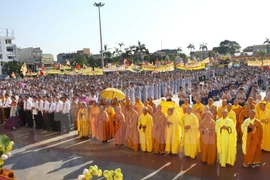
Bell beating to start the spring festival at Ba Vang pagoda in Quang Ninh province. (Photo: VNA)
Hanoi (VNA) - The management of religious and worshipping places is one of the issues of great interest of National Assembly deputies at the question-and-answer session in the June 6 morning.
One of the issues that attracted great interest from NA deputies who raised various questions at the question-and-answer session in the morning of the June 6 during the seventh plenum of the 14th NA was the management of religious and worshipping places.
“No commercialization of pagodas”
Answering a question by NA deputies on whether there is the “commercialization of pagodas”, Minister of Interior Le Vinh Tan affirmed: “A report by the Government Committee on Religious Affairs has clearly pointed out that so far, now officials or state employees have pooled money to build pagodas for the purpose of commercialization. However, over the recent past, a number of individuals have taken advantage of the religious and worshipping places as well as the belief of the mass to practice superstitious acts for illegal benefits, which has stirred up discontent in the society.”
Elaborating on the matter, Tan further said over the recent times, the erection of pagodas in Vietnam has been done in accordance of the provision at Point 3, Article 56 of the Law on Belief and Religion. Religious and belief establishments can have been constructed with voluntary donations from a number of organizations and collectives, but this is not for the commercialization purposes.
Sharing that viewpoint, Most Venerable Thich Bao Nghiem, Vice President of the Vietnam Buddhist Sangha Executive Councile, stressed: “I affirm that no pagodas have any construction investment from individuals and collectives for the purpose of commercialization as a number of NA deputies have asked with the very new and heavy words and conceptions like ‘BOT pagodas’.
“As an NA deputy, a Buddhist practitioner an in my position as Vice President of the Vietnam Buddhist Sangha Management Council, I would like to solemnly report to the NA and the voters throughout the country that all of the pagodas in the country were constructed and are managed by the Vietnam Buddhist Sangha, the local Buddhist Sangha and people. No pagodas are placed outside this system.”
Regarding the “abnormal” behaviours that take advantage of the belief of the mass for the practice of superstitious acts, the monk held that this is only a “minority”.
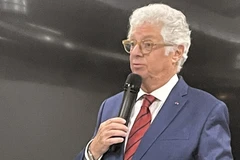
 Most Venerable Thich Bao Nghiem. (Photo: VNA)
“The Buddhist Sangha has always brought into full play the spirit of patriotism, religion and nation, built the modern way of life, preserved and brought into play traditional cultural values. Abnormal phenomena are all seriously dealt with. I affirm that the Vietnam Buddhist Sangha does not tolerate any practitioners, especially officials, who violate the virtue and religious regulations,” Most Venerable Thich Bao Nghiem stressed.
Debate on discipline severity for Ba Vang pagoda incident
Directly referring to the fine of 5 million VND for Pham Thi Yen in the incident at Ba Vang pagoda in Quang Ninh province, many NA deputies held that this is not deterrent enough. Deputy Thai Truong Giang from Ca Mau argued that Yen’s act shows signs of criminal violation which should be prosecuted.
Replying to this, Minister Le Vinh Tan said that in the period from March 20-28, authorities and the Vietnam Buddhist Sangha and Quang Ninh province sent in various verification documents and reports to the Prime Minister.
“On the basis of the verification, relevant authorities and units have taken disciplinary measures as provided for in the law and religious rules of Buddhism. After the measures were taken, the public has been settled and the majority of the people show content with the measures by the Vietnam Buddhist Sangha and Quang Ninh province,” the minister said.
According to leading officials of the ministry, in order to deal with the phenomenon, the unit is applying a number of solutions such as proposing the government issue decrees on strengthening the management of the operation of religious establishments, including concrete provisions on the discipline of violations, and the communications work on the matter, as well as the training on the state management of religious issues.
Also replying on this issue, during the session in the June 5 afternoon, Minister of Culture, Sports and Tourism Nguyen Ngoc Thien highlighted that the incident at Ba Vang pagoda both violated the law and adversely affected the virtue and way of life, which should be criticized and dealt with. As for the discipline, the People’s Committee of Uong Bi city in Quang Ninh province has issued a decision on the fine against the administrative violation by Yen with 5 million VND. This is the highest in Decree 158/2013/ND-CP on the fines against administrative violations in culture, sports, tourism, and advertisement.
According to Minister Thien, the fine is only a solution which should be made more severe to deal with the phenomenon.
“Together with fining, we need to intensify the accusation and criticism of the anti-cutural and non-virtue acts. I hold that the combination of the both measures will give a better effect,” the minister said.
Also on the management of religious and worshipping places, Most Venerable Thich Bao Nghiem held that the coordination between local authorities and the religious establishments is yet to be satisfactory.
From the angle of state management, Minister Nguyen Ngoc Thien admitted that currently, the coordination to prevent superstitious acts among authorities and localities is yet to be effective. The Ministry of Culture, Sports and Tourism is responsible for managing the relics while the responsibility of the state management of religious activities belong to the Ministry of Interior.
“In the time to come, the ministries and authorities and the localities should intensify their collaboration in managing activities related to religions, belief and worshipping places,” Minister Thien said.
At the question-and-answer session in June 6 morning, Deputy Prime Minister Vu Duc Dam stressed: “Superstition stems from poor knowledge, that is why there is a very important need to strongly push up the communications work and awareness campaigns so as to improve the people’s knowledge. This will help them understand and practice in a right way”.-VNA