Long An develops high-tech dragon fruit area

The southern province of Long An aims to develop a dragon fruit area of 2,000 ha in 2017-2020, using high-technologies.
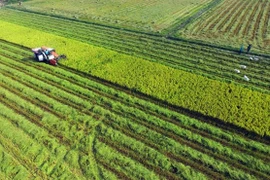
Long An develops high-tech dragon fruit area ảnh 1Dragon fruit farming in Chau Thanh district, Long An (Photo: VietGap.com)

LongAn (VNA)
– The southern province of Long An aims to develop a dragonfruit area of 2,000 ha in 2017-2020, using high-technologies.

LongAn’s dragon fruit export turnover hits about 40 million USD annually, helpinggenerate jobs for tens of thousands of locals.

Theprovince has defined dragon fruit as one of its key crops, only after rice.

ChauThanh district has been selected as a core area for dragon fruit cultivation,with more than 7,500 ha, making up more than 80 percent of total dragon fruitarea in the province.

LeVan Hoang, Director of the provincial Department of Agriculture and RuralDevelopment, said Long An is focusing on changing farmers’ methods to develophigh-tech agriculture in tandem with new-style rural area building.

NguyenVan Thinh, Chairman of the Chau Thanh district People’s Committee, said thedistrict has instructed communes to intensify their connectivity in production,and encouraged big enterprises to invest in dragon fruit, especially exports tomarkets like Japan, the US and Europe.

Atthe same time, the locality has built dragon fruit production chains,established preservation and processing facilities and diversified products.

ChauThanh district has also coordinated with the provincial Department of Industryand Trade to promote its products in several countries, he added.

VoThanh Hong, Vice Chairman of the Chau Thanh district People’s Committee, saidthe high-tech dragon fruit production model will improve competitiveness andclimate change adaptation of products, helping meet requirements ofindustrialisation and modernisation and raise income of locals.

Hesaid to develop 2,000ha of dragon fruit, Chau Thanh district will double itsspending on agriculture in 2017 to promote the use of science and technology indragon fruit production. -VNA
VNA

See more

The meeting between the Quang Ninh delegation and Siemens Mobility (Photo published by VNA)

Quang Ninh seeks cooperation, investment opportunities in Germany

A Quang Ninh official praised the collaboration between Siemens Mobility and VinSpeed in developing the Hanoi–Quang Ninh high-speed railway and expressed his hope that the project will pave the way for future cooperation between Siemens Mobility and Quang Ninh in modern railway development and workforce training.

At the 10th intersessional meeting of UNCITRAL Working Group III in Ninh Binh province on September 7, 2026. (Photo: VNA)

Vietnam hosts UNCITRAL Working Group III intersessional meeting for first time

By hosting the 10th UNCITRAL Working Group III intersessional meeting, Vietnam wishes to continue playing an active and proactive role in UNCITRAL in general and Working Group III in particular, working alongside the international community to strengthen cooperation, share experience and contribute to the development of the international legal framework.

An Asian customer with a Vietnamese coconut product served with straws (Photo: VNA)

Vietnam’s agricultural exports: Shifting from volume to value

Vietnam has about 1.2 million hectares of fruit-growing areas, producing around 13 million tonnes a year. Its fruits are exported to more than 60 countries, including major markets such as the US, the EU, Japan, the Republic of Korea and China. The country is also among the world’s leading exporters of rice, cashew nuts, pepper and coffee, with its products reaching more than 150 countries, including markets with stringent standards.

A modern production line at Hana Micron Vina Co. Ltd., a wholly invested by the Republic of Korea, in Van Trung Industrial Park in Bac Ninh province (Photo: VNA)

Northern Vietnam attracts 80.5% of new manufacturing FDI in first half

John Campbell, Director and Head of Industrial Services at Savills Vietnam, said investment in electronics and semiconductors continued to concentrate in northern localities, which have developed relatively complete manufacturing ecosystems encompassing industrial infrastructure, technical labour and supplier networks.

At the 2025 K–Vietnam Pop-up Festa in Dalat (K-Market Vietnam 2025) held in the central province of Lam Dong on November 8, 2025. The event features a series of cultural and trade exchange activities between Vietnam and the RoK, with more than 100 Lam Dong and Korean enterprises showcasing typical products from both sides. (Photo: VNA)

Vietnam, RoK seek to expand trade cooperation

The Ministry of Industry and Trade’s Department of Foreign Markets said Korean companies showed strong interest in Vietnam International Sourcing (VIS 2026), covering food, logistics, digital technology, mechanics, shipbuilding, seafood and distribution.

According to the Vietnam Coffee Cocoa Association (Vicofa), Vietnam exported nearly 1.7 million tonnes of coffee in the first eight months of 2026, earning more than 6 billion USD. (Photo: VNA)

Vietnamese coffee exports poised for strong finish toward year-end

According to the Vietnam Coffee Cocoa Association (Vicofa), Vietnam exported nearly 1.7 million tonnes of coffee in the first eight months, earning more than 6 billion USD. Export volume rose by over 10% year on year, while export value fell by 11.2% due to lower export prices.

Ciputra is one of the landmark projects representing the presence of Indonesian investment in Vietnam since the first wave of FDI. (Photo: bietthu-ciputra.vn)

Foreign capital seeks stronger foothold in Vietnam through M&A

Foreign investors carried out 1,815 capital contribution and share purchase transactions in Vietnam in the first seven months of 2026, with total capital exceeding 6.5 billion USD. While the number of transactions fell 8.4% year-on-year, their value rose 61.6%.

At the Vietnam- Myanmar Business Forum in Hanoi on September 6 (Photo: VNA)

Myanmar President pledges to facilitate Vietnamese investment

Myanmar calls for Vietnam's cooperation in digital infrastructure development, cybersecurity, digital transformation, public services, information technology, and digital payment systems, as well as in fostering an innovation-driven business environment.

Using AI to search and process legal information (Photo: VNA)

Legal profession reshaped in age of artificial intelligence

In Ho Chi Minh City, digital transformation in the legal profession is not simply about introducing more technology into professional practice. It must also create ways of working that ensure technology serves people, while lawyers retain control and responsibility for the quality of legal services. This is particularly important in a metropolis with a large-scale economy and diverse legal needs.

Activities in Chan May Bay, part of the Chan May–Lang Co Economic Zone in Hue city. (Photo: VNA)

Hue steps up investment drive in Chan May–Lang Co Economic Zone

Covering more than 27,000ha, the Chan May–Lang Co Economic Zone is emerging as a key economic, urban, industrial and eco-tourism centre in southeastern Hue, with functional areas dedicated to seaports, industry, non-tariff activities, urban development and tourism.

The Ministry of National Defence's inter-agency inspection team visits La Gi Fish Port in Phuoc Hoi ward, Lam Dong province. (Photo: VNA)

Lam Dong's IUU fishing prevention efforts inspected

According to the Lam Dong provincial IUU Fishing Prevention Steering Committee, all 8,177 fishing vessels measuring at least 6 metres in length have been registered and updated in the national fisheries database VNFishbase.

A member of Minh Quang Cooperative in Hung Yen province works on a farm. (Photo: VNA)

Vietnam aims to link half of farm cooperatives with enterprises by 2030

The Ministry of Agriculture and Environment will promote links between cooperatives, enterprises, science and technology organisations and other economic entities along with carrying out programmes to develop concentrated agricultural, forestry and fisheries raw material areas and enhance value chain production.

The night-time economy is increasingly seen as an important avenue for Vietnam’s tourism sector to extend visitors’ stays (Photo: VNA)

Revitalising growth momentum for night-time economy

The night-time economy has moved beyond being merely an add-on service to become a new growth driver for tourism. Night-time activities can “awaken” familiar heritage spaces and breathe new life into them. Art, light and music experiences after dark can create distinctive attractions while meeting the desire of middle- and high-end visitors to explore cultural depth.