Vietnam’s coffee shops boom amid business closures

While business closures continue to rise, signalling economic difficulties, Vietnam's coffee shop industry is experiencing remarkable growth.

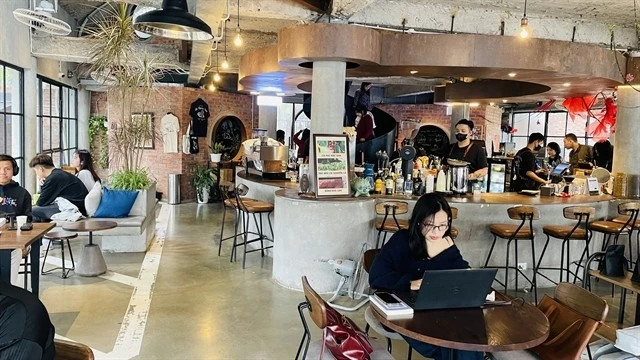
A coffee shop in Hanoi (Photo: VNA)

Hanoi (VNS/VNA) - From small alleyway cafés to high-end coffee chains, Vietnam now boasts over 500,000 coffee shops.

While business closures continue to rise, signalling economic difficulties, Vietnam's coffee shop industry is experiencing remarkable growth.

According to the General Statistics Office (GSO), over 58,300 businesses withdrew from the market in January 2025, a year-on-year increase of 8.1%. Of them, 52,800 businesses temporarily suspended operations, 3,500 waited for dissolution, and 2,000 completed dissolution procedures.

Yet, in stark contrast, new coffee shops are opening across major cities, particularly in Hanoi. These shops are offering everything from traditional drinks to unique concepts such as pet and tech cafés, catering to evolving consumer demands, daidoanket.vn reported.

From small alleyway cafés to high-end coffee chains, Vietnam now boasts over 500,000 coffee shops, according to data from the consultancy group Mibrand.

The country’s coffee market, valued at approximately 510 million SSD in 2024, is projected to reach 765 million USD by 2029, according to F&B research firm Ipis.

Le Tuan Ha, a former construction business owner, recently pivoted to open a technology café. He told daidoanket.vn that technology is a modern trend and in the coffee business, he generates daily revenue without having to worry about bad debts.

Similarly, a Hanoi-based lecturer invested in a pet café to supplement her household income. After deducting expenses, she hopes to save 15-20 million VND per month (589-785 USD) for her family.

The hidden costs behind a café dream

However, industry insiders warn that profitability in the coffee shop business is not as easy as it seems.

Pham Van Duong, owner of Leka Coffee in Hanoi's Hoang Cau street, said before opening his shop, he saw countless online stories about people making fortunes from selling drinks.

Inspired and eager to start a business after losing his job, Duong invested in a coffee shop. However, after three months, Duong said he is still losing money due to unexpected costs such as ingredient quality issues, trendy interior designs and social media advertising expenses.

Le Tuan Ha, another coffee shop owner, noted that while the cost of coffee beans was relatively low, accounting for just 10% of total expenses, the real challenge lied in maintaining profitability.

Investments in location, equipment, branding and staff wages quickly added up, making it difficult to sustain a stable income, Ha said.

He said his shop has 30 tables and after deducting expenses, he earns around 60 million VND per month in profit, but the business requires his full attention and he can't take holidays or even a day off.

Nguyen Hai Linh, director of an organic coffee company in the Central Highlands, said the sector offers flexibility, making it accessible to both start-ups and established brands.

However, it demands proper investment, industry experience and strategic planning. If done correctly, it can be profitable, but many newcomers underestimate the challenges, Linh spoke to the online newspaper.

According to trade experts, Vietnam's coffee industry contributes around 3 % of the country’s GDP and the overall beverage sector generates approximately 60 trillion VND for State revenues annually.

While success is possible, experts caution that profitability requires careful financial management, strategic marketing and a long-term commitment./.

VNA
See more

Phu Quoc pepper products, granted three stars under the OCOP programme in An Giang province, are displayed at an exhibition of outstanding OCOP products from the Mekong Delta. (Photo: VNA)

Phu Quoc leverages OCOP programme to take local specialities global

Better known as one of Vietnam’s premier island destinations, Phu Quoc is leveraging its “One Commune, One Product” (OCOP) programme to transform traditional specialities into internationally recognised products, integrating local agriculture, food processing and tourism to promote sustainable economic growth.

Production at an FDI enterprise in Tay Ninh province. (Photo: VNA)

FTA Index 2025 to be unveiled later this month

The index is designed to provide valuable information not only for State management agencies but also as an important reference for businesses, foreign investors, and industry associations in planning investment and business activities in Vietnam.

Air Premia, a carrier of the Republic of Korea, will resume flights between Incheon and Ho Chi Minh City from November 5. (Photo: The Courtesy of Air Premia)

Air Premia to resume Incheon–Ho Chi Minh City route from November

Flights will depart Incheon International Airport at 6:40 pm (RoK time) and arrive at Tan Son Nhat International Airport in Ho Chi Minh City at 11 pm (Vietnam time). Return flights will leave Ho Chi Minh City at 12:30 am on Mondays, Tuesdays, Thursdays, Fridays and Sundays, landing in Incheon at 7:40 am.

Production at Viet Hai High-Tech Structure Production Company Limited in Vung Ang Economic Zone. Ha Tinh province aims to develop Vung Ang Economic Zone into a regional centre for industry, energy, seaports and logistics (Photo: VNA)

Revised master plan of Vung Ang EZ approved

The adjustment aims to create a more rational development framework to maximise the zone’s potential and advantages while providing a legal foundation for construction management and ensuring sustainable development.

Illustrative image (Photo: VNA)

Vietnam looks to domestic market to sustain wood industry growth

Vietnam’s wood sector has long been a top foreign-currency earner. Exports of wood and wooden products neared 17.3 billion USD in 2025, reaching more than 160 countries and territories and clearing the high bars set by the US, the European Union and Japan.

Delegates at the event (Photo: VNA)

Vietnam remains key market for Polish food producers

The campaign promotes selected European Union agricultural and food products, including fresh, chilled and frozen beef and pork, fresh apples, apple juice and dried apples, targeting consumers, importers, distributors, retailers and the hospitality sector.

Wei Xiaoli, a representative of Shandong Jindafeng Machinery Co., Ltd., in an interview granted to the Vietnam News Agency. (Photo: VNA)

Chinese firms see strong potential for agricultural mechanisation cooperation with Vietnam

Business representatives said mechanisation not only helps reduce reliance on manual labour but also improves production efficiency, shortens planting and harvesting times, reduces post-harvest losses and enhances the quality of agricultural products. For rice-producing countries like Vietnam, they noted, accelerating mechanisation is an inevitable trend to strengthen the competitiveness of the agricultural sector.

Community-led fisheries groups have become frontline defenders of coastal fisheries. (Photo: VNA)

Community-led fisheries groups strengthen IUU fight in Ha Tinh

With a long coastline and abundant inshore fishing grounds, Ha Tinh has long identified the marine economy as a key growth driver. However, growing fishing pressure and destructive practices have posed major management challenges. Community-led self-management initiatives are now providing an effective solution.

At the VIFC-HCMC (Photo: VNA)

700 bln USD for net zero: Vietnam bets on VIFC

Assoc. Prof. Dr. Nguyen Huu Huan, Vice Chairman of the Executive Board of VIFC-HCMC, said the VIFC will focus on building market infrastructure needed to bridge the gap between big investment pledges and bankable projects.

A view of the launch ceremony for the expanded Vietnam–China cross-border QR payment service. (Photo: NAPAS)

Over 1 billion Weixin Pay users can make QR code payments in Vietnam

NAPAS, Weixin Pay, and BIDV will study the rollout of the reverse payment service, enabling users of Vietnamese banking applications and e-wallets to make QR code payments in China, with the aim of completing a comprehensive cross-border payment ecosystem between the two countries.

Vietnam cuts retail fuel prices on August 6. (Photo: VNA)

Vietnam cuts retail fuel prices on August 6

The maximum retail price of E5RON92 biofuel was reduced by 1,160 VND to 21,728 VND (0.83 USD) per litre, while that of E10RON95-III fell by 1,035 VND to 22,324 VND per litre.