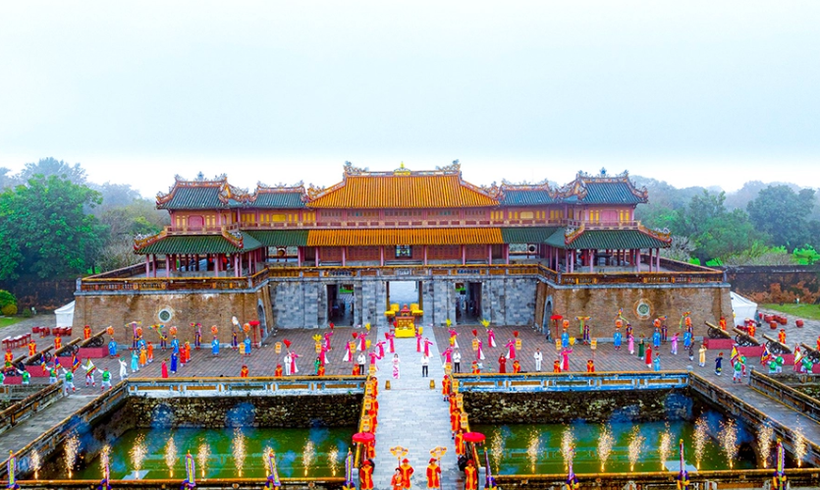
Hue (VNA) – A symposium on strategies to increase sustainability and livability of World Heritage cities was held on October 15 as part of the fifth regional conference of the Organisation of World Heritage Cities - Asia and the Pacific (OWHC-AP), which kicked off on the same day in the central city of Hue.
The forum offered an opportunity for experts and mayors of World Heritage cities in Asia Pacific to exchange insights on preserving and promoting heritage values, draw practical lessons applicable to each city’s urban development strategy, and explore pathways toward a sustainable future.
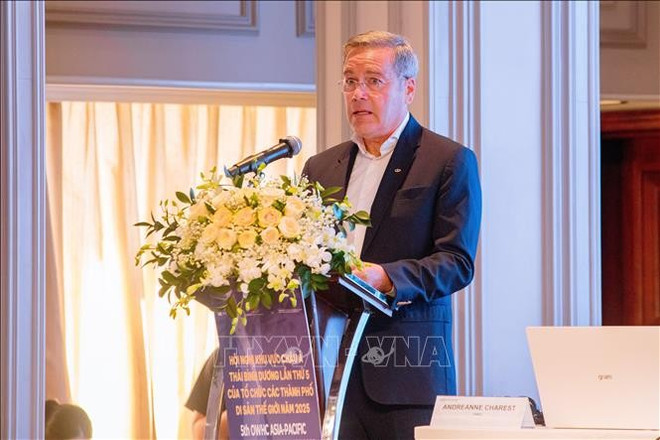
Mikhael De Thyse, Secretary-General of the Organisation of World Heritage Cities (OWHC) introduced the New Urban Project (NUP) of the organisation, saying that OWHC’s member cities have identified four key priorities, namely housing, public spaces, mobility, and urban character, to help revitalise living environments. The network’s cities are working and learning together to develop common solutions, while proposing strategies and projects encompassing all five priorities.
Experts and mayors from the network of World Heritage Cities in Asia Pacific mentioned specific challenges faced by their cities, including climate change, rapid urbanisation, environmental pollution risks, and other local issues unique to each city.
For instance, Hue faces limited resources for heritage preservation and promotion, relying mainly on the State budget. Rapid tourism growth has caused imbalances and strain on heritage sites, while overlapping legal regulations between preservation and development create additional challenges.
The workshop also featured insightful presentations from domestic and international experts.
According to Phan Thanh Hai, Director of the Hue Department of Culture and Sports, the city aims to build a green and smart heritage urban model through integrated planning that connects heritage with living spaces and nature. Hue has applied GIS, 3D spatial mapping, and AI technologies in heritage management and monitoring.
He revealed that the central city has also developed a heritage-based economy through fostering cultural and creative industries; placed communities at the centre of preservation efforts; strengthened heritage education and communications; and expanded international cooperation with other heritage cities in the region.
Experts from the Republic of Korea and Malaysia emphasised the crucial role of heritage managers in coordinating, mobilising, and managing World Heritage sites.
Assoc. Prof. Ji Hong Kim from Hanyang University of the RoK stressed preservation and development are not mutually exclusive but must be harmonised through balanced policies and the mediating role of heritage managers. He noted that heritage managers, must understand both global and local values, comply with relevant policies, and consider the experience of visitors as well as the quality of life of local residents./.