Ministries, localities urged to speed up land clearance for North-South high-speed railway project

The Deputy PM assigned the Ministry of Construction to work with each locality the railway passes through to review the project site, particularly the sections that run through core natural forest areas, cultural heritage sites, defence-security zones, or densly populated residential areas.

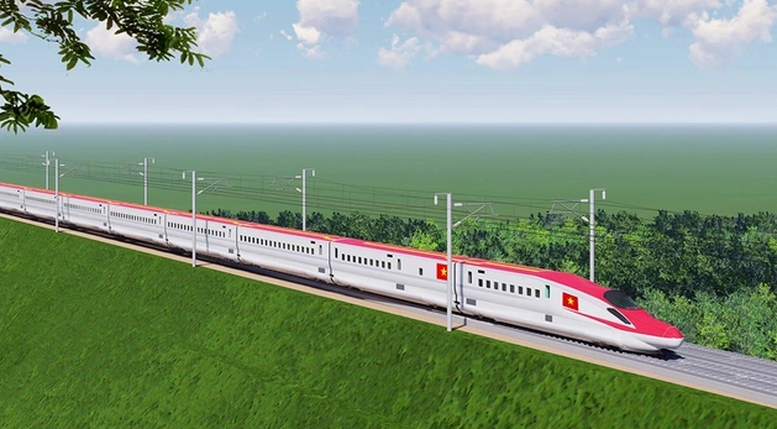
Illustrative photo (Photo: baochinhphu.vn)

Hanoi (VNA) – Deputy Prime Minister Tran Hong Ha asked ministries and localities to speed up land clearance and relocation works in the North-South high-speed rail line project during a hybrid conference on the land clearance plan for the railway project on June 16.

The Deputy PM assigned the Ministry of Construction to work with each locality the railway passes through to review the project site, particularly the sections that run through core natural forest areas, cultural heritage sites, defence-security zones, or densly populated residential areas.

Meanwhile, localities must proactively assess needs, and accurately determine the affected land area and houses to develop specific relocation plans.

Besides, the Ministry of Construction needs to coordinate with the Ministry of Justice to soon complete the Government's Resolution, removing obstacles in planning arising after the merger of provincial-level administrative units.

Regarding financial resources, Ha affirmed that the site clearance and resettlement to serve the North-South high-speed railway project is an independent project, using the central budget. The Ministry of Finance must have specific instructions to 15 relevant provinces and cities for implementation.

Each province must establish a provincial steering committee and a support team to directly manage the project implementation, he added.

Ha also noted that, along with the Government adjusting the master plan, localities must simultaneously adjust provincial planning, zoning, and detailed planning around stations to optimise traffic, trade, and service connections, creating space for modern, multi-layered, and integrated urban development.

According to the Deputy Minister of Construction Bui Xuan Dung, the North-South high-speed railway has a length of 1,541 km, starting at Ngoc Hoi station in Hanoi and ending at Thu Thiem station in Ho Chi Minh City. It passes through 15 provinces and cities after the provincial mergers. It has 23 stations, including five freight stations. Under the preliminary land use plan, the project requires an area of about 10,827 hectares, and 120,836 households are expected to move to make room for the railway.

In late April, the Government assigned the Ministry of Construction to review and hand over preliminary design documents and site clearance boundaries for localities to develop plans, implement resettlement and compensation. To date, the ministry handed over documents to all projected localities.

Localities the railway passes through must urgently develop detailed plans, proactively allocate local budget funds to carry out site clearance work, and establish a site clearance steering committee before July 1.

As of June 12, the People's Committees of provinces and cities had assigned specific tasks to units in charge of site clearance. However, only Ninh Binh province had established its steering committee, and five localities, namely Vinh Phuc, Phu Yen, Ha Tinh, Thanh Hoa and Ninh Binh provinces had completed a preliminary review of resettlement need, and Hue City had made an implementation plan.

Under the plan, localities are required to complete basic compensation and resettlement work before December 2026 to hand over the site to contractors. Vietnam Electricity (EVN) is responsible for relocating 110kV or higher power facilities, with completion required before December 2026./.

VNA

See more

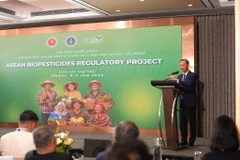
Nguyen Quang Hieu, Deputy Director of the Department of Crop Production and Plant Protection under the Ministry of Agriculture and Environment, speaks at the conference. (Photo: Daibieunhandan.vn)

Vietnam pushes biopesticides to support green farming

Biological plant protection products have emerged as an important solution to gradually reduce dependence on chemical pesticides, support integrated pest management (IPM), and advance ecological and organic farming.

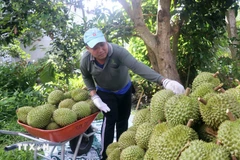
Harvesting Ri6 durian. ( Photo: VNA)

Vietnam’s durian exports need better management capacity

Over the past decade, the country’s durian cultivation area has expanded nearly sixfold to around 180,000 hectares, with output exceeding 1.5 million tonnes. The Central Highlands region is the largest growing region, accounting for more than 75,000 hectares.

Illustrative image (Photo: VNA)

Reference exchange rate up on January 8

With the current trading band of +/- 5%, the ceiling rate applicable for commercial banks during the day is 26,381 VND/USD, and the floor rate 23,869 VND/USD.

The first co-produced film Love in Vietnam was shot in different areas including Ba Na Hill in Da Nang city.

Vietnam–India co-production bridges cultures on screen

A sweeping cross-cultural romance set against Vietnam’s landscapes and cityscapes, the Vietnam–India co-production Love in Vietnam is positioning itself as both a cinematic crowd-pleaser and a soft-power showcase, aiming to elevate the country’s global image while sparking interest in its tourism, culture and people.

Production activities of Vinacomin at a mining site. (Photo: VNA)

Major firms face delisting risks due to shareholding concentration

Several billion-dollar companies in Vietnam are facing the imminent risk of losing public company status and being delisted from stock exchanges as highly concentrated shareholding structures squeeze out minority investors and raise fresh concerns over governance and market sustainability.

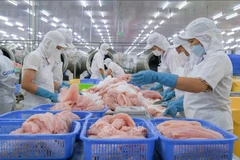
Processing pangasius for export at Caseamex Joint Stock Company, Tra Noc Industrial Park, Can Tho city. (Photo: VNA)

Seafood sector targets 11.5 billion USD in exports in 2026

In 2026, the sector aims for total seafood output of more than 10 million tonnes, up 0.6% from 2025. Of the total, capture fisheries are expected to reach about 3.75 million tonnes, down 2.1%, while aquaculture output is projected at 6.25 million tonnes, up 2.2%. Seafood export turnover is targeted at around 11.5 billion USD.

Vietnam's GDP expands by more than 8% in 2025. (Photo: VNA)

International financial institutions optimistic about Vietnam’s 2026 growth

As Vietnam enters 2026 - the first year of the 2026–2030 socio-economic development plan, international organisations stress that maintaining macroeconomic stability, improving growth quality and staying the course on fundamental reforms will be crucial in turning positive assessments into tangible outcomes and shaping a more sustainable development cycle ahead.

The application of Israeli technology in melon cultivation has delivered high economic efficiency (Photo: VNA)

VIFTA provides impetus for Vietnamese exports to Israel

The greatest benefit generated by the VIFTA lies in the immediate removal or phased deep reduction of many tariffs, significantly improving the price competitiveness of Vietnamese goods. At the same time, clearer provisions on rules of origin, customs procedures and trade remedies are helping foster long-term business partnerships.

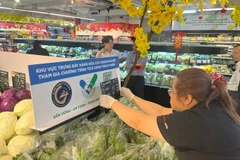
Vegetables with a green tick at a supermarket in Ho Chi Minh City. (Photo: VNA)

“Green tick” products ready for Tet holiday

Products bearing the city’s “green tick of responsibility” label, which indicates clear origin and verified quality, are increasingly visible on shelves and drawing strong consumer attention.

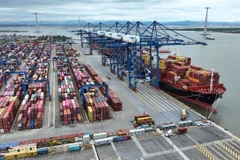
Imports and exports at Lach Huyen container port in Hai Phong city (Photo: VNA)

2026 Economic Census kicks off on January 7

The 2026 census aims to fully, comprehensively and objectively assess the current situation of economic establishments nationwide, including enterprises, public service units, associations, religious institutions and individual business households.​