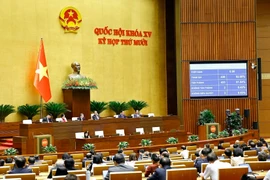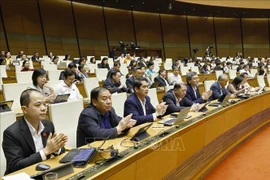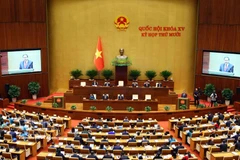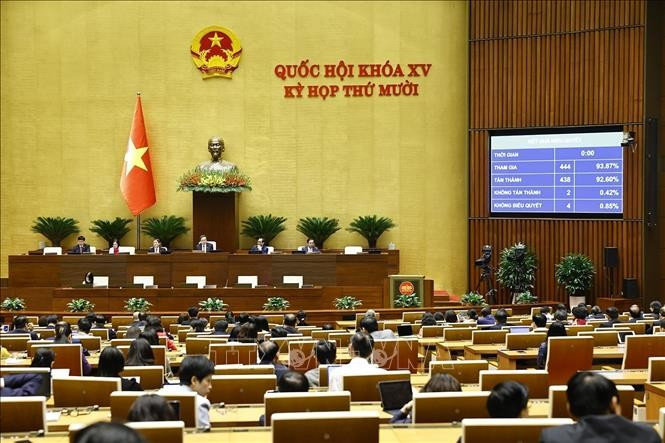
Hanoi (VNA) – The National Assembly on December 11 approved the Law on Specialised Courts at International Financial Centre at its ongoing 10th session, with 438 out of 444 deputies voting in favour.
The law is considered a crucial foundation for the centre’s effective operation and an important measure to bolster investor confidence.
Notably, the new law, which will take effect at the beginning of next year, expands the pool of eligible appointees for specialised court judges to include foreign nationals.
In its explanatory report, the Supreme People’s Court said the employment of foreign judges is a pivotal factor in establishing credibility with global investors. Courts in major financial hubs such as Dubai, Kazakhstan and Singapore also follow this model. It noted that judges with international experience and deep expertise in diverse legal systems, including common law and civil law, are necessary to adjudicate the highly internationalised disputes expected within the financial centre. The presence of foreign judges is expected to reassure investors who prefer adjudicators with similar legal backgrounds.
The provision also addresses an immediate shortage of qualified judges capable of handling complex financial disputes once the centre becomes operational. Vietnam currently lacks a sufficient number of judges with strong foreign-language skills, specialised expertise and international professional standing to adjudicate cases under common-law principles. The participation of foreign judges is therefore seen as a transitional but essential step that will also enable Vietnamese judges to learn from their counterparts and gradually take on full responsibility.
Under provisions of the new law, the specialised courts will be part of the People’s Court system and will be based in Ho Chi Minh City, with jurisdiction over disputes arising within the international financial centre. Its structure will include a first-instance court, a court of appeal and supporting units.
The court will have a chief judge, deputy chief judges, judges and clerks. The Chief Justice of the Supreme People’s Court will appoint or dismiss the chief judge and deputies for five-year terms. Judges may be either Vietnamese or foreign nationals, appointed by the State President upon the Chief Justice’s recommendation, also for five-year terms.
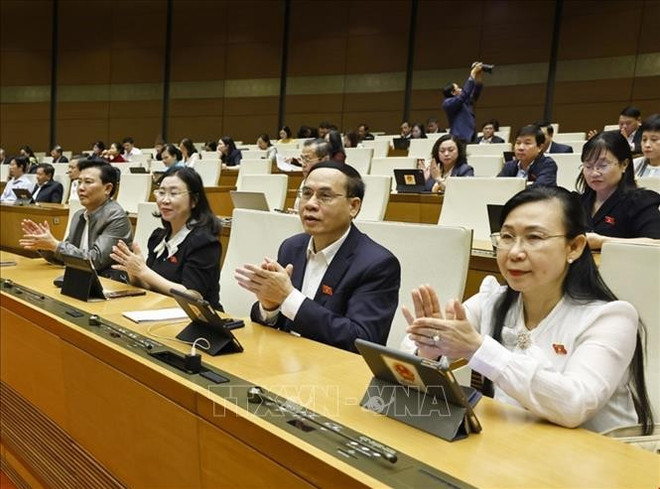
Also during the morning session, the NA adopted the Law on Digital Transformation and the Law on National Reserves.
Presenting the revised draft Law on Digital Transformation, Minister of Science and Technology Nguyen Manh Hung said the legislation responds to new challenges in the digital era, where data sharing, system connectivity and digital platforms are essential for national competitiveness. For the first time, the law provides clear definitions of digital systems, digital data, digital infrastructure, digital platforms, digital government, digital economy and digital society.
A key element of the law is the distinction between digital transformation and traditional IT application. While IT application shifts existing operations into the digital environment, digital transformation changes governance models and service delivery, a core principle summarised as “transform first, digitise later”.
The compiling board said this framework will help avoid fragmented or inconsistent implementation across localities.
The law also includes policies to reduce the digital gap, especially in remote, mountainous, border and island regions, by prioritising resources to expand access to online education, telemedicine and digital public services. In addition, the legislation positions the digital economy as a new growth engine. It introduces mechanisms to support small and medium-sized enterprises in adopting digital platforms and integrating into digital value chains, with the aim of maintaining double-digit growth contributions from the digital sector in the coming years./.