National Assembly adopts law relating to organisation of people’s procuracies

The newly adopted law stipulates that the people’s procuracy system comprises the Supreme People’s Procuracy; people’s procuracies at the provincial and municipal level; regional people’s procuracies; and military procuracies at all levels.

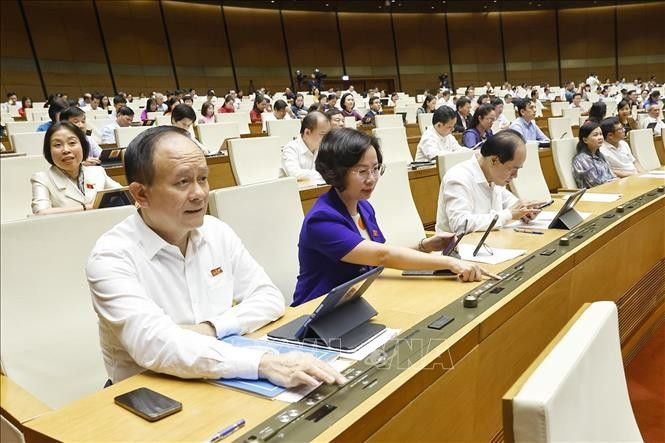
Deputies press buttons to vote on laws and resolutions at the 15th NA's 9th session. (Photo: VNA)

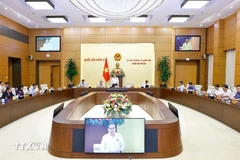
Hanoi (VNA) — The 15th National Assembly (NA) on June 24 approved the Law amending and supplementing several articles of the Law on the Organisation of the People’s Procuracies, with 409 out of 412 lawmakers present voting in favour, representing 85.56% of all deputies.

The newly adopted law stipulates that the people’s procuracy system comprises the Supreme People’s Procuracy; people’s procuracies at the provincial and municipal level; regional people’s procuracies; and military procuracies at all levels.

The Supreme People’s Procuracy will have no more than 27 procurators. The total number of procurators at people’s and military procuracies will be determined by the Prosecutor General of the Supreme People’s Procuracy and submitted to the relevant authorities for approval.

The same process will apply to the number of procurators and investigators at the Central Military Procuracy, which will also be decided by the NA Standing Committee based on the recommendation of the Prosecutor General of the Supreme People’s Procuracy, in agreement with the Minister of National Defence.

The law also requires first-time appointments of procurators to go through a competitive selection process. Promotions to higher prosecutorial ranks must follow a transparent and objective procedure that ensures appointees meet the criteria for each level. Prosecutors cannot be promoted while under disciplinary action, investigation, prosecution, or trial, or during any period of discipline as prescribed by Party and State regulations. The law will take effect on July 1, 2025.

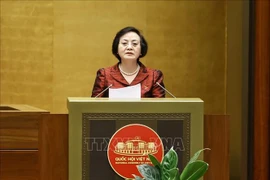
Earlier, presenting the report on feedback from NA deputies on the draft law, Nguyen Huy Tien, Prosecutor General of the Supreme People’s Procuracy, noted that the amendments include standards and conditions for appointing procurators. Appointments will not require further examinations, except for the initial entry exam. Subsequent promotions will depend on fulfilling legal requirements, ensuring alignment with reforms under the revised Law on Cadres and Civil Servants, and maintaining consistency with regulations on judges’ ranks./.
VNA

See more

Prime Minister Le Minh Hung chairs a working session with the Standing Board of the Dong Nai Party Committee on June 13, 2026. (Photo: VNA)

PM urges Dong Nai to step up role as a key driver of national growth

The PM said the positive results achieved by Dong Nai in its first year as a centrally governed city stemmed from a crucial factor, a shift in mindset, thinking and methods of implementation, reflecting the leadership’s determination to innovate, pursue development and embrace a spirit of initiative and responsibility.

Standing Deputy Minister of Foreign Affairs Nguyen Minh Vu receives Representative Director and Executive Vice President of Idemitsu Kosan Atsuhiko Hirano in Hanoi on June 12, 2026. (Photo: Ministry of Foreign Affairs)

Deputy FM urges Idemitsu Kosan to expand green energy investment in Vietnam

Receiving IKC Representative Director and Executive Vice President of Idemitsu Kosan Atsuhiko Hirano in Hanoi on June 12, Deputy FM Vu commended the company’s efforts in promoting investment and cooperation in Vietnam over the years, especially its role as a shareholder in the Nghi Son Refinery and Petrochemical (NSRP) project.

Prime Minister Le Minh Hung chairs a working session with the Standing Board of the Ho Chi Minh City Party Committee on June 13, 2026. (Photo: VNA)

Ho Chi Minh City must maximise role as economic powerhouse: PM

Prime Minister Le Minh Hung called for a comprehensive review of Ho Chi Minh City’s 2026 economic growth scenarios, with a focus on identifying untapped potential across sectors and deploying effective measures to maximise growth in the remaining quarters of the year, particularly in manufacturing, pharmaceuticals, logistics, finance and banking, and other high-value-added industries.

The national flags of Vietnam and the Philippines. Photo: VNA

Vietnam congratulates Philippines on Independence Day

General Secretary of the Communist Party of Vietnam and State President To Lam and Prime Minister Le Minh Hung on June 12 sent congratulatory messages to Philippine President Ferdinand Romualdez Marcos Jr on the occasion of the 128th anniversary of the Declaration of Independence of the Republic of the Philippines (June 12, 1898 – 2026).

Former Deputy Minister of Foreign Affairs Ambassador Pham Quang Vinh. (Photo: VNA)

AFF 2026 marks Vietnam’s transition from participant to regional agenda-setter

With sharp strategic mindset and a proven capacity for practical action at both bilateral and multilateral levels, Vietnam has demonstrated its role as a builder and agenda-setter, contributing to a robust platform for dialogue and cooperation in pursuit of a resilient, peaceful, and truly people-centred ASEAN Community by 2045

Party General Secretary and State President To Lam addresses the national conference disseminating and implementing Politburo Resolution No. 06-NQ/TW (Photo: VNA)

📝OP-ED: When foreign affairs pioneer in shaping nation's future

Resolution No. 06-NQ/TW represents both a continuation and a development of the Party’s comprehensive foreign policy and President Ho Chi Minh’s thought. If international integration helped create a favourable environment for development, diplomacy today is tasked with protecting and expanding that space.

An overview of the 4th session of the 17th Hanoi People’s Council for the 2026–2031 term. (Photo: VNA)

Capital Law 2026 paves way for Hanoi’s new development model

One of the key breakthroughs of the new resolutions is the shift from a traditional management-oriented approach to a development-enabling model. The proposed policies are designed not only to address current issues but also to establish the foundation for a more modern, proactive and flexible system of urban governance.

Vietnamese Ambassador to Algeria Tran Quoc Khanh (seventh from left) poses for a group photo with the leaders and staff of the University of Skikda. (Photo: VNA)

Vietnam, Algeria strengthen agricultural trade connectivity

Vietnam’s main exports to Algeria include coffee, cashew nuts, pepper, textiles and garments, steel and selected industrial products, while the North African country sells animal feed, chemicals, dates and other agricultural products to Vietnam.

Vietnamese Deputy Minister of Foreign Affairs Le Thi Thu Hang speaks at the forum. (Photo: VNA)

Vietnam, Switzerland eye stronger economic connectivity

Vietnamese Deputy Minister of Foreign Affairs Le Thi Thu Hang expressed Vietnam’s desire to see Swiss enterprises expand their long-term presence and investment in the country, particularly in high technology, innovation, renewable energy, pharmaceuticals, healthcare and digital transformation. She also emphasised cooperation in talent development, high-end tourism and international financial centre development.

Chairman of the People’s Committee of Hue city Nguyen Khac Toan (right) presents a souvenir to Karl Wilfing, President of the State Parliament of Lower Austria. (Photo: People’s Committee of Hue city)

Hue city moves to deepen multifaceted cooperation with Austrian partners

Toan proposed Lower Austria consider establishing an official cooperation mechanism with Hue to facilitate investment collaboration in tourism, education and training, healthcare, information technology, green and smart urban development, heritage conservation, hi-tech agriculture and sustainable development.