National Day amnesty reflects Vietnam’s humane policy

The National Day amnesty is a testament to the humane policies of the Party and State, the effectiveness of rehabilitation, and the balance of strict law enforcement with compassion in Vietnam’s governance.

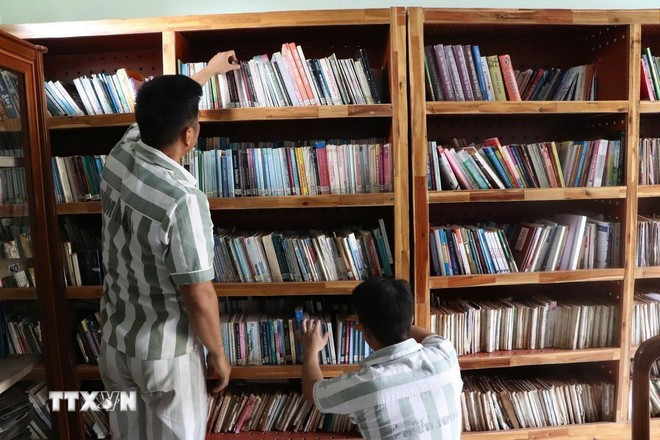
Inmates at Detention Centre No. 2 under the Ho Chi Minh City Department of Public Security study and reform themselves with the hope of soon returning to their families and starting a new life. (Photo: VNA)

Hanoi (VNA) – The State President has signed a decision granting special amnesty to many inmates nationwide on the occasion of the 80th National Day (September 2, 1945 –2025), which reflects the nation’s tradition of humanity and the Party and State’s consistent policy of leniency towards those who have repented and made efforts to become useful citizens.

At Detention Centre No. 2 under the Ho Chi Minh City Department of Public Security, excitement filled the cells in late August as inmates on the amnesty consideration list eagerly awaited reunion with their families.

L.M.V., sentenced to three years and six months for a traffic violation and who has served 16 months, said he was overwhelmed when learning he was eligible. He credited his hard work, discipline, and belief in the Party and State’s clemency policy for motivating him to change. Similarly, N.C.L., convicted of gambling, expressed deep gratitude at the chance of release, noting that family reunion was his greatest aspiration.

Lieut. Col. Pham Thi Thuy Hien, deputy warden of the facility, said that once the President’s decision was issued, the unit informed inmates about eligibility and procedures through bulletin boards, notices and internal broadcasts.

This round, 45 inmates at the centre qualified for amnesty dossiers. From the beginning of their sentences, they were informed of the criteria, which encouraged compliance, discipline, and active participation in labour and study programmes. Assessments were carried out regularly to ensure transparency. The centre also worked with lawyers’ associations and vocational training providers to offer legal education, psychological counseling, and career guidance to help inmates reintegrate into community after release.

Vocational training to prevent recidivism

At Phu Hoa Prison under the Ministry of Public Security, the atmosphere was equally joyful. N.Q.H., eligible for amnesty, said he had been guided into vocational training, worked diligently, and was recognised for his efforts. “I am grateful for the Party and State’s leniency policy. I am also glad to see other inmates, even those not yet eligible, share in the joy and encourage one another,” he said.
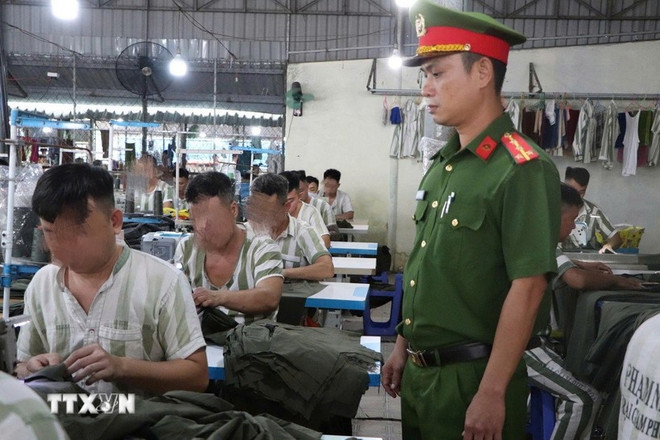
vocational-training.jpg
Inmates at Phu Hoa Prison receive vocational training in tailoring, construction, and other occupations, along with guidance to help them reintegrate into the community after being granted amnesty and released. (Photo: VNA)

Lieutenant Colonel Nguyen Thanh Hieu, deputy warden of Phu Hoa Prison, said 134 inmates had been proposed for release thanks to their good conduct and compliance with regulations. He stressed that vocational training in tailoring, construction, and other trades is crucial not only for amnesty consideration but also as preparation for stable employment after release.

In recent years, Phu Hoa Prison has reported no cases of recidivism among released inmates, a result attributed to effective education during incarceration and continued support from families and local authorities afterward, he noted.

On July 3, the President signed Decision No. 1244/QĐ-CTN on the second round of special amnesty for 2025. This year’s clemency marks an expansion from previous years, with broader eligibility criteria and the inclusion of some offence categories previously excluded, based on comprehensive evaluations of inmates’ rehabilitation.

Across detention centres, preparations are underway to support reintegration. Vocational training, psychological counseling, legal aid, and job placement programmes are being strengthened to ensure released inmates can rebuild their lives.

The National Day amnesty is a testament to the humane policies of the Party and State, the effectiveness of rehabilitation, and the balance of strict law enforcement with compassion in Vietnam’s governance./.
VNA

See more

Prime Minister Pham Minh Chinh talks to people receiving medical services at the Yen Khuong health station in Thanh Hoa province on November 9. (Photo: VNA)

PM visits residents, armed forces in Thanh Hoa's border commune

In Yen Khuong commune, the PM called for greater attention to school health, nutrition for children and the elderly, and the development of a civil-military medical cooperation model, not only to serve local residents but also to support people living across the border in Laos.

Party General Secretary To Lam (front, fourth from left) and officials mark the start of construction on the Na Ngoi Primary and Junior Secondary Boarding School in Na Ngoi commune, Nghe An province, on October 11, 2025. (Photo: VNA)

Work starts on inter-level boarding schools in border areas

The simultaneous beginning of construction on 72 schools, with the participation of leaders of the Government, ministries, sectors, and localities, is meant to reflect the strong determination and close coordination across the entire political system in caring for students in border areas.

Co.opmart Hue staff pack relief goods to ensure they reach those in need as quickly as possible. (Photo courtesy of Saigon Co.op)

Saigon Co.op rushes to deliver essential goods to storm-hit areas

The Saigon Union of Trading Cooperatives (Saigon Co.op) has urgently deployed an emergency support package, sending tens of tonnes of essential goods and relief teams to provinces hit by by recent historic storms and floods across central and northern Vietnam.

Local residents take the donated breeding cows home. (Photo: VNA)

Breeding cows presented to poor households along Vietnam–Cambodia border

Accordingly, leaders of the Border Guard High Command and Tay Ninh province of Vietnam, and Svay Teap district in Svay Rieng province of Cambodia presented 20 breeding cows, valued at 20 million VND (760 USD) each, to 20 households - 10 in Long Thuan commune (Tay Ninh) and 10 in Monorom commune of Svay Teap district.

Tuyen Quang province's tax officer assist people in carrying out tax payment procedures. (Photo: Nhandan.vn)

Tuyen Quang works hard to maximise state revenue in 2025

Tuyen Quang’s state budget revenue was estimated at more than 5.55 trillion VND (210.8 million USD) in the first 10 months of 2025, reaching 91% of the target assigned by the Prime Minister and 62.5% of the plan set by the provincial People’s Committee.

A ceremony in response to Vietnam Law Day held in Khuong Mai secondary school in Hanoi (Photo: nhandan.vn)

Vietnam Law Day to be observed in Hanoi

A national-scale ceremony marking Vietnam Law Day (November 9) is scheduled for November 7 afternoon in Hanoi, offering a chance for every citizen to uphold the spirit of respecting the Constitution and law, fostering a culture of legal compliance for the goal of wealthy people and a strong, democratic, equitable, and civilised nation.

The success of the Russian October Revolution had a profound impact on revolutionary movements around the world, including in Vietnam. Under the light of Marxism–Leninism and the October Revolution, Nguyen Ai Quoc found in it a “miraculous handbook,” the path to national salvation for the Vietnamese people. In the photo: The people of Hanoi seized the Residential Palace of the Tonkin Governor – the headquarters of the French-backed administration in northern Vietnam, marking the success of the August Revolution in Vietnam on August 19, 1945. (Photo: VNA Archives)

Russian October Revolution opens a window into Vietnam

On the eve of the 108th anniversary of the October Revolution, through a bilingual presentation by lecturer Hong Hoa and documentary footage, the question of how a revolution that took place in faraway Russia in 1917 could help an Asian nation like Vietnam achieve independence and freedom in 1945 was vividly explained to students born a century after the event.