Hanoi (VNA) – Nearly all Vietnamese, 95–98%, now have access to basic digital services, social media, and online information platforms, a level of connectivity that surpasses many advanced economies.
From young children and teenagers to the elderly, and across urban centres, rural villages and remote mountainous regions, citizens are increasingly equipped to join the digital realm, share opinions freely, access knowledge, and benefit from public services, e-commerce, education, and health care. These gains underscore tangible advances in human rights realisation in the digital era.
The Vietnam Internet Association reported close to 80 million Internet users nationwide, ranking the country among the global leaders in penetration rates. On average, users log about seven hours daily online for learning, professional tasks, and social engagement.
Separately, a Ministry of Science and Technology report indicated 104.7 million mobile broadband subscriptions as of April 2025, with usage continuing to climb amid accelerated infrastructure upgrade.
At the Internet Day 2025 event held on December 17, Deputy Minister of Science and Technology Pham Duc Long highlighted Vietnam's 10th-place global ranking in fixed broadband speed and 15th in mobile broadband speed.
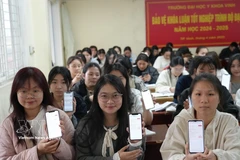
Currently, 89.8% of adults own smartphones. Following more than a year of 5G commercialisation, the network has reached nearly 59% of the population. Mobile broadband infrastructure now extends across virtually the entire country, including distant borders and islands, providing essential foundation for a digital economy, digital government, and digital society.
These milestones are not coincidental but rooted in the Party and State’s strategic decisions. The Politburo's Resolution 57-NQ/TW on breakthroughs in science, technology, innovation and national digital transformation, issued on December 22, 2024, explicitly prioritises the people-centred approach, aiming ultimately to improve living standards and broaden access to information, knowledge, and services for everyone.
The resolution positions individuals and enterprises as the core, key stakeholders, primary resources and main drivers; scientists as the pivotal force; and the State as the guiding entity that fosters optimal conditions for advancement in these fields. It frames the right to benefit from scientific and technological progress as an integral element of human rights, aligning with the global trend and marking a progressive shift in development thinking.
Complementing this, Resolution 59-NQ/TW on global integration in the new context expands opportunities for Vietnamese citizens and companies to engage with worldwide knowledge, technologies, markets, and best practices.
In addition, the Party, State and Government have introduced a range of bold new policies to better safeguard human rights and pool resources for a new era of national development. While the Constution and legal documents have been amended, supplemented or issued, the reorganisation of the political apparatus strongly carried out towards greater efficiency and effectiveness, efforts promoted to realise socio-economic targets, the combat against corruption, wastefullness, negative phenomena, smuggling and counterfeits enhanced, envionmental protection boosted, and new social welfare policies released.
Resolution 66-NQ/TW on reforming law enforcement underscores the requirement to protect the rights and legitimate interests of citizens at every stage of State management. It emphasises the continuation of administrative procedure reform, the perfection of legal documents, the enhancement of authotities' accountability, and the ensuring of citizens' rights to access justice and make complaints and denunciations as core tasks, reinforcing the foundation for human rights in a law-governed socialist state.
Resolution 68-NQ/TW on private sector development, Resolution 71-NQ/TW on education and training, and Resolution 72-NQ/TW on health care, broaden economic, social and cultural rights. The rights to employment, job choice, lifelong learning and medical access are increasingly better protected. The Employment Law and its guiding decrees have been formulated to better safeguard workers’ rights and interests, in line with the core conventions of the International Labour Organisation (ILO) of which Vietnam is a member.
Another notable aspect of human rights protection in Vietnam is the freedom of belief and religion. Over 95% of citizens practice a belief or religion; 43 organisations across 16 religions have been officially recognised, serving over 27.7 million followers through some 200,000 places of worship nationwide. Vietnam also stands out for hosting major global religious gatherings such as United Nations Vesak celebrations, which have drawn international delegations and garnered widespread acclaim.
Vietnam’s development trajectory shows that human rights extend beyond slogans to concrete improvements in living standards, development opportunities, and the commitment to leaving no one behind. Despite ongoing challenges and resource constraints, Vietnam is steadily improving its institutional framework, enlarging rights spaces, and elevating the level of benefits enjoyed by its people./.
VNA