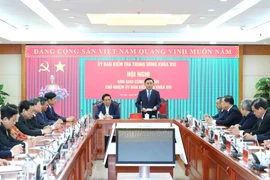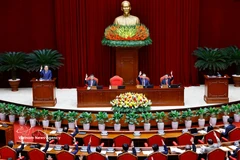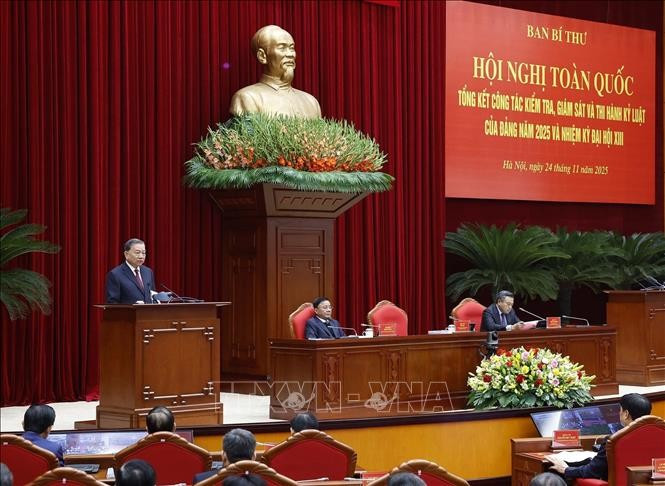
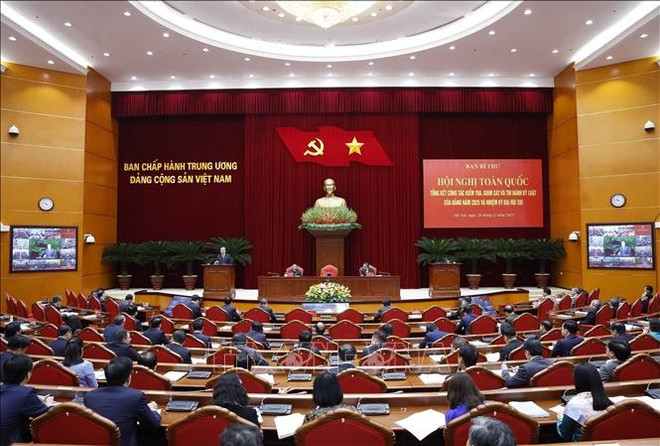
Hanoi (VNA) – Party General Secretary To Lam emphasised the need to ensure there are no “gaps” or “blind spots” in Party inspection and supervision while addressing a national conference held by the Party Central Committee’s Secretariat on November 24 to review inspection, supervision and disciplinary work in 2025 and the 13th tenure.
At the event, which was held in the Party Central Committee’s headquarters and connected online to all provincial and municipal Party Committees and Party bodies under the Party Central Committee, participants observed a minute of silence for victims of recent storms and flooding, and contributed donations to support affected localities.
Reports presented at the conference showed the Party Central Committee’s Inspection Commission has advised the Party Central Committee, Politburo and Secretariat to issue 44 important regulations, programmes and guidelines on inspection, supervision and discipline implementation.
The commission have proactively coordinated with relevant agencies to handle violations in complex cases of public concern and actively contributed to preparations for the 14th National Party Congress. Digital transformation efforts have also advanced across the Party’s inspection sector.
During the tenure, the Politburo, Secretariat and Party Committees at all levels inspected over 232,400 Party organisations and more than 1.28 million Party members.
Inspection Commissions at all levels examined 13,612 Party organisations and 38,378 Party members showing signs of violations. They oversaw the asset and income declarations of 11,172 Party members, concluding that 830 had committed violations or shortcomings. The Party Central Committee’s Inspection Commission supervised 145 officials under the management of the Politburo and the Secretariat, imposing disciplinary measures on 10 Party members.
Party committees and grassroots Party cells conducted thematic supervision of 176,229 Party organisations and 596,688 Party members. Inspection Commissions at all levels carried out thematic supervision of a further 123,906 Party organisations and 174,472 Party members.
General Secretary Lam noted that the 13th tenure took place amid rapid, complex and unprecedented domestic and international developments. Yet the Party has demonstrated its mettle, unity and resilience, helping the country overcome major challenges and achieve significant results, with many key targets expected to be met or surpassed.
He stressed that a key lesson throughout the tenure is that Party building and rectification must be strengthened precisely in difficult times. Inspection and supervision work has played a decisive role in enhancing the Party’s leadership capacity, safeguarding discipline and reinforcing public trust.
The General Secretary also pointed out existing shortcomings, including limited attention to inspection in some Party Committees, insufficient routine supervision, slow detection of repeated violations, and gaps in follow-up enforcement, requiring immediate remedial measures.
To improve inspection and supervision in the next tenure, he urged all levels to strictly implement Party regulations, strengthen oversight at the grassroots level, and enhance the capacity of local Inspection Commissions. He instructed the Central Inspection Commission to review the implementation of the 10th Party Central Committee’s Resolution on strengthening Party inspection and propose a new resolution after the 14th National Party Congress. To ensure there are no ‘gaps’ or ‘blind spots’ in inspection and supervision, the Party chief called for a shift toward proactive, early-warning oversight across all areas of leadership and implementation, especially in major strategic decisions He requested timely detection and strict handling of cases involving political, moral or lifestyle degradation; violations of Party regulations; corruption, wastefulness, negative phenomena and group interests, while protecting those who dare to innovate for the national interest.
The General Secretary highlighted the need to build streamlined, strong and effective Inspection Commissions at all levels, staffed by competent, upright officers “as clear as mirrors and as sharp as swords”, firmly loyal to the Party and immune to pressure or temptation.
He pointed to the need for improved training, professional competence, principled working styles and better capacity for early detection and objective, fair assessment, especially at grassroots level.
He also stressed promoting digital transformation and data connectivity to enable “inspection based on data, supervision based on data”, and strengthening coordination across the political system, particularly in handling complex and sensitive cases./.