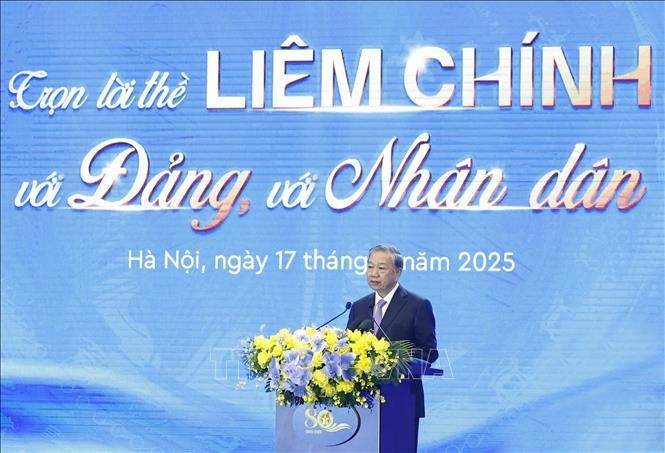
Hanoi (VNA) - Party General Secretary To Lam on November 17 outlined crucial, forward-looking requirements for the Government Inspectorate, stressing the need for the inspection work to fundamentally shift its focus from merely "handling violations" to "prevention early and from afar."
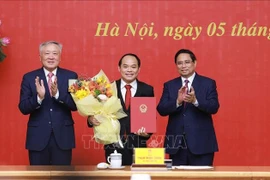
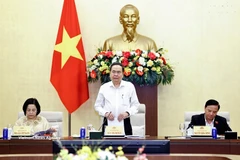
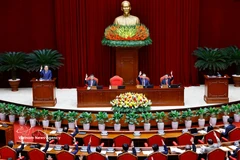
Speaking at the ceremony marking the 80th anniversary of the traditional day of Vietnam's inspection sector (November 23, 1945 – 2025) in Hanoi, General Secretary Lam emphasised that as Vietnam enters a new development phase - striving to become a strong, prosperous, and happy nation, and a developed, high-income country by 2045, the role of inspection has become more critical and comprehensive.
He stated that inspection is no longer just a tool for detecting wrongdoings, it is an institution that fosters transparency, promotes innovation, and safeguards social stability and public trust. A sound governance system requires a robust oversight mechanism, and the inspection sector is the pillar of this structure.
With this vision, the General Secretary called for the sector to pursue comprehensive reform and strong modernisation, linking the inspection work with national development goals and placing the people at the centre of all activities. The ultimate aim is to build an efficient, integrity-driven public administration that truly serves people.

General Secretary Lam suggested several key orientations and priorities for the sector, stressing that it must deeply grasp the Party's guidelines on building and rectifying the Party and the socialist rule-of-law state.
The paramount requirement is a major shift in mindset and method, he said, inspection must move beyond detecting and penalising violations to proactive prevention, value creation, and promoting development.
Every inspection must serve a dual purpose: early detection of wrongdoings to protect public assets and simultaneously facilitating the resolution of difficulties for organisations, businesses, and people, the Party chief noted.
Inspection must be one step ahead, providing early forecasts and warnings of risks, and preventing small breaches from accumulating into major violations, he said.
The work must pivot its core focus from "handling violations" to "prevention early and from afar," combining administrative inspection with specialised thematic inspection and merging on-site checks with digital data analysis, the Party leader added.
General Secretary Lam stressed that all inspection activities must be objective, impartial, and transparent, adhering to the motto: "No forbidden zones, no exceptions, but also no extremism or formalism."
He also noted that inspection results should be used to review practices, identify problems, and propose improvements to policies and laws, thereby addressing legal "gaps" or "loopholes" in state management.
The General Secretary called for a major push toward modernisation, technology application, and digital transformation across the sector. This includes building and operating the national database for handling citizens' complaints and denunciations and for controlling assets and incomes of public officials. The goal is to move towards conducting inspections, resolution of complaints, and supervision entirely within a digital environment, making the process transparent, fast, efficient, and cost-effective.
The Party leader requested that the inspection sector to strengthen the Party's leadership in the inspection work to meet the requirements of preventing and combating corruption, wastefulness, and negative phenomena.
He stressed the importance of building a contingent of inspection officials who are truly integrity-driven, brave, intelligent, and proficient. Inspection officials must possess "a bright heart, a steady mind, refined expertise, and correct actions" and have the courage to protect what is right, fight against what is wrong, and dare to take responsibility for the common good.
Finally, General Secretary Lam urged the sector to coordinate closely with agencies of internal affairs to ensure synchronicity and effectiveness. He expressed his confidence that, through concerted efforts, the inspection sector will continue its glorious tradition and make worthy contributions to building a clean, legal, and development-facilitating State./.