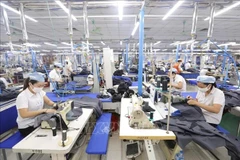
The Ministry of Industry and Trade applies online certification for garment-textile exports to Mexico. (Photo: Duc Duy/VietnamPlus)
Hanoi (VNA) – The Ministry of Industry and Trade has officially granted online certification for Vietnamese garment-textile exports to Mexico.
Vietnam is an important trading partner of Mexico and an effective Comprehensive and the Progressive Agreement for Trans-Pacific Partnership (CPTPP) will be a message to the world that member countries will continue opening their markets.
At the launch ceremony of the online certification in Hanoi on June 20, Deputy Minister of Industry and Trade Tran Quoc Khanh described it as a new generation free trade agreement, with commitments covering a wide scale. Countries engaging in the pact account for 13.5 percent of the global gross domestic product (GDP) and they are expected to gain various opportunities from the agreement, especially for the garment and textile industry.
Meeting rules of origin is the most difficult task as Vietnam’s textile industry is yet to be well developed and relies heavily on imports. However, according to the Ministry of Industry and Trade, Vietnam has agreed to launch an online certification system aiming at long-term goals, as the deal serves as a catalyst to attract investment in raw materials.
However, to ensure online certificates for export reach the right products and to deter those taking advantage of the rules of origin, the ministry has worked with the Mexican side to build a joint online monitoring mechanism.
"The implementation of such an online monitoring mechanism will create the maximum advantage for businesses and closely link the supply chains between Vietnamese and Mexican businesses," the deputy minister said.
Sara Valdés Bolano, Mexican Ambassador to Vietnam, said Vietnam is an important trading partner of Mexico and an effective CPTPP will be a message to the world that member countries will continue opening their markets.
Mexico appreciates Vietnam's commitments in the textile sector and is interested in strengthening cooperation and facilitating trade between the two countries, the diplomat added.
Earlier, on January 14 this year, the CPTPP came into force. Signed in March 2018, it is the successor to the Trans-Pacific Partnership (TPP) Agreement, a similar deal that included the US. President Donald Trump withdrew the US from the TPP soon after he was elected.
The trade deal was joined by 11 member states, namely Australia, Brunei, Canada, Chile, Japan, Malaysia, Mexico, New Zealand, Peru, Singapore, and Vietnam.
According to Tran Thanh Hai, Deputy Director of the ministry’s Import and Export Department, Vietnam must comply with its commitments in the CPTPP and with the contents of two bilateral pacts signed between ministers of Vietnam’s Ministry of Industry and Trade and Mexico’s Ministry of Economy on textile tariff quota and textile supervision.
On April 19, the ministry issued Circular 07/2019/TT-BCT regulating the export of textiles and garments to Mexico under the CPTPP. Taking effect on June 20, the circular includes five chapters and 12 articles to incorporate into national law the commitments of the two pacts.
Regarding preferential tax regulations, Hai explained textile and garment products must meet conditions like having Certificate of Origin C/O and Certificate of Eligibility C/E and meeting one of the rules of origin provided in Paragraph 3, Article 4 of Circular 07.
In addition, textile and garment products subject to tariff quotas for exports to Mexico provided in this circular include those using cotton and acrylic fibres and children's clothes and diapers.
However, the leader of the Import and Export Department also noted that the tariff quotas have only applied to 2019, while those of the following years will be announced by the ministry after receiving notice from the Mexican side.
Vietnam’s total garment-textile export turnover was estimated at 14.5 billion USD in the first five months of 2019, a year-on-year rise of 9.11 percent.-VNA