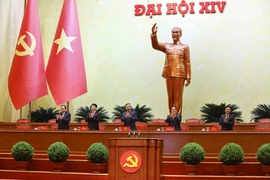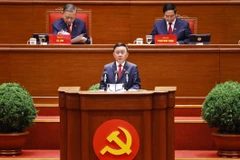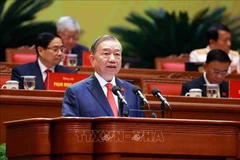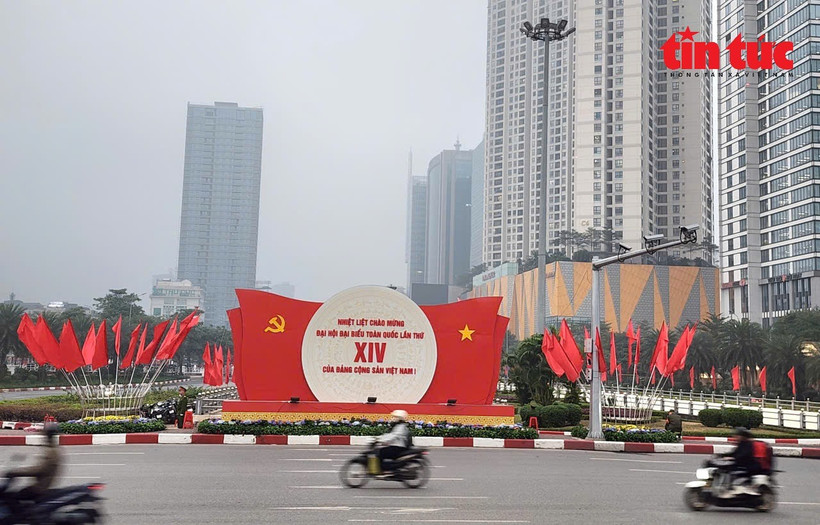
Hanoi (VNA) – The 14th National Congress of the Communist Party of Vietnam, held from January 19 to 25, in Hanoi, is expected to be a congress of long-term vision, and one that ushers the country into an era of the nation’s rise, with substantive breakthroughs.
Over the 96 years of the Party’s formation and development, its congresses have been occasions to set out strategic orientations for the development of the revolution, the country, and the Party itself.
On January 19, 2011, the 11th National Congress adopted the amended and supplemented Party Statutes. Its Article 9 stipulates that the highest leading body of the Party is the National Congress. Between the two congresses, the Party’s leading body is its Central Committee.
The National Congress is the highest leading body, playing a decisive role in all activities and orientations of the Party in each historical period, and deciding on the most important issues related to the guidelines and strategies for national development.
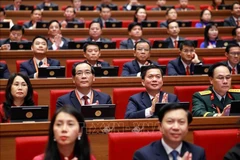
Specifically, the Congress is an occasion to assess the country’s development situation during each term, review leadership outcomes, and draw valuable lessons of both theoretical and practical significance. It is also where the Party gives full play to collective intellect, the spirit of solidarity, renewal, and creativity in order to set out policies and orientations for national development in the subsequent period.
Through the Congress, delegates select the most outstanding individuals to elect the Central Committee - the Party’s highest leading body between the two congresses.
In addition to its role as with previous congresses, the 14th National Congress is taking place under “unprecedented conditions,” carrying the significance of a call that ignites the aspiration of the entire nation to rise into a new era - the era of breakthrough development.
“Unprecedented conditions” mean that after 40 years of Doi moi (Renewal), Vietnam has overcome the state of underdevelopment, gradually completing a socialist-oriented market economy. Today, the S-shaped land is no longer a backward agricultural country but has become an economy of large scale within the region. In 2025, GDP reached approximately 514 billion USD, ranking 32nd in the world, with GDP per capita at 5,026 USD, placing Vietnam among upper-middle-income countries.
Economists note that the country has now accumulated an important foundation in terms of economic scale, infrastructure, production capacity, and international integration. This is the moment for decisive choice: either to make a breakthrough and advance into the group of high-income developed countries in the coming decades, or to fall into a trajectory of average growth, slowly improving productivity, and gradually declining competitiveness.
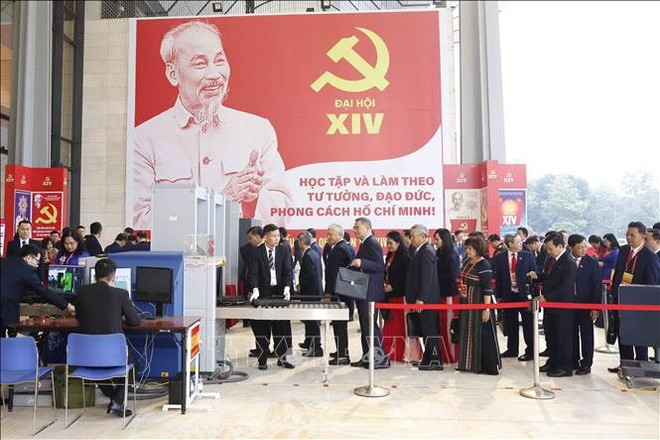
The answer will be found at this Congress, which is expected to demonstrate the Party’s long-term vision and strong political determination to lead the implementation of substantive breakthroughs across many areas of the country’s socio-economic life.
The above expectations are entirely well founded.
Regarding institutional breakthroughs, nearly one year before the congress, on April 30, 2025, Party General Secretary To Lam, on behalf of the Politburo, signed and promulgated Resolution No. 66-NQ/TW on reforming the work of lawmaking and law enforcement to meet the requirements of national development in the new era.
According to Resolution 66, by 2030 Vietnam will have a legal system that is democratic, fair, coherent, unified, public, transparent, and feasible, capable of removing obstacles arising from practice, paving the way for development-oriented governance, and mobilising all citizens and businesses to participate in socio-economic development.
The legal system will be developed in a manner that unleashes all productive forces, unlocks all development resources, genuinely safeguards the freedom of business, property ownership rights, and freedom of contract, and ensures equality among enterprises of all economic sectors, with the private sector identified as one of the most important driving forces of the national economy.
In essence, this resolution is closely linked with Resolution No. 68-NQ/TW dated May 4, 2025 on private economic development. Resolution 68 affirms that the private sector is one of the most important drivers of the national economy and a pioneering force in promoting growth, creating jobs, improving labour productivity, and enhancing national competitiveness.
The targets set out in Resolution 68 stipulate that by 2030, Vietnam will strive to have 2 million enterprises; at least 20 large enterprises participating in global value chains; and an average growth rate of the private sector of about 10–12% per year. The sector is expected to contribute approximately 55–58% of GDP and about 35–40% of total state budget revenue.
For Vietnam to achieve rapid and sustainable development, with annual GDP growth of 10% or higher, breakthroughs in science and technology are indispensable. For this reason, the Politburo issued Resolution No. 57-NQ/TW on December 22, 2024, entitled “Breakthroughs in the Development of Science, Technology, Innovation, and National Digital Transformation.”
The core spirit of Resolution 57 is that for Vietnam to develop strongly in the new era, strategic and revolutionary policy decisions are required to create breakthroughs in science and technology development.
The targets set are bold and resolute: by 2030, the country’s scientific, technological, and innovation potential and capacity will reach advanced levels in many key fields, ranking among the leading group of upper-middle-income countries; the technological and innovation capacity of enterprises will exceed the world average; and several scientific and technological fields will attain international standards.
Regarding breakthroughs in human resources, the draft documents to be submitted to the 14th National Congress affirm that the Party’s and the State’s guidelines and policies on comprehensive human development in Vietnam have become increasingly complete, focused, and substantive.
Economic growth in the country has been more closely linked with ensuring social progress and equity. The Government prioritises the allocation of resources for social welfare and implements in a concerted and effective manner policies and solutions for sustainable poverty reduction.
As a result, the multidimensional poverty rate has declined rapidly, from 4.4% in 2021 to 1.3% in 2025, exceeding the target set by the Resolution of the 13th National Congress. As of September, the entire country had completed the elimination of 334,234 temporary and dilapidated houses, finishing the goal three years ahead of schedule. The number of people receiving regular social assistance has expanded to over 3.5 million, 55% of whom are elderly people.
Thus, the long-term vision and substantive breakthroughs expected at the 14th National Congress are all directed toward the ultimate goal, fully consistent with the congress’s communication slogan: “An enduring Vietnam; a peaceful Fatherland; a nation of prosperity and development!”./.