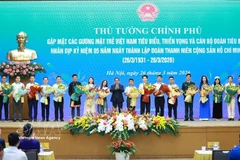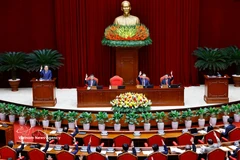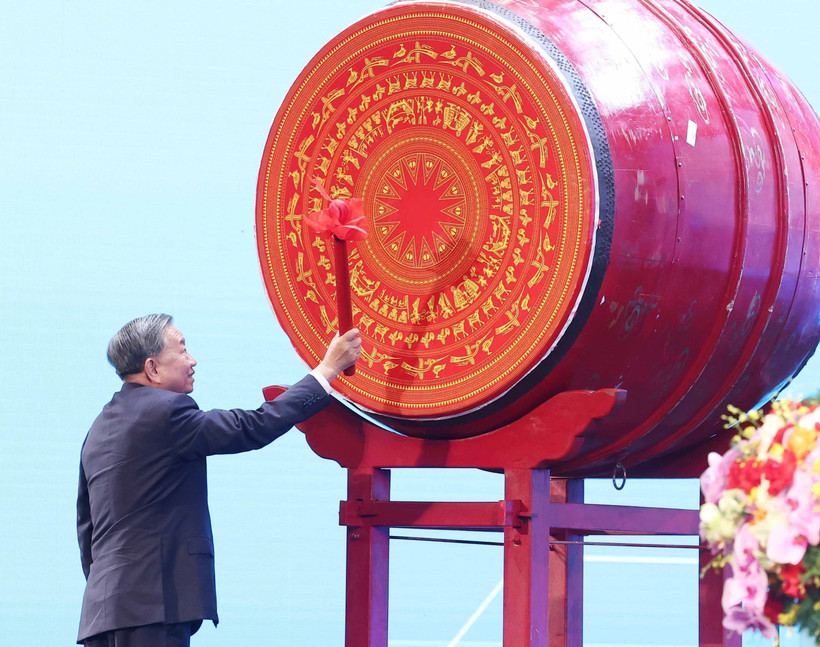
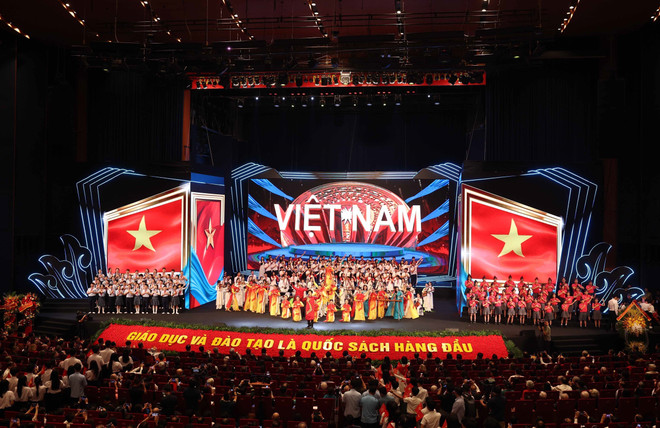
Hanoi (VNA) – Party General Secretary To Lam addressed a ceremony marking the 80th anniversary of the education sector and the start of 2025-2026 school year in Hanoi on September 5, outlining a series of tasks for a modern education.
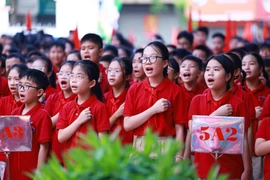
The event, broadcast live on VTV1 and digital platforms, connected the National Convention Centre with educational establishments nationwide. For the first time, all schools across the country simultaneously held the flag-raising ceremony and sang the national anthem to open the new school year.
In his speech, General Secretary Lam extended greetings and best wishes to teachers, education managers, and students nationwide, expressing his confidence that the sector would continue making breakthroughs, living up to the nation’s tradition of valuing learning and aspiration to rise.
The General Secretary stressed that over the past 80 years, whether in the flames of war or in the process of national construction during peacetime, revolutionary education in Vietnam has always stood at the forefront: providing human resources, nurturing talent, and playing a decisive role in national liberation, reunification, and development. Since the launch of Doi Moi (renewal), the education and training sector has expanded its network, improved quality, and gradually embraced global integration. Despite these gains, he acknowledged uneven educational quality and persistent regional disparities.
According to him, the Politburo has issued Resolution No. 71 on breakthroughs in education and training. To quickly bring the Resolution to life, he called on the entire Party to renew its mindset in educational leadership, moving away from outdated practices, and ensuring robust, effective implementation.
Education must remain the nation’s top priority, he said, calling on the National Assembly to perfect the legal framework for a modern, stable foundation. The Government was directed to ramp up investment in financial resources, infrastructure, and personnel, while dismantling institutional barriers to mobilise societal support. The Vietnam Fatherland Front, mass organisations, and social groups were tasked with fostering unity and spreading a nationwide movement to nurture future generations.
He said the education sector itself must lead the charge by reforming teaching methods, governance, and mindset. A dedicated cadre of teachers, blending expertise, ethics, and passion, should inspire students. Students, in turn, were encouraged to nurture ambition, aspiring to become global citizens who meet international benchmarks while retaining Vietnamese identity.
To drive success in this new phase, the Party chief outlined a shift from incremental tweaks to a bold, nation-building strategy, with quality, equity, integration, and efficiency as guiding principles. Strict discipline in execution was highlighted, alongside ensuring equal access to education to boost literacy nationwide. Priority must be given to remote, border, island, and disadvantaged areas through increased investment in schools, teacher training, student nutrition, and digital infrastructure, ensuring no child is left behind.
General education reform must be comprehensive, going beyond knowledge transfer to shape character, foster physical development, nurture emotional growth, and instill civic responsibility and discipline. The aim is to cultivate a generation that is “talented, compassionate, and resilient”, with universal secondary education achieved as soon as possible.
Higher education and vocational training were singled out for transformation. Universities must evolve into hubs of knowledge creation and technology transfer, fueling innovation and entrepreneurship. Training, research, and application should align with Vietnam’s development needs. Vietnam, he stressed, should build major universities of global and regional standing and modern vocational training establishments to produce a skilled workforce capable of advancing sci-tech, industrialisation, and digital transformation.
The Party chief called for stronger international integration in education to learn from global best practices, narrow gaps, and spread standards. He encouraged joint training, programme linkages, credit recognition, exchanges of lecturers and students, and attracting international scholars, towards improving the position of the education sector.
He stressed the importance of building a strong team of teachers and education managers, calling teachers the “soul of education” and the decisive factor in the success or failure of educational reform.
Beyond imparting knowledge, teachers nurture aspirations, shape character, and inspire confidence in students, so educators must continually learn, innovate, and set exemplary examples, he said. He noted that the newly - adopted Law on Teachers provides a foundation to improve teachers’ living conditions, safeguard their rights and benefits, and at the same time raise professional standards, ethics, responsibility, and social status.
The General Secretary also called for accelerating digital transformation and the application of artificial intelligence (AI) in education, describing investment in education as an investment in the nation’s future. He urged comprehensive planning and restructuring of the educational system, particularly public universities, to form training - research - innovation centres on par with the region and reaching international standards. He also emphasised the need for efficient public spending without dispersion, stronger public–private partnerships, and broad mobilisation of social resources to advance education and human development.
He affirmed that building a learning society and promoting lifelong learning will help form the strongest foundation for a self-reliant nation. Lifelong learning is not only each individual’s asset but also a core national value, ensuring that Vietnam advances with the times and asserts its intelligence and identity in the international arena.
The Party chief advised students to set clear goals, practice self-discipline in learning, nurture curiosity, and strengthen their capacity to master digital technology and AI in a smart, safe, and humane way. He urged them to live with love, responsibility, and a sense of community, stating that every step forward of students is the future of the country.
The Party has always regarded education and training as a top national priority and a decisive motivation for the nation’s future, he said, adding that more than ever, investment in education must be seen as investment for sustainable and prosperous development of the country. He called on the entire Party, people, and army; sectors, localities, and every family and individual to join hands in caring for the cause of educating people, for the prosperity of the nation, and the happiness of the people.
On this occasion, he presented the first-class Labour Order to the Ministry of Education and Training for its outstanding achievements in state management of education, training, and nurturing talented students who won top prizes at regional and international Olympiads.
In his address, Minister of Education and Training Nguyen Kim Son noted that Vietnam’s education sector has experienced three major reforms and two extensive, revolutionary renewals over its proud history. Guided by the Party’s leadership and educational policies, the sector has progressively strengthened its institutional framework and completed the national education system.
Vietnam’s education sector has played a decisive role in building the country’s current standing and strength, Son said, stressing that despite many shortcomings compared with leading global systems, Vietnam’s achievements over the past eight decades are remarkable.
In the new academic year, the sector will implement the Politburo’s resolution on breakthroughs in education and training development and work to address existing limitations, while proposing the National Assembly’s adoption of three legislative documents on special mechanisms to carry out the resolution, the minister noted.
Currently, the country counts more than 52,000 schools serving 26 million students, with 65% of general schools meeting national standards and many equipped with modern facilities. The teaching workforce of 1.6 million has been professionally trained, with elite groups recognised as being on par with educators worldwide.
Vietnam is also home to 243 universities and over 800 colleges and vocational institutions, spanning public, private, and international systems. Some universities and disciplines have secured positions among the world’s top 500, offering training across nearly all global fields and professions.
The higher education sector contributes around 75% of the nation’s scientific research, inventions, and innovations. The country’s scientific community has also grown considerably, with many distinguished individuals making valuable contributions both at home and abroad./.