Party chief sets guidelines for feedback on 14th Party Congress’s draft documents

The shared objective of the Party, the National Assembly, the Government, and the people is clear and simple: a sustainably developing nation, a just and humane society, citizens empowered to succeed through their own efforts, and strict accountability for those who violate the law, with no exceptions.

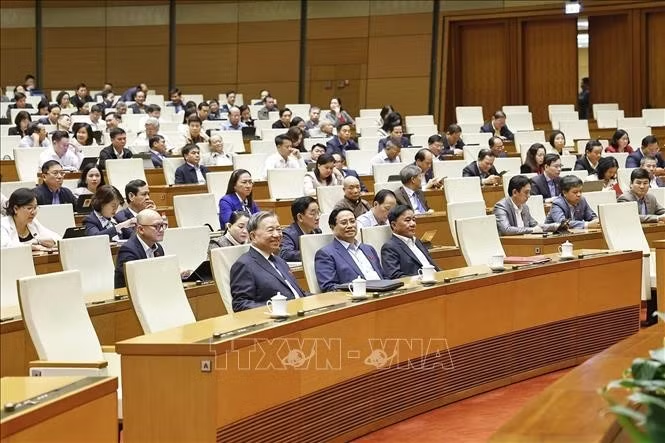
Party General Secretary To Lam, Prime Minister Pham Minh Chinh and delegates attending the session (Photo: VNA)

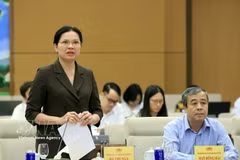
Hanoi (VNA) - Party General Secretary To Lam outlined specific requirements for submitting feedback on the draft documents for the 14th National Party Congress at the ongoing 10th session of the 15th National Assembly on November 4.

The Party General Secretary emphasised that legal and institutional reforms aim to strengthen the rule of law and build a socialist state of the people, by the people, and for the people. However, he noted that challenges remain: while laws may be clear in principle, they are often difficult to enforce in practice, and policies that appear sound on paper can face significant hurdles in local implementation.

He urged to speak frankly about the root causes behind the gap between lawmaking and implementation. He questioned why some laws, decrees, and circulars, painstakingly drafted and comprehensive, still leave grassroots officials hesitant to act, businesses struggling to comply, and citizens confused. He called for clarity on where overlaps occur, where ministries and sectors interpret regulations differently, and where authority is delegated in ways that hold officials accountable for matters beyond their control.

The legal system must be “easy to remember, easy to understand, and easy to implement,” he stressed, adding that the wording of laws should be concise and unambiguous, leaving no room for misinterpretation, abuse, or evasion. Every policy, he said, must have measurable impacts, manageable risks, and, above all, must facilitate rather than complicate procedures. “A good law is not one that reads well but one that works in real life,” he remarked.

Regarding building a rule-of-law socialist State, the Party chief said Vietnam must build a state that is strong but not overreaching; disciplined yet close to the people; decisive in action but humane, persuasive, and open to dialogue. Such orientations, he stressed, must be clearly articulated in the 14th National Party Congress's documents.

For decentralisation, delegation of authority, and organisational structure, he said authority should be delegated to lower levels when they can act more efficiently and closer to the people than higher authorities. However, it must be accompanied by sufficient resources, personnel, tools, and legal safeguards so that officials can act and take responsibility confidently for the public interest, without facing undue personal liability.

Regarding the two-tier local administration model, the Party chief urged delegates to provide concrete feedback on designing the system so that citizens remain close to the authorities, and public service delivery remains seamless.

He stressed the need for a strong link between the Party, the State, the Vietnam Fatherland Front, socio-political organisations, and the people, noting that the Party should lead fully without overstepping, the government should act legally and responsibly, and organisations like the VFF should connect authorities with citizens, who actively participate in supervision and collaboration.

He also highlighted the Party’s leadership and governing role within the legal system and in practical administration, stating that as the ruling party, the Communist Party of Vietnam bears responsibility before the people for the country’s development and residents’ daily lives, setting policies, supervising their implementation, and being accountable for the outcomes.

The documents to be submitted to the 14th National Party Congress cannot simply state “strengthen the Party’s leadership” in general terms, they must clarify that the Party leads to ensure all policies and laws truly serve the people, promote national development, safeguard independence, sovereignty, and territorial integrity, maintain political and social stability, and preserve the great national solidarity, the Party leader said.

The Party also leads efforts to combat narrow-minded sectoral or local interests, group selfishness, corruption, and wastefulness, while protecting those who dare to think boldly, act decisively, and take responsibility for the common good, he added.

He called for a comprehensive review of issues that remain unresolved or insufficiently addressed in the documents, warning that bottlenecks left unattended now would be far more costly to fix in the next five years.

The Party chief underscored that the shared objective of the Party, the National Assembly, the Government, and the people is clear and simple: a sustainably developing nation, a just and humane society, citizens empowered to succeed through their own efforts, and strict accountability for those who violate the law, with no exceptions.

He urged each NA deputy to speak frankly about what they truly observe, the concerns they hold, and the responsibilities they are willing to assume. He expressed confidence that, with their experience, close ties to voters, and personal integrity, they would fulfill this important task with distinction./.

VNA
See more

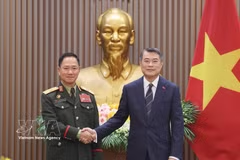
Prime Minister Le Minh Hung (right) and Lao Deputy Prime Minister and Minister of National Defence General Khamlieng Outhakaisone at their meeting on October 13 (Photo: VNA)

Defence, security cooperation is an important pillar of Vietnam–Laos ties: PM

Expressing his pleasure at the positive development of the special relationship between Vietnam and Laos, the PM highlighted defence and security cooperation as an important pillar of the bilateral ties. He praised the two defence ministries and armies for implementing high-level agreements, strengthening mutual trust and helping maintain a peaceful and stable environment conducive to socio-economic development.

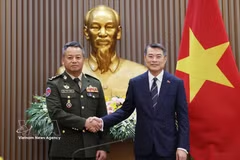
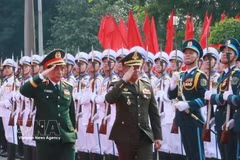
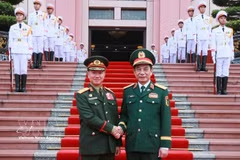
Vietnamese Deputy Prime Minister and Minister of National Defence Gen. Phan Van Giang (left) and his Cambodian counterpart General Tea Seiha review the Honour Guard of the Vietnam People's Army (Photo: VNA)

Vietnam, Cambodia sign defence cooperation plan for 2027

Giang called on agencies and units of the two defence ministries to implement agreed cooperation programmes, focusing on political and ideological education to strengthen political trust, and cooperation between military services and arms. The two sides should step up coordination in border management and protection to build a Vietnam-Cambodia border of peace, cooperation and development.

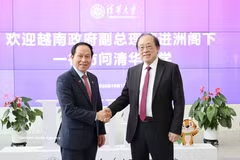
Deputy Prime Minister Le Tien Chau (L) and Professor and Academician Andrew Chi-Chih Yao, Director of Tsinghua University's Institute for Interdisciplinary Information Sciences. (Photo: VNA)

Deputy PM visits China’s Tsinghua University, seeking closer educational cooperation

Tsinghua has worked to implement the Vietnamese and Chinese leaders’ orientations for higher education cooperation. Last year, it admitted 27 Vietnamese students and postgraduates, the highest number to date, all of whom received scholarships. The university also hosted the second Vietnam-China Higher Education Cooperation Forum, helping promote exchanges and cooperation between the two countries’ educational institutions.

Vietnamese Ambassador to Russia and Azerbaijan Dang Minh Khoi (Photo: VNA)

Substantive contributions to CICA help enhance Vietnam's int'l standing: Ambassador

For Vietnam, active participation in and substantive contributions to CICA not only help implement its foreign policy of independence, self-reliance, self-strengthening, multilateralisation and diversification of relations, but also create more favourable conditions for enhancing the country’s standing and contributing to peace, stability, cooperation and sustainable development in the region

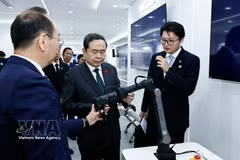
National Assembly President Tran Thanh Man explores AI-powered interactive display products at Guangzhou Shiyuan Electronic Technology Co., Ltd. (CVTE) on October 13, 2026. (Photo: VNA)

NA President visits Beijing Economic-Technological Development Area

The National Assembly was ready to listen to businesses’ legitimate proposals and further improve the legal framework to support foreign enterprises’ long-term and effective operations in Vietnam, ensuring compliance with the law and balancing the interests of all parties, said President of the Vietnamese National Assembly Tran Thanh Man.

Deputy Prime Minister and Minister of National Defence General Phan Van Giang (R) and his Lao counterpart General Khamliang Outhakaysone in Hanoi on October 13. (Photo: VNA)

Vietnam, Laos strengthen defence cooperation

Deputy Prime Minister and Minister of National Defence General Phan Van Giang held talks with his Lao counterpart General Khamliang Outhakaysone in Hanoi on October 13, focusing on measures to deepen bilateral defence ties and advance strategic connectivity between the two countries.

Vietnam values ties with US film, television, digital content studios

Vietnam values ties with US film, television, digital content studios

The Motion Picture Association (MPA) of the US welcomes Vietnam’s efforts to protect IP rights, including improvements to the legal framework and action against violations. The association is ready to work with Vietnam, share information and bolster its ability to protect IP rights, helping build an attractive and reliable environment for foreign firms.

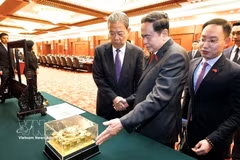
Vietnamese National Assembly (NA) President Tran Thanh Man (centre) and Chairman of the Standing Committee of the National People’s Congress (NPC) of China Zhao Leji exchange gifts in Beijing on October 12. (Photo: VNA)

Vietnam, China step up legislative cooperation, experience sharing

Vietnamese National Assembly (NA) President Tran Thanh Man and Chairman of the Standing Committee of the National People’s Congress (NPC) of China Zhao Leji called for more balanced and sustainable trade, high-quality investment, modern and coordinated railway connectivity, and stronger cooperation in science and technology.