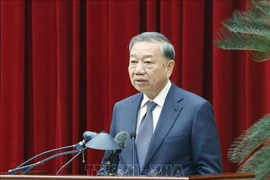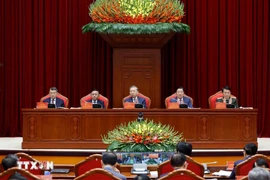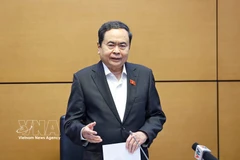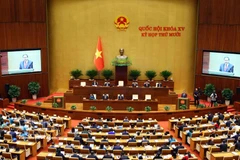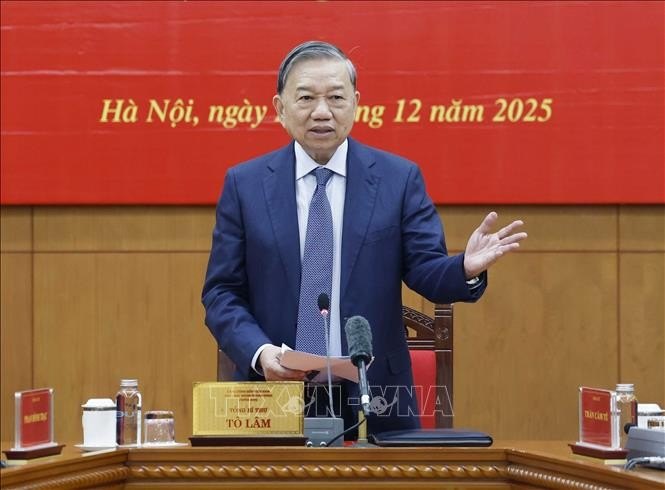
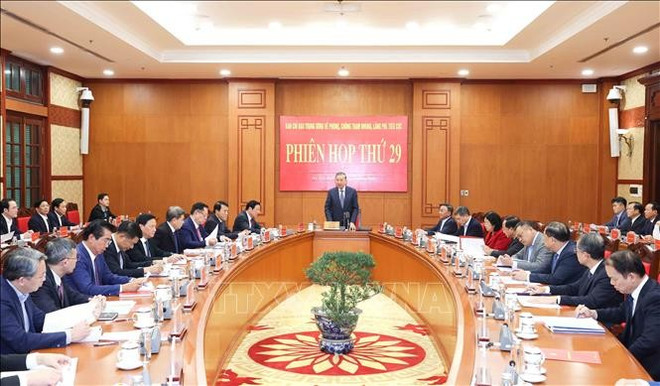
Hanoi (VNA) – Party General Secretary To Lam, head of the Central Steering Committee for Prevention and Control of Corruption, Wastefulness, and Negative Phenomena, on December 25 chaired the committee’s 29th meeting to review its 2025 performance and discuss its work programme for 2026.
The committee agreed that in the past year, efforts against corruption, wastefulness, and negative practices continued to be implemented in a strong, resolute, and comprehensive manner, with many new approaches producing clear results, fostering broad consensus and unity among officials, Party members, and the public.
During the year, the Party Central Committee’s Politburo and Secretariat issued more than 130 documents on Party building, the political system, and corruption, wastefulness, and negative practice prevention and combat. The National Assembly and the Government amended and promulgated 89 laws and more than 900 decrees, directives, and resolutions, focusing on addressing loopholes, shortcomings, inconsistencies, and overlaps in legal documents, and improving institutions governing state apparatus operations under the three-tier government model to promote socio-economic development.
Ministries, sectors, and localities issued nearly 12,000 guiding documents to implement legal regulations on socio-economic management, contributing to enhanced effectiveness in preventing corruption, wastefulness, and negative practices.
Efforts to detect and handle corruption, wastefulness, and negative practices were further strengthened. Competent agencies focused on inspection, supervision, investigation, and the thorough handling of serious and complex cases of public concern. Since the beginning of the year, Party committees and inspection commissions at all levels have disciplined more than 330 Party organisations and 9,600 Party members. The Party Central Committee and its Politburo, Secretariat, and Inspection Commission disciplined 23 officials under Party Central Committee management, including six prosecuted cases.
Asset recovery work continued to show positive progress. During the year, judicial authorities temporarily seized, froze, and recovered assets worth over 1.27 trillion VND (48.25 million USD), along with many other valuable assets.
Regarding key tasks for 2026 - the first year of implementing the Resolution of the 14th National Party Congress, the Steering Committee emphasised that efforts against corruption, wastefulness, and negative practices must be carried out more resolutely, effectively, and sustainably in line with the Congress’s Resolution.
Key priorities include promptly reviewing and addressing loopholes, inconsistencies, and overlaps in Party regulations and State laws; amending laws related to corruption and wastefulness prevention; implementing the National Strategy on Corruption and Wastefulness Prevention; finalising a unified anti-corruption evaluation index nationwide; and developing a new resolution of the Party Central Committee on Prevention and Control of Corruption, Wastefulness, and Negative Phenomena for the new period.
The Steering Committee will focus on thoroughly handling serious and complex cases of public concern; preventing the recurrence of past violations; avoiding corruption and wastefulness in national and local key projects; completing investigations and handling of 21 cases and five incidents under its supervision in 2026; and resolving delayed, long-standing projects, especially ten key projects assigned to the Government Party Committee.
Emphasis was placed on improving asset recovery efficiency through synchronised measures at all procedural stages; encouraging voluntary compensation; strengthening international cooperation in fugitives’ capture and overseas asset recovery; building a culture of integrity, transparency, and accountability; accelerating digital transformation; and advancing data-based supervision and inspection.
The Steering Committee also called for strengthened power control, enhanced efficiency of the two-tier local government system, strict handling of petty corruption, increased oversight of officials’ exercise of power, and strict handling of harassment and negative practices affecting citizens and businesses.
The role of elected bodies, the Vietnam Fatherland Front and its member organisations, the press, and the public in supervision was emphasised, alongside continued organisational consolidation and improved coordination among anti-corruption agencies./.