Path to EU widened for Vietnamese garments-textiles

Vietnam’s garment-textile sector is expected to expand its markets once the Vietnam-EU Free Trade Agreement (EVFTA) comes into force in early 2018.
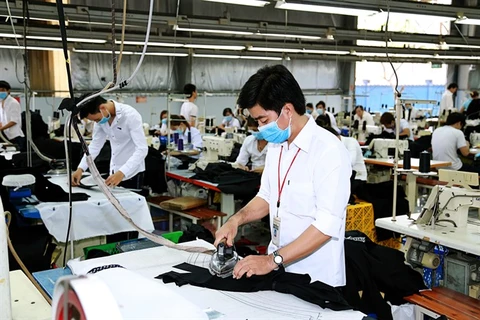
Path to EU widened for Vietnamese garments-textiles ảnh 1Illustrative photo (Source: VNA)
Hanoi(VNA) – Vietnam’s garment-textile sector is expected to expand its markets oncethe Vietnam-EU Free Trade Agreement (EVFTA) comes into force in early 2018, reducingtax on Vietnamese garments and textiles exported the EU to zero percent overthe next seven years.  

To make use ofopportunities offered by the pact, experts suggested local enterprises prepareto meet rules set by the deal, especially those regarding product origin.

Europe is apromising market for Vietnamese garments and textiles with export turnoverreaching 3.5 billion USD in 2016, just behind the US.

Truong Van Cam, VicePresident of the Vietnam Textile and Apparel Association (VITAS), describedrules of origin as the most important thing in the agreement.

He said,Vietnamese garment-textile firms must ensure that their products originate fromVietnam or use materials imported from the EU or the bloc’s trade partners.

The localgarment-textile industry is still heavily dependant on imported materials ,mostly from China, the Republic of Korea (RoK) and Taiwan (China), with thefabric sector, for example, importing up to 86 percent of materials forproduction and export.

VITAS DeputySecretary General Vu Thi Phuong suggested domestic enterprises review theirinvestment and business strategies to catch up with the transformation from thecut-make-and-trim production model to free-on-board and original designmanufacturing (ODM) practices.

According toPhuong, apart from strict rules, the agreement also offers an open mechanism tothe Vietnamese side, saying that products using materials from the EU’s partnercountries will also enjoy the tariff breaks.

Under theagreement, fabrics from the RoK, which has a free trade agreement with the EU, areconsidered as having clear product origin and are eligible for the taxreduction.

VITAS statisticsshow that the garment-textile sector spends more than 10 billion USD each yearon importing fabric, with more than half from China, about 18 percent from theRoK and 15 percent from Taiwan (China).

If Vietnamesefirms continue to import materials from China, they will find it hard tobenefit from the EVFTA, the association said.

European experts proposedlocal enterprises learn the rules and the roadmap for tariff reductions inorder to better access the market.-VNA
VNA

See more

A quick report from data analytics platform Metric shows the number of active sellers across Shopee, TikTok Shop, Lazada and Tiki has dropped to just over 602,000, marking a year-on-year decline of more than 7%. (Illustrative photo: VNA)

Higher marketplace fees weigh on online sellers

Analysts identify rising operational costs as the key factor behind the exodus. In 2025, platforms simultaneously rolled out fee hikes ranging from 10–15%, significantly increasing the financial burden on merchants.

The latest approvals underscore the growing presence of Vietnamese rice in one of the world’s most demanding markets. (Photo: VNA)

Fragrant rice deepens EU market presence

Although the volume of individual shipments remains relatively modest, industry experts say the steady flow of exports reflects stable demand in the EU for high-quality rice.

Promoting stronger foreign direct investment (FDI) inflows is considered an important solution to help drive economic growth. (Photo: VNA)

Vietnam emerges as hub for high-quality FDI

Vietnam is gradually becoming a strategic destination for high-quality global FDI. Investment flows are increasingly directed toward sectors such as high-tech manufacturing, electronics, digital infrastructure, modern logistics, and industries that are closely linked to global supply chains.

Shrimp processing for export at Huy Nam company, An Giang province. (Photo: VNA)

Fisheries sector proactively adjusts to emerging challenges

In addition to food safety regulations, the US continues to closely monitor the origin of imported seafood through the Seafood Import Monitoring Programme (SIMP) administered by the National Oceanic and Atmospheric Administration (NOAA). Requirements linked to the Marine Mammal Protection Act (MMPA) are also a major concern for businesses.

Pham Van Cong, Chairman of the Vietnam Cashew Association, speaks in a conference reviewing the industry’s 2025 performance and deploying procurement plans for 2026 in HCM City on March 13. (Photo: VNA)

Cashew sector braces for challenges in 2026 amid global uncertainties

Vietnam’s cashew industry recorded export turnover of about 5.5 billion USD in 2025, the highest level ever. He noted that the result reflects the industry’s remarkable development, dynamism and timely adaptation to complex and unpredictable challenges both domestically and globally.