PetroVietnam: 45-year mission of oil exploration

Throughout its 45-year history of operation, the Vietnam Oil and Gas Group (PetroVietnam) has faced numerous difficulties and challenges, but with the trust and support of the Party and State, the group has weathered all storms to fulfill its mission and contribute greatly to national socio-economic development.
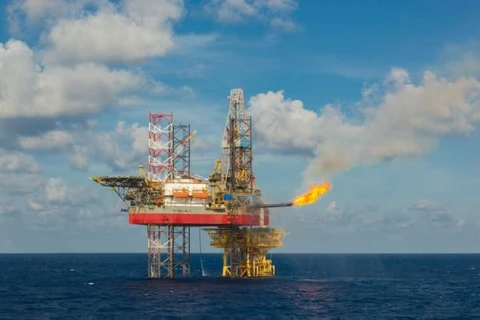
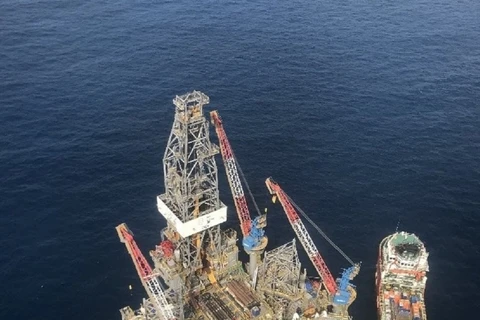
PetroVietnam: 45-year mission of oil exploration ảnh 1Workers change shifts on Chim Sao platform (Photo courtesy of PetroVietnam)

Hanoi, (VNA) – Throughout its 45-year history of operation, the Vietnam Oil and Gas Group (PetroVietnam) has faced numerous difficulties and challenges, but with the trust and support of the Party and State, the group has weathered all storms to fulfill its mission and contribute greatly to national socio-economic development.

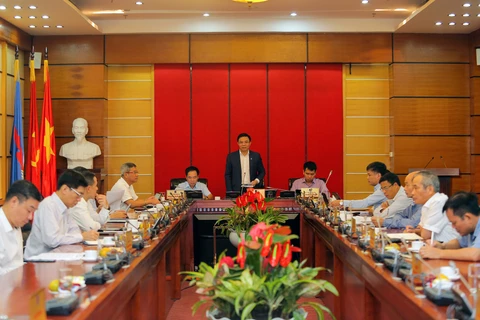
Less than three months after the liberation of the south and re-unification of the country in 1975, on July 20, 1975, the Politburo issued Resolution 244-NQ/TW on oil exploration in the country during a meeting in Sai Gon. Just one month later, the National Assembly’s Standing Committee approved Decision 33-QN/QH/K5 on the establishment of a Vietnam Oil and Gas General Department.

On September 3, 1975, the Government Council issued Decree 170/CP on setting up the Vietnam Oil and Gas General Department, which turned a new page in the history of Vietnam’s oil and gas industry, ending the separate operation of several organisations in the Geology General Department and Chemicals General Department.

Later, the Party, National Assembly and Government have issued numerous resolutions to orientate and create a corridor for the development of the oil and gas sector.

The group has grown up from almost zero, and have made the impossible possible. Behind each of its major projects such as the Dung Quat refinery, the Ca Mau Gas-Power-Fertiliser Complex or the Nghi Son refinery and petrochemical complex, there were untold stories about uncountable difficulties and snares that the contingent of engineers and workers in the industry have surmounted.

During the most difficult times of the group, such as when oil flows from oil wells of the Vietsovpetro joint venture reduced to an unimaginable level in 1988, leaders of the Party, State and Government still kept their trust in the oil and gas sector and encouraged the sector to seek solutions. The finding of oil in sedimentary rock not only saved the Vietsovpetro joint venture but also opened up a new chapter for oil exploration and exploitation in waters under Vietnam’s sovereignty and jurisdiction.

Many other projects, like the Phu My fertilizer plant, the Dinh Co gas processing plant, the Ca Mau Gas-Power-Fertiliser Complex and the Hua Na and Dak-dring hydro-power plants, also faced protest and doubt. But with the trust and support of the Party and State, they have been completed and put into operation, contributing greatly to national economic development.

PetroVietnam: 45-year mission of oil exploration ảnh 2An overview of the Ca Mau Gas-Power-Fertiliser Complex (Photo courtesy of PetroVietnam) 

PetroVietnam has become the core of the national oil and gas industry. It has developed the full chain of the industry from upstream to midstream and downstream. The industry’s operation also serves as a driver of development in many localities. Major products of PetroVietnam, such as electricity, fertilizer, petrol, oil and gas, play an important role in ensuring power and food security for the country, laying a solid foundation for other economic sectors to develop.

Since the beginning of 2020, the group has struggled with the twin crises – impacts of the COVID-19 pandemic and declining oil prices. However, it has managed to maintain the pace of production and ensure the supply of strategic commodities such as gas, electricity, fertiliser, and petrol for the national economy. The group also posted a profit of more than 10 trillion VND (430 million USD) and paid more than 38 trillion VND (1.63 billion USD) to the State budget.

PetroVietnam: 45-year mission of oil exploration ảnh 3Maintenance work at Dung Quat refinery (Photo courtesy of PetroVietnam ) 

The oil and gas sector also had good news recently, which was the discovery of a large oil and gas reserve at Ken Bau well in Block 114, in Song Hong Basin, offshore Vietnam’s northern continental shelf, about 65km from Quang Tri province, and 86km from Da Nang city in the central region. The finding is expected to open up more opportunities to attract investment in exploitation and processing, the gas power industry, and oil and gas services in the time to come./.
VNA

See more

Representatives of Central Retail Vietnam and Lotte Plaza Market sign a distribution cooperation agreement at the networking event in Ho Chi Minh City on March 13. (Photo: VNA)

Vietnamese firms step up cooperation with international distribution chains

Connecting Vietnamese businesses with international distribution networks has been a key component of government-led trade promotion programmes for many years, which are designed to help domestic companies place goods directly into global retail systems rather than exporting solely through intermediaries.

Direct Hanoi–Amsterdam flights by Vietnam Airlines to begin on June 16. (Photo: Vietnam Airlines)

Vietnam Airlines to launch direct Hanoi–Amsterdam service on June 16

Under the plan, the Hanoi–Amsterdam route will commence operations on June 16, 2026, with an expected frequency of three return flights per week using modern wide-body Airbus A350 aircraft. This will be the first direct air link between Vietnam and the Netherlands, helping to shorten travel time and enhance connectivity between Vietnam and one of Europe’s key economic, logistics and aviation transit hubs.

Farmers harvest the 2025 Winter–Spring rice crop in An Giang province. (Photo: VNA)

An Giang accelerates export shift to meet green consumption trends

To enhance competitiveness, authorities are assisting businesses in obtaining globally recognised certifications such as GlobalG.A.P., Organic and HACCP, enabling key exports including rice, seafood and clean agricultural products to strengthen their position in global markets, according to Quang Xuan Lua, Director of the An Giang Centre for Trade and Investment Promotion.

Motorcycle riders refill their vehicles at a petrol station in Hanoi (Photo: VNA)

E5 RON92 biofuel price falls in latest adjustment

Since the beginning of this year, domestic fuel prices have undergone 14 adjustments, including five decreases and nine increases for RON95 and six declines and eight hikes for E5 RON92. Meanwhile, diesel price has fallen three times and risen 11 times.

A French customer is tasting Vietnamese lychee. (Photo: VNA)

Vietnamese agricultural products boost global brand recognition

Vietnam aims to achieve about 74 billion USD in agro-forestry-fishery export turnover this year. Expanding value-added products, improving quality standards and strengthening brand building, especially through international supermarket systems, will be key to enhancing the competitiveness and global recognition of Vietnamese agricultural products.

An apartment building developed by BCONS in Binh Duong (Photo: VNA)

Resolution 68 boosts businesses entering market

By the end of 2025, Vietnam had more than one million active enterprises. In the first two months of 2026, about 64,500 enterprises entered or re-entered the market, up 29.4% year-on-year, averaging 32,200 newly established or returning businesses per month.

A Vinh Long official introduces signature local products to Korean guests. (Photo: VNA)

Vinh Long courts Korean investment in key sectors

Vice Chairman of the provincial People’s Committee Nguyen Truc Son vowed to accompany investors and provide them with optimal conditions, while building a transparent and stable business environment to secure long-term engagement from foreign enterprises, particularly those from Daejeon.

Delegates at the launching ceremony (Photo: VNA)

Digital platform on overseas market development launched

With Vietnam’s network of 64 trade offices overseas, Deputy PM Son noted that connecting them through a modern digital platform could help establish a unified national trade information system that operates efficiently, transparently and with strong forecasting capacity.

The Government’s issuance of Decree No. 72/2026/ND-CP revising preferential import tariffs on several petrol products and raw materials is a timely move to diversify supply sources. (Photo: VNA)

Fuel import tariff cuts strengthen Vietnam’s energy resilience: experts

Economic expert Dinh Trong Thinh said revising fuel import tariffs helps diversify supply sources and reduce reliance on traditional markets, thereby strengthening Vietnam’s ability to cope with potential global supply shocks. Ensuring access to multiple energy sources is also vital for safeguarding national energy security, he added.

Leaders of Dak Lak province inspect IUU fishing prevention and control efforts at Phu Lac fishing port, Hoa Hiep ward. (Photo: daklak.gov.vn)

Dak Lak readies for EC mission on anti-IUU fishing efforts

Dak Lak province is completing preparations for an upcoming European Commission (EC) inspection on efforts to combat illegal, unreported and unregulated (IUU) fishing, with a view to having the fisheries “yellow card” removed.

Vietnamese Ambassador to Argentina Ngo Minh Nguyet speaks at the event. (Photo: VNA)

Vietnam, Argentina promote trade, investment cooperation

On relations with South America, Nguyet noted that in December 2025, Vietnam and the Southern Common Market (MERCOSUR) announced the launch of negotiations for a Preferential Trade Agreement (PTA). She expressed her hope that the agreement will be signed soon, thereby further boosting trade and investment between Vietnam and MERCOSUR member states, including Argentina.

Customers buy petrol at a Petrolimex petrol station in Tran Hung Dao ward, Hung Yen province. (Photo: VNA)

PM orders stronger measures to ensure stable petrol supply

The MoIT was instructed to direct key petrol producers and traders to proactively develop supply plans to guarantee adequate fuel provision for distribution systems, maintain regular sale operations, and sell products at listed prices. It must also closely monitor developments in global and domestic petrol markets and adopt appropriate management measures when necessary.