PM attends 28th ASEAN–Japan Summit

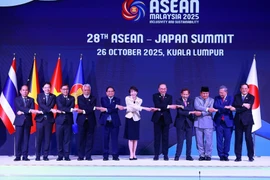
At the end of the 28th ASEAN–Japan Summit in Malaysia, the ASEAN and Japan leaders adopted the Joint Statement on Further Promotion and Implementation of the ASEAN Outlook on the Indo-Pacific (AOIP).

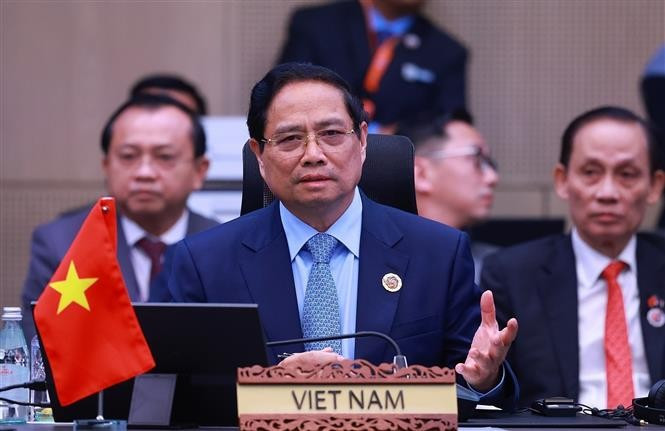
Prime Minister Pham Minh Chinh addresses the 28th ASEAN–Japan Summit in Malaysia (Photo: VNA)

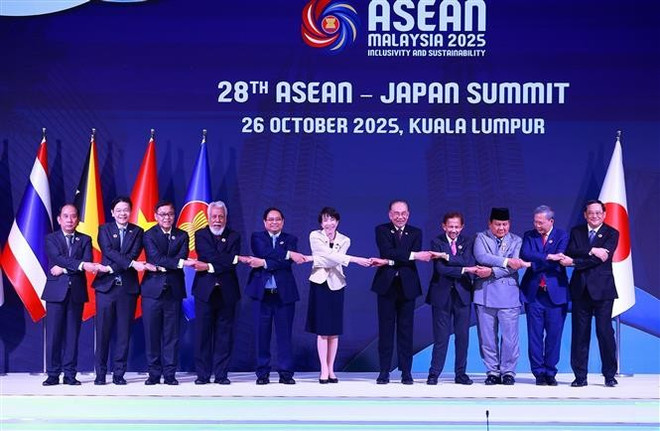
Hanoi (VNA) – Prime Minister Pham Minh Chinh joined leaders of other ASEAN member states and Japanese Prime Minister Sanae Takaichi at the 28th ASEAN–Japan Summit on October 26 afternoon.

In his remarks, Prime Minister Chinh called for enhanced economic connectivity towards a green, inclusive, and comprehensive transformation in the digital era, urging both sides to soon upgrade the ASEAN–Japan Free Trade Agreement. He highlighted the need to prioritise cooperation in digital and green economies, sustainable supply chains, and early completion of the ASEAN–Japan Air Services Agreement.

He also suggested stepping up cooperation in education, training, health care, science and technology, and environmental protection to narrow development gaps, especially in high-quality human resources training, digital and AI application, and preventive healthcare capacity.

The PM further proposed promoting vibrant cultural exchanges and requested Japan to enhance technology transfer and human resources training in nuclear power and safety for ASEAN countries.

Stressing the importance of maintaining peace, security, and stability in the region, including the peaceful settlement of disputes, particularly maritime ones, in accordance with international law and the 1982 United Nations Convention on the Law of the Sea (UNCLOS), the Vietnamese leader affirmed ASEAN’s readiness to play a constructive role in and facilitate dialogue among relevant parties, including through ASEAN-led mechanisms, to promote lasting peace and stability on the Korean Peninsula.
vna-potal-thu-tuong-tham-du-hoi-nghi-cap-cao-asean-nhat-ban-lan-thu-28-8364971.jpg
Prime Minister Pham Minh Chinh and leaders of ASEAN countries, along with Japanese Prime Minister Sanae Takaichi, attend the 28th ASEAN-Japan Summit. (Photo: VNA)

ASEAN leaders emphasised Japan as one of the bloc’s oldest and most reliable partners. Bilateral cooperation has grown substantively and dynamically, becoming a model of a practical and mutually beneficial Comprehensive Strategic Partnership. To date, ASEAN and Japan have completed 108 out of 130 action lines under the Joint Vision Statement on friendship and partnership.

Japan is currently ASEAN’s fourth-largest trading partner and fifth-largest foreign investor, with two-way trade reaching 236.6 billion USD and investment totalling 17.5 billion USD in 2024. Japan’s regional cooperation initiatives, such as Co-Creation, the Asia Zero Emissions Community (AZEC), and the Asian Energy Transition Initiative (AETI), have brought tangible benefits to people of both sides.

Looking ahead, ASEAN and Japan will prioritise cooperation in digital transformation, innovation, clean energy, education, health care, cybersecurity, climate change response, food security, and sustainable agriculture, leveraging the ASEAN–Japan Integration Fund (JAIF 3.0) to support project implementation.

ASEAN countries also expressed their wish to work with Japan to upgrade the ASEAN–Japan Comprehensive Economic Partnership Agreement (AJCEP) and effectively implement the Regional Comprehensive Economic Partnership (RCEP). They called on Japan to support ASEAN’s efforts to implement the Digital Economy Framework Agreement (DEFA), realise the ASEAN Power Grid (APG), and push for the effective operations of the ASEAN Centre for Public Health Emergencies and Emerging Diseases (ACPHEED) and the Regional Reserve of Medical Supplies. They also urged cooperation on the fifth phase of the Initiative for ASEAN Integration (IAI) Work Plan (2026–2030), as well as subregional collaboration and narrowing development gaps within ASEAN.

The leaders reaffirmed their commitment to upholding international law and a rules-based multilateral trading system, stressing the importance of dialogue, cooperation, and trust-building, along with peaceful dispute settlement based on international law, to sustain regional peace, security, and stability.

In her remarks, the Japanese Prime Minister affirmed that Japan was the first country to support and will continue to support ASEAN’s Outlook on the Indo-Pacific (AOIP). She emphasised Japan’s commitment to aligning its major strategies and cooperation programmes with the ASEAN Community Vision 2045, while working with the bloc to further advance the three key pillars of ASEAN–Japan cooperation: peace and stability, socio-economic creation for the future, and a “heart-to-heart” partnership for future generations.

PM Sanae Takaichi proposed further strengthening cooperation in specific areas such as maritime security, cybersecurity, combating transnational crime, developing a safe, secure, and reliable AI ecosystem, disaster prevention, and the promotion of education and training.

At the end of the summit, the ASEAN and Japan leaders adopted the Joint Statement on Further Promotion and Implementation of the ASEAN Outlook on the Indo-Pacific (AOIP)./.
VNA

See more

Professor Mi Liang, Director of the Centre for Southeast Asian Studies at Beijing Foreign Studies University of China. (Photo: VNA)

14th National Party Congress opens new stage in Vietnam’s growth: Chinese scholar

The professor noted that summarising four decades of experience with Doi Moi is essential for further refining Vietnam’s development model in the coming period. He also suggested that Vietnam should continue strengthening anti-corruption efforts and preventing negative practices and moral degradation among officials to ensure the sustainability of the reform process.

Prime Minister Pham Minh Chinh speaks at a meeting with ministries, agencies and the energy security task force in Hanoi on March 10, 2026. (Photo: VNA)

PM orders no energy shortages under any circumstances

Pham Minh Chinh chaired a meeting with ministries, agencies and the national energy security task force to discuss measures to ensure a proactive energy supply for socio-economic development and support double-digit growth targets amid mounting tensions in the Middle East affecting global energy supply chains.

Vietnamese Minister of Foreign Affairs Le Hoai Trung (C) holds phone talks with his Korean counterpart Cho Hyun on March 10 (Photo: VNA)

Vietnam, RoK seek to boost all-around cooperation

Vietnam consistently attaches great importance to its relationship with the RoK and wishes to further deepen bilateral cooperation in a substantive and effective manner across fields, Minister of Foreign Affairs Le Hoai Trung stated.

Khanh Hoa Party Secretary Nghiem Xuan Thanh inspects election preparations at Polling Station No. 2 in Bac Nha Trang ward. (Photo: VNA)

Khanh Hoa gears up for elections, facilitates voting for tourists

Thanh requested a thorough review of voter lists to ensure all eligible voters can exercise their rights. Polling teams were asked to establish advisory groups to assist voters when needed. He also stressed the need to make arrangements so that tourists visiting Nha Trang can cast their ballots in accordance with regulations.

Party General Secretary To Lam speaks at the conference to announce the Politburo’s decision to establish the Central Theoretical Council for the 2026–2031 tenure. (Photo: VNA)

Central Theoretical Council for 2026-2031 term established

The Party chief noted that in recent years the council has made significant contributions to the Party’s theoretical research and development, particularly in clarifying the path toward socialism in Vietnam and contributing to the preparation of major Party documents, including those presented at national Party congresses.

An overview of the press briefing in Hanoi on March 10 to introduce the 10th Vietnam–China Border Defence Friendship Exchange. (Photo: VNA)

Tenth Vietnam–China border defence friendship exchange to feature innovations

Scheduled for March 18–19 in Quang Ninh province of Vietnam and China’s Guangxi Zhuang Autonomous Region, the exchange aims to realise high-level common perceptions between the two Parties and countries on deepening substantive defence cooperation, strengthening friendship and solidarity, and promoting practical collaboration among border protection forces, local authorities and people in border areas, thereby contributing to building a border of peace, friendship, stability, cooperation and development.

Professor Carl Thayer from the Australian Defence Force Academy at the University of New South Wales speaks to the Vietnam News Agency (VNA)'s resident correspondent in Sydney. (Photo: VNA)

Australian expert hails performance of 15th NA, People’s Councils at all levels

During the 15th term, NA deputies raised a number of critical issues with government ministers during question time regarding environmental protection, land administration, and food safety. Deputies were particularly engaged during discussions on amendments to the 2013 Constitution and the Law on the Organisation of Local Administration.

General Nguyen Tan Cuong (right), Chief of the General Staff of the Vietnam People's Army and Deputy Minister of National Defence, presents a souvenir to Senior Lieutenant General Saichay Kommasith, Chief of the General Staff of the Lao People’s Army and Deputy Minister of National Defence of Laos, at their meeting on March 9. (Photo: qdnd.vn)

Vietnam, Laos strengthen defence cooperation

General Nguyen Tan Cuong proposed both sides continue effectively implementing the agreed cooperation areas, including holding high-level delegation exchanges, maintaining consultation and dialogue mechanisms, and coordinating to successfully organise the annual meeting of the defence ministers of Vietnam, Laos and Cambodia.