PM meets with OECD Secretary-General in Davos

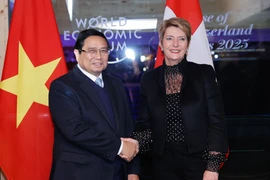
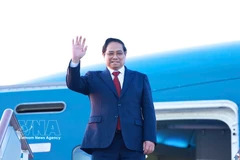
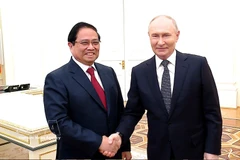
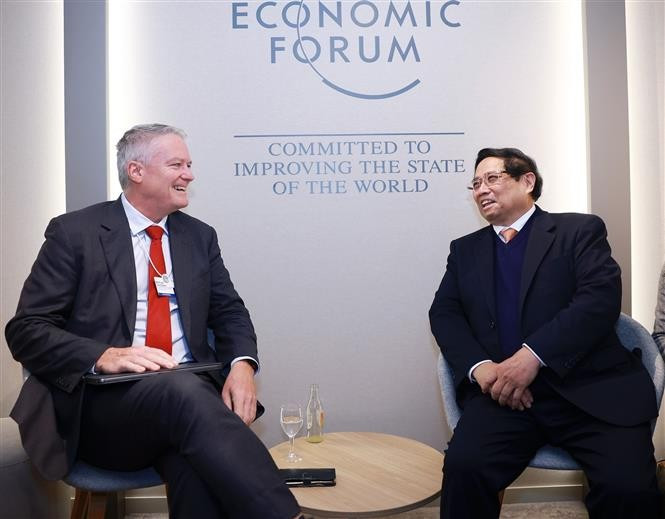
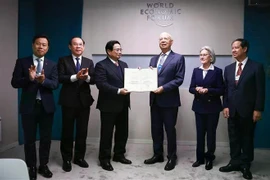
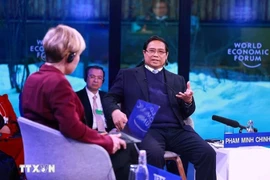
Prime Minister Pham Minh Chinh met with Secretary-General of the Organisation for Economic Cooperation and Development (OECD) Mathias Cormann in Davos, Switzerland on January 22 (local time) as part of his participation in the 55th Annual Meeting of the World Economic Forum (WEF) here.

Prime Minister Pham Minh Chinh (L) meets with Secretary-General of the Organisation for Economic Cooperation and Development (OECD) Mathias Cormann in Davos, Switzerland on January 22 (local time) (Photo: VNA)

Davos (VNA) - Prime Minister Pham Minh Chinh met with Secretary-General of the Organisation for Economic Cooperation and Development (OECD) Mathias Cormann in Davos, Switzerland on January 22 (local time) as part of his participation in the 55th Annual Meeting of the World Economic Forum (WEF) here.

Expressing gratitude for the OECD’s support during Vietnam’s co-chairmanship of the Southeast Asia Regional Programme, fight against COVID-19, and policy consultations, PM Chinh praised the strong partnership between Vietnam and the OECD.

He noted that the two Southeast Asia Ministerial Conferences held in Hanoi contributed to bring the OECD and the region closer together.

Outlining Vietnam's strategic development goals, the Vietnamese Government leader said that, building on 40 years of Doi Moi” (Renewal), 2025 will mark the start of a new era for Vietnam to rise up for a prosperous and developed nation by 2045.

To enhance cooperation between Vietnam and the OECD, the PM urged the Secretary-General to direct the organisation's specialised committees to share expertise, provide policy advice, and assist Vietnam in boosting its competitiveness towards aligning with the OECD’s global governance standards.

He also called on the organisation to support Vietnam in preparing and publishing key economic reports, which will serve as essential references for long-term policy formulation.

PM Chinh suggested that the OECD consider Vietnam’s early accession to the organisation and facilitate the inclusion of Vietnamese professionals within its Secretariat.

He affirmed Vietnam will meet all necessary procedures, standards, and conditions for membership, as part of its efforts to deepen global economic integration and make greater contributions to international peace, cooperation, and development.

For his part, Cormann recognised Vietnam as a dynamic and fast-growing economy, playing an increasingly significant role in Southeast Asia - a major driver of global economic growth. The OECD, he said, is keen to strengthen its collaboration with Vietnam and stands ready to provide support through policy advice and assistance, including in Vietnam’s pursuit of OECD membership.

He agreed to facilitate Vietnam’s participation in the OECD Declaration on International Investment and Multinational Enterprises. He also committed to enhancing connections between the OECD’s specialised committees and Vietnam’s ministries and agencies, to further the effectiveness of their cooperation.

PM Chinh invited Cormann to the 4th P4G (Partnering for Green Growth and the Global Goals 2030) Summit, scheduled for April, and the 16th UN Conference on Trade and Development (UNCTAD16)’s ministerial meeting in October, both to be held in Vietnam.

He also confirmed that Vietnam will send a representative to the OECD Ministerial Council Meeting in June, demonstrating its strong commitment to and desire for closer collaboration with the organisation./.
VNA

See more

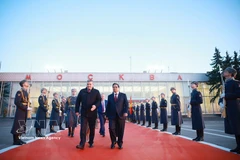
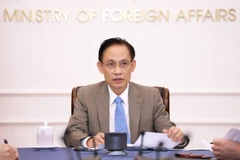
Vietnamese Minister of Foreign Affairs Le Hoai Trung (Photo: VNA)

Vietnamese, Lao foreign ministers hold online talks

The two ministers agreed to maintain close coordination in the time ahead and to expand cooperation under the new framework and orientation, underscoring the significance of the two countries’ “great friendship, special solidarity, comprehensive cooperation, strategic cohesion”.

State President Luong Cuong (fourth from left, first row) and newly-appointed foreign ambassadors in Hanoi on December 12, 2025. (Photo: VNA)

State President receives newly-appointed foreign ambassadors

Receiving Egyptian Ambassador Hany Mostafa Mohamed Mostafa Hassan, President Cuong affirmed that Vietnam highly evaluates Egypt’s role, position, and contributions to regional peace and stability. He also congratulated the African country on its achievements in implementing the 2030 Vision.

An overview of the seminar on the Party’s leadership in ensuring macroeconomic stability, renewing the growth model, restructuring the economy and promoting international integration (Photo: VNA)

Vietnam, Cuba exchange theoretical views on Party’s leadership in macroeconomic stability

The two sides explored in depth the Party’s role in leadership, orientation, oversight and strategic coordination in economic management; approaches to implementing economic restructuring programmes alongside the renewal of the growth model; measures to respond to global economic volatility, inflationary pressures and shifts in global trade; and the building of effective strategic advisory bodies to ensure the Party’s comprehensive leadership in a changing context.

Vietnam’s Ambassador to Australia Pham Hung Tam (Photo: VNA)

Australia–Vietnam Policy Institute serves as bridge for bilateral relations

Established in 2022, AVPI serves as a forum for exchanging ideas among businesses, government agencies, non-profits, universities, and scholars in Australia on Vietnam. The institute acts as a platform for policy dialogue, focusing on research and insights on strategic relations and bilateral economic ties.

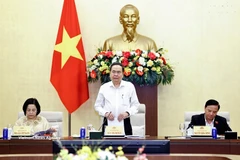
General Secretary and Chairman of the NA Office Le Quang Minh chairs the press conference announcing the results of the NA's 10th session (Photo: VNA)

10th session helps strengthen public trust in personnel work, NA’s supreme oversight

Personnel consolidation carried out at the NA's 10th session helps ensure continuous, unified, effective, and efficient leadership of the state apparatus; guarantee smooth and uninterrupted direction and governance; and prevent any leadership gaps in critical areas. All positions elected or approved by the legislature meet the key criteria required within the organisational structure.