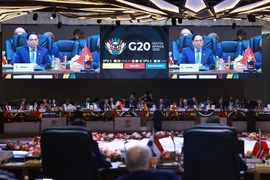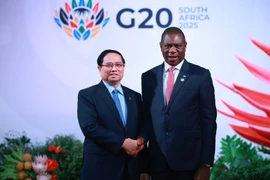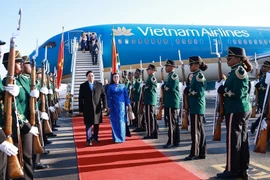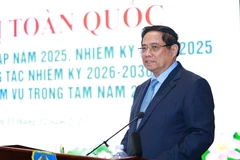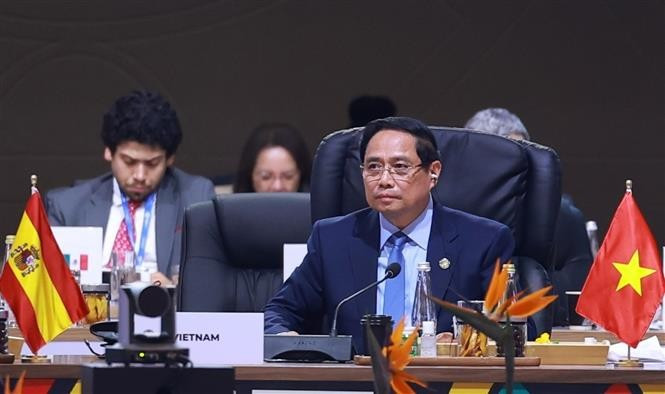
Johannesburg (VNA) - Prime Minister Pham Minh Chinh delivered an important address at the opening ceremony of the G20 Summit in Johannesburg, South Africa, on November 22 in which he proposed three strategic assurances to promote inclusive and sustainable growth and ensure that no one is left behind.
First, to ensure stability as a basis for development in international relations, global politics and the world’s macro-economy, the PM proposed that the G20 take the lead in building mechanisms for international cooperation grounded in mutual respect, seeking solutions to conflicts and creating a favourable environment for development.
He suggested that the G20 coordinate policies to prevent systemic risks and respond to crises; limit trade barriers and reduce supply-chain fragmentation; and advance debt-conversion initiatives to help safeguard global macro-economic stability.
Second, to ensure a rules-based multilateral trading system centred on the WTO and a balanced, transparent and open global financial architecture with equal access to science, technology and development finance, he proposed that the G20 strengthen cooperation; avoid politicising science and trade; support developing countries through fair and mutually beneficial trade policies; enhance digital-transition capacity; and promote comprehensive WTO reform to improve its effectiveness.
Third, to build flexible and effective global governance and foster an enabling ecosystem for development in the digital and green transition era, he called for stronger dialogue within the G20 and multilateral mechanisms to shape a governance framework that harmonises economic, social and environmental goals, balances present and future development needs and reflects the interests of all economies. He urged deeper cooperation on artificial intelligence, climate change response, disaster prevention and public health.
The Vietnamese leader stressed that the world is undergoing profound and unprecedented changes with global, comprehensive and human-centred implications. In this context, he underlined, global governance should aim at the core objective of maintaining peace, stability and promoting inclusive, comprehensive development.
The foremost principle is to ensure equality and mutual benefit, grounded in international law and norms, while upholding solidarity, cooperation and dialogue to generate strength, deliver tangible benefits and reinforce trust. The overarching approach must be people-centred, nationwide, comprehensive and global in scope, with humanity placed firmly at its heart, he stated.
PM Chinh reaffirmed that Vietnam stands ready to cooperate actively, equally and for mutual benefit with all countries, the G20 and the broader international community for a peaceful, prosperous and sustainable world where development is inclusive and no one is left behind. His remarks were welcomed and appreciated by many participating countries.
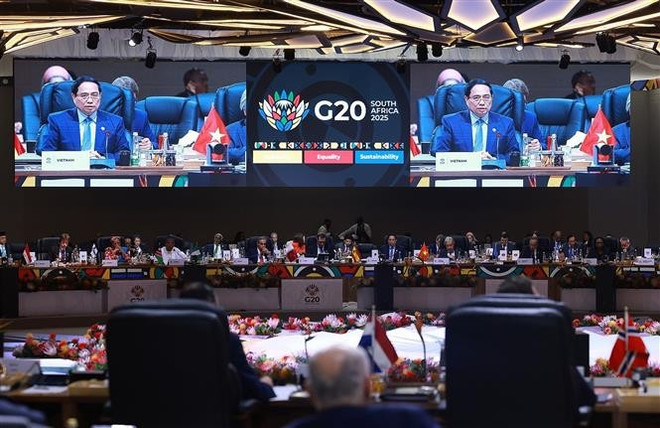
The two-day summit brings together leaders of G20 members, 20 invited countries and 21 international and regional organisations. This is the first time a G20 Summit has been hosted in Africa, marking the conclusion of South Africa’s G20 Chairmanship and the point at which all G20 members have now served as Chair.
On the first working day, delegates focused on two key discussions on sustainable and inclusive economic development – leaving no one behind, and G20 contributions to a resilient world.
Leaders exchanged views and agreed on major orientations relating to economic development, the role of trade, development finance and debt management, disaster-risk reduction and climate change mitigation, just energy transition and food security.
They shared concerns that the global economy is facing elevated risks and instability, including macroeconomic imbalances, rising protectionism, escalating public debt and increasingly limited access to financing. These challenges, compounded by slowing growth and ongoing geopolitical tensions, are constraining development efforts worldwide.
In this context, they stressed the need to strengthen coordination of fiscal, monetary and trade policies; address macroeconomic imbalances and inequality; bolster market confidence; deepen regional connectivity; and mobilise greater investment resources to maintain macroeconomic stability and support inclusive and sustainable global growth.
Leaders reaffirmed that international trade remains a key driver of growth, supporting efforts to strengthen the multilateral trading system, advance the reform of the WTO and help small and medium-sized enterprises integrate into global value chains.
They also called for deeper reform of the international financial architecture, enhanced debt transparency and sustainability, effective implementation of mechanisms such as the G20 Common Framework on debt treatment, a greater role for multilateral development banks and stronger resource mobilisation for infrastructure, energy transition and sustainable development.
The summit also highlighted the urgency of strengthening resilience to natural disasters and responding to climate change, given the increasingly severe impacts on people’s lives, economic activity and sustainable development efforts.
Leaders agreed to step up international cooperation on disaster-risk management, early-warning systems, resilient infrastructure and water–food–health security, as well as to mobilise more resources for green energy transition and sustainable agriculture./.