Hanoi (VNA) – The Ministry of Education and Training (MoET) has unveiled a pilot curriculum framework for artificial intelligence (AI) education in general schools, slated for rollout from early 2026 before being reviewed, refined and scaled up, in a move aimed at strengthening students’ core digital skills while promoting the responsible and humane use of AI.
Proactive, blended teaching approaches
Prof. Dr. Le Anh Vinh, Director General of the MoET's Vietnam Institute of Educational Sciences, said that during the development of the AI competency framework, the institute surveyed more than 11,000 students nationwide in early 2024. Results showed that 87% were aware of AI applications in education, but major challenges included limited knowledge and skills, inadequate equipment and technology, and insufficient teacher guidance.
A separate survey conducted in early 2025 among nearly 35,000 teachers found that 76% had used AI in classrooms. While almost 70% held positive views, concerns persisted over accuracy, data privacy and security, as well as the potential erosion of human interaction.
These findings highlight the urgency of introducing AI education in schools, with early exposure seen as critical to helping students use the technology effectively and responsibly.
In February 2026, the ministry will hold its first training programme for the pilot AI education. Three delivery models will be tested: integrating AI into existing subjects; teaching selected standalone topics; and organising experiential activities and clubs. The pilot outcomes will serve as a basis for rolling out AI education nationwide across Grades 1–12.
The framework is built around four core strands: human-centred thinking, AI ethics, AI techniques and applications, and AI system design.
Content is structured into three levels aligned with schooling stages. At primary level (Level 1 – Familiarisation), students are introduced to basic concepts. Lower secondary students (Level 2 – Foundation) develop baseline competencies in ethics, techniques and applications, and begin analysing AI’s social impacts. At upper secondary level (Level 3 – Creation), students gain confidence in using AI, understand basic principles, design and fine-tune simple AI tools, and engage in deeper critical thinking on social issues, human rights and civic responsibility.
Local initiatives and flexible implementation
With one of the country’s largest student populations, Ho Chi Minh City's Department of Education and Training considers the AI pilot a strategic step towards fostering digital capacity, logical thinking and self-directed learning.
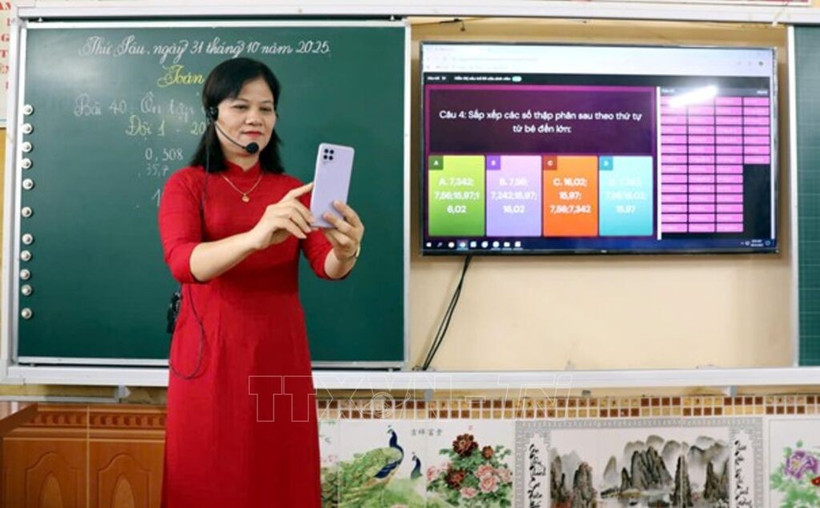
The department has issued a plan to pilot AI teaching in general schools from the second semester of the 2025–2026 academic year. Schools are encouraged to flexibly combine implementation formats, with AI integration into subjects, especially Informatics, prioritised to ensure broad access. AI will also be used as a tool to support innovation in teaching methods across other subjects.
Schools with sufficient teaching capacity may develop elective themes or standalone modules, expand clubs and extracurricular activities, and partner with universities, research institutes and businesses to diversify learning materials and practical experiences.
Avoiding a theory-heavy new subject
Assoc. Prof. Dr. Nguyen Chi Thanh, Dean of the Faculty of Education at the University of Education under Vietnam National University, Hanoi, said early access to AI is essential to equipping students, particularly Generation Z “digital natives”, with core digital competencies, enabling them to become informed technology users rather than passive consumers. He stressed that AI content must be age-appropriate and highly personalised.
AI, he noted, can be delivered through multiple channels, including subject integration, clubs and thematic activities, while taking into account schools’ broader social engagement. To prevent teacher overload, AI itself should be harnessed to streamline administrative tasks such as assessment, lesson planning, learning material design, student feedback and communication with parents and partners. This, however, requires systematic training for teachers.
He also suggested developing adaptive learning systems that allow students to study independently through videos and self-assessment, reserving classroom time for consolidation and discussion. Such systems must be tailored to different age groups.
Dr. Ngo Thanh Xuan, Principal of the Lao Cai High School for the Gifted, said integrating AI into general education is both timely and inevitable. At the upper secondary level, where career orientation is emphasised, students are encouraged to explore, design and refine simple AI applications through scientific projects.
This project-based approach focuses on developing problem-solving skills, creativity and mastery of AI tools, enabling students to apply AI to community-oriented products and future career pathways. It is particularly effective in specialised schools, where students typically possess strong logical and creative thinking and clear career goals.
Through such models, students move beyond abstract concepts to hands-on creation, from identifying problems and building datasets to designing and testing models. The approach fosters a truly interdisciplinary learning environment, linking mathematics, informatics, biology, geography and even literature within a single task.
By engaging in real-life projects, students also come to recognise that AI is not merely a technology but a social responsibility, one that involves accountability for data, communities, transparency and societal impact. This understanding lays a vital foundation for nurturing a generation capable of applying AI in a humane and sustainable manner in the future./.