Resolution No. 57 unleashes innovation potential for enterprises, education establishments: expert

The key to success in scientific research lies in the collaboration between private enterprises and universities. When private companies place orders with universities, academic institutions receive funding for operations while providing students with opportunities to handle real-world problems.

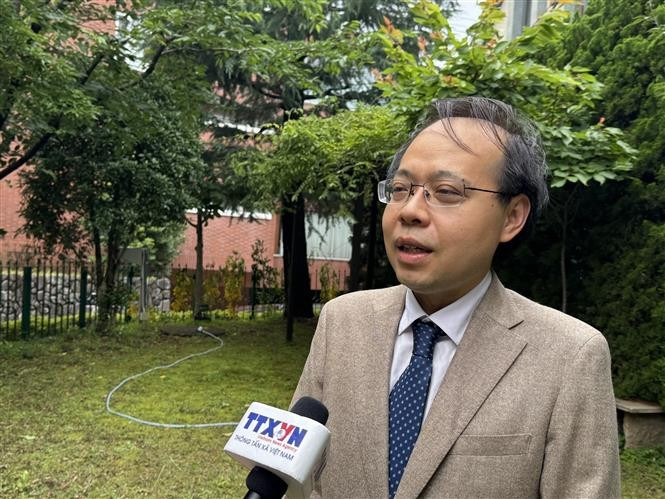
Professor Pham Nam Hai from the Institute of Science Tokyo grants an interview to the VNA. (Photo: VNA)

Hanoi (VNA) – The Politburo’s Resolution No. 57/NQ-TW on breakthroughs in science – technology, innovation, and national digital transformation helps remove constraints on businesses and institutes, enabling them to ingrate more deeply into the science – technology value chain, according to a Japan-based Vietnamese professor.

In a recent interview with the Vietnam News Agency, Professor Pham Nam Hai from the Institute of Science Tokyo said that the resolution establishes a target of allocating 2% of GDP annually to science – technology, with 60% of this investment coming from enterprises who will engage in science – technology development.

This marks the first time in the country's history that such a substantial investment goal for science and technology has been clearly defined relative to the country's economic potential, Hai stated.

Vietnamese scientists in Japan could contribute to this process through various channels, he said, highlighting they could participate in technology training programmes, particularly in semiconductor and AI, for Vietnamese students pursuing doctoral research. Besides, they could provide consulting services for domestic enterprises, guiding them towards new research directions that can create specific products with practical application in the domestic market.

Amidst global digital transformation, the professor underscored the rise of AI as central to an emerging AI economy. Vietnam has the potential to engage in the AI technology chain through two primary approaches. On the software side, Vietnam could leverage open-source models developed by advanced economies while adapting and localising them to Vietnamese conditions. To do that, he also underscored the need for Vietnam to build large-scale data centres.

Besides, the country should develop hardware capabilities and set up AI hardware centres. These platforms will support AI models specifically customised for Vietnam, applicable across numerous sectors. This includes not only cloud-based AI models but also Edge AI models that operate on peripheral devices, potentially integrated into everyday products like televisions and manufacturing applications.

Hai said the models will significantly enhance the efficiency of goods production and industrial processes as compared to human-controlled systems.

He emphasised that the key to success in scientific research lies in the collaboration between private enterprises and universities. When private companies place orders with universities, academic institutions receive funding for operations while providing students with opportunities to handle real-world problems.

In turn, businesses benefit from cutting-edge technologies developed at minimal cost. This allows universities to operate more autonomously and equips graduates with the skills and pathways to the workforce. The professor underscored that this collaboration represents a crucial key to developing Vietnam's science and technology research chain.

He suggested the State implement policies to facilitate deeper business participation in science – technology development chains. He cited Japan’s tax incentives for R&D investments as a model worth replicating, which encourage companies to invest in the activity rather than purchasing technology from external sources./.

VNA

See more

Certificates of membership in the Vietnam International Financial Centre in Da Nang are awarded at the conference on January 9. (Photo: VNA)

Da Nang continues targeted investment promotion approaches

According to Chairman of the Da Nang People’s Committee Pham Duc An, the city prioritises building sustainable economic ecosystems and focuses on key breakthrough sectors with strong spillover effects, including high technology and digital transformation, logistics, urban infrastructure, finance, processing and manufacturing industries, high-tech agriculture, and the pharmaceutical and medicinal herb industry.

In 2025, Hyundai sales reached 53,229 vehicles across the Vietnamese market. (Illustrative photo: Yonhap/VNA)

Hyundai sales in Vietnam rise almost 23% in December

In 2025, sales reached 53,229 vehicles across the market, a result considered a testament to the efforts by TC Group, Hyundai Thanh Cong, and the entire Hyundai dealership network nationwide amidst a volatile market.

Hydroponic vegetable cultivation model at the High-Tech Agricultural Park (Photo daibieunhandan.vn)

HCM City accelerates shift toward ecological urban agriculture

​The city’s agricultural sector is undergoing a strong transformation, restructuring toward higher value-added and sustainable development. In recent years, the sector has maintained steady growth, with agricultural, forestry and fisheries output rising by an estimated 2.5% annually.

Illustrative photo (Photo: VNA)

Dong Nai to launch major projects ahead of 14th National Party Congress

The launch of work on these projects represents an important political event for the province as they demonstrate the strong commitment of the entire political system to developing a comprehensive and modern infrastructure network, enhancing inter-regional connectivity, and addressing social welfare needs.

Illustrative image (Photo: VNA)

Lam Dong ready for nationwide economic census 2026

The entire process needs to reassure respondents that statistical activities operate independently, information is protected under the Statistics Law, and all data collection is completely separate from tax management.

Officials cut the ribbon to inaugurate the IFC Da Nang. (Photo: VNA)

Vietnam launches International Financial Centre in Da Nang

The Government has clearly defined the development orientation of the International Financial Centre in Da Nang as a modern international financial hub closely linked with the innovation ecosystem, digital technology, and sustainable finance.

Officers of the Thanh Hai Border Guard Station (Phu Thuy ward, Lam Dong province) patrol and monitor fishing vessels entering and leaving the port. (Photo: VNA)

Lam Dong steps up oversight to curb IUU fishing

As of early January 2026, the province had 8,210 registered fishing vessels, with more than 90% holding valid fishing licences, according to the department. A total of 8,115 vessels, or 98.76%, have been updated in the National Population Database, while 1,773 out of 1,941 vessels measuring 15 metres or longer have been granted food safety certificates, accounting for 91.34%.

Prime Minister Pham Minh Chinh speaks at the national conference on accelerating public investment for 2025 and 2026 (Photo: VNA)

People’s legitimate rights, interests must never be overlooked in public investment: PM

The Prime Minister underlined that public investment has consistently been identified as a key political task, with public investment disbursement results serving as one of the criteria for evaluating officials under Party regulations. Through state spending, public investment directly boosts aggregate demand and serves as an effective tool for regulating and stabilising the macroeconomy while safeguarding major economic balances.