Semiconductor industry short of high-quality workforce

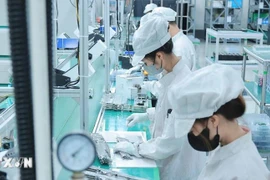
Under the semiconductor industry development strategy by 2030 with a vision to 2050, Vietnam sets a target to train at least 50,000 high-quality professionals. Ho Chi Minh City along shoulders some 9,000 in the domains of integrated circuit design, chip manufacturing, and related technologies.

Hanoi (VNA) - Vietnam's semiconductor industry stands at the threshold of a billion-dollar opportunity, yet faces a critical shortage of high-skilled talent that threatens to derail its ambitious plans to integrate deeply into global value chains.

Human resources – the most daunting challenge

Under the semiconductor industry development strategy by 2030 with a vision to 2050, Vietnam sets a target to train at least 50,000 high-quality professionals. Ho Chi Minh City along shoulders some 9,000 in the domains of integrated circuit design, chip manufacturing, and related technologies.

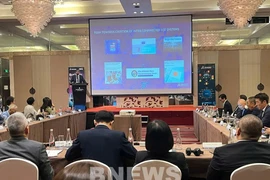
Deputy Director of the municipal Department of Science and Technology Nguyen Huu Yen described the semiconductor industry as a blood vessel for the global economy, creating foundations for high-tech sectors like AI, IoT, big data, and smart electronic devices.

For businesses, it is necessary to identify the skills and knowledge gaps in students, as well as contribute to the training process. Meanwhile, state management agencies should create an ecosystem that is attractive enough to retain talent and draw major global tech giants.

As the country’s economic and science-tech hub, HCM City is determined to lead the charge in semiconductor development, seeing it an opportunity and a historical responsibility with domino effects on the entire southern key economic region and the country as a whole.

Director of the Centre for the 4th Industrial Revolution in HCM City (HCMC C4IR) Le Truong Duy cited a Deloitte report projecting the global semiconductor market to reach 1 trillion USD by 2030, while the world faces a shortage of at least one million engineers. This presents both a formidable challenge and tremendous opportunity for Vietnam.

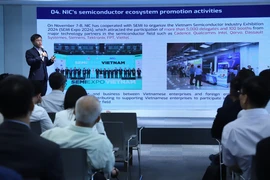
Currently, Vietnam's semiconductor industry is still in its early stage but has begun to show signs of growth. Major global players like Samsung, Amkor, Nvidia, and Qualcomm have selected Vietnam as a strategic destination. Domestically, companies like Viettel and FPT Group have started participating in the supply chain.

Duy said the country has only about 7,000 microchip engineers. HCM City supplies around 400-500 students to companies annually, fulfilling less than 10% of the national strategy’s target. In the meantime, there are fewer than 10 professors in the city with experience in “tape-out chip”.

Semiconductor alliance and breakthrough solutions

The HCM City Department of Science and Technology, in collaboration with the HCMC Semiconductor Technology Association (HSIA), has recently established the Alliance for Research and Training in Semiconductors and Microelectronics (ARTSeMi).

This alliance aspires to become a "common home" for substantive cooperation through innovative training programme development, integration of enterprises into teaching processes, sharing of research resources, and technology transfer. This strategic move aims to cultivate a generation of "golden human resources" for the semiconductor industry, realising technological autonomy goals and sustainable digital economy development.

Duy said HCMC C4IR will join hands with the HSIA and the alliance to develop a semiconductor institute, helping restructure national key R&D programmes, establish cross-industry, cross-regional, and international R&D alliances, and promote research cooperation, training, and technology transfer initiatives.

Meanwhile, Yen held that universities and institutes must quickly innovate their curricula, bridging the gap between theory and practice. Notably, mechanisms must be penned for enterprises to participate in programme development, laboratory sponsorship, internship guidance, and recruitment processes./.

VNA
See more

Phin Ho Tra – a national five-star OCOP product. (Illustrative photo: VNA)

Hanoi to host Vietnam OCOP Festival 2025

The festival is seen a practical activity celebrating the achievements made by the capital and the country in 2025, affirming OCOP’s role in rural economic development, contributing to realising Vietnam’s aspiration for strong economic growth in the context of deep integration.

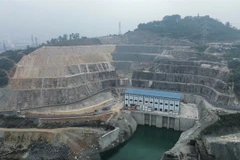
The expanded Hoa Binh Hydropower Plant (Photo baochinhphu.vn)

EVN launches major power projects

Among the flagship projects inaugurated was the expanded Hoa Binh Hydropower Plant with a total installed capacity of 480MW per year and average annual output of about 488 million kWh.

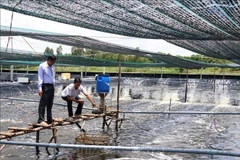
An ultra-intensive shrimp farming model linked with environmental protection in Ca Mau province. (Photo: VNA)

Fisheries take the lead in the Mekong Delta’s green transition

Across the Mekong Delta, leading aquaculture producers, processors and exporters, along with suppliers of inputs, are transitioning to circular, high-tech and clean production models that cut greenhouse gas emissions and comply with international certification standards.

A perspective view of the Red River Landscape Boulevard project in Hanoi (Photo: VNA)

Works starts on Hanoi’s Red River Landscape Boulevard Axis project

The project is among the 234 key works and projects being launched, inaugurated or technically opened simultaneously across 34 cities and provinces nationwide to mark the 14th National Party Congress. Its launch contributes to implementing the country’s strategic development orientations while concretising Hanoi’s development goals in the new period.

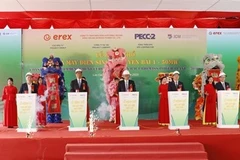
The ground-breaking ceremony of the Yen Bai 1 biomass power plant in Lao Cai province on December 19. (Photo: VNA)

Work starts on 114-million-USD biomass power plant in Lao Cai

The project, developed by Erex Yen Bai Biomass Power Co. Ltd. is located in Dong Cuong commune, Lao Cai province. It is backed by Japan’s Erex Group and falls under the Joint Crediting Mechanism, a bilateral initiative between Vietnam and Japan to reduce greenhouse gas emissions.

At the inauguration ceremony (Photo: VNA)

Vietnam Railways Corporation unveils upgraded coaches, digital tools

These moves reflect the VNR's commitment to fulfilling six priority tasks set by the Prime Minister, including leading in innovation and digital transformation, applying sci-tech in line with the Politburo’s Resolution No. 57-NQ/TW, and spearheading advances in digital, green and circular economy.

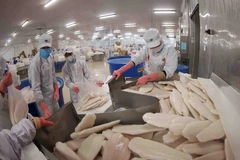
Producing MDF panels for export at Hai Duong MDF Construction and Manufacturing Co., Ltd., in Ho Chi Minh City (Photo: VNA)

HCM City targets 15 billion USD in wood exports by 2035

The merger of HCM City with Binh Duong and Ba Ria – Vung Tau is expected to give the local wood industry a strong boost into a phase of high-quality growth driven by linkages, innovation, sustainability, and deeper integration into global value chains.

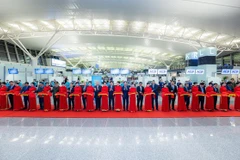
Delegates cut a ribbon to inaugurate the expanded Terminal T2 at Noi Bai International Airport in Hanoi on December 19, 2025. (Photo: VNA)

Expanded Terminal T2 at Noi Bai International Airport makes debut

The project expands the terminal’s floor area to over 200,000 sq.m, increases passenger capacity from 10 million to 15 million, even up to 18 million per year, and boosts operational capacity with boarding gates rising from 17 to 30 and jet bridges from 14 to 27, meeting strong growth in international travel demand.

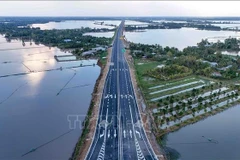
A section of Can Tho - Ca Mau Expressway (Photo: VNA)

Can Tho – Ca Mau travel time halves from December 19

Stretching more than 110 km with a total investment of over 27.5 trillion VND (1.04 billion USD), the project not only resolves long-standing traffic bottlenecks in the Mekong Delta, but also opens up new development opportunities for the entire region - especially Ca Mau, the last locality in the country to be directly connected to the eastern North–South expressway axis.