Thai Binh: Nam Cao linen village revived via community-based tourism

In stark contrast to its quiet past, Nam Cao linen weaving village (now Thong Nhat commune, Kien Xuong district, the northeastern coastal province of Thai Binh) is bustling.

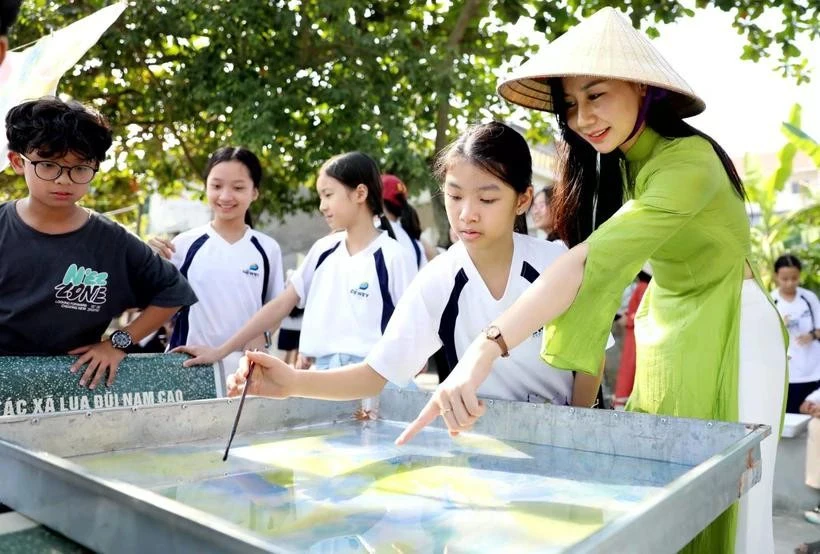
Students from The Dewey Schools (Hanoi) experience the traditional craft of linen weaving at Nam Cao village, Thong Nhat commune, Kien Xuong district, Thai Binh province. (Photo: VNA)

Hanoi (VNA) - In stark contrast to its quiet past, Nam Cao linen weaving village (now Thong Nhat commune, Kien Xuong district, the northeastern coastal province of Thai Binh) is bustling. The weaving machines are humming again, with skilled artisans spinning golden threads, and tourists experiencing the 400-year-old traditional craft. This weaving revival was led by a decade of determined efforts to restore a craft once on the brink of extinction.

In its prime, the village’s high-quality products were sought after in both domestic and international markets, with millions of metres of fabric exported annually. However, from the 1990s to around 2010, industrial fabrics and ready-made clothing pushed Nam Cao into a decline. Many local artisans left the trade for better-paying jobs, leaving only a few households to preserve the craft.

The turning point came when Luong Thanh Hanh, an entrepreneur born in 1985, decided to leave her high-income interior design job in a major city to start anew in Nam Cao. Despite not being a native, her passion for rustic handcrafted goods inspired her to establish “Hanh Silk” brand. She launched projects aimed at restoring the local linen weaving by creating a value chain that spans raw materials, production, distribution, and export.

The businesswoman said that Vietnamese silk and linen products are highly favoured on international markets. Thus, in collaboration with the village’s artisans, she aspires to revive and help the Nam Cao linen weaving brand secure its place on the global stage. Her vision is that when people think of silk and linen, they will refer to Vietnam in general and Thai Binh in particular.

Her efforts have paid off. The Nam Cao linen weaving cooperative now groups nearly 300 members producing 500 types of products. These are exported to 20 countries, including the US, UK, Italy, Australia, India, the Republic of Korea, and nations in the Middle East, generating over 10 billion VND (392,850 USD) on an annual basis. This year, for the first time, Nam Cao linen will feature on the prestigious Milan Fashion Week stage, showcasing Vietnam’s craftsmanship to the world.

For local artisans like Hoang Thu Huong, who have witnessed the highs and lows of the village, the establishment of the cooperative has brought renewed energy to the community. Huong and her peers are especially delighted, as they can preserve the traditional craft handed down by their ancestors while earning an average monthly income of between 5-8 million VND per person.

The Nam Cao Silk Weaving Cooperative emphasises eco-friendly practices, using natural dyes from plants, fruits, and roots to minimise environmental impacts. Its efforts have turned the village into a thriving hub for tourism.

Luong Thanh Hanh, director of the cooperative, shared that to preserve and develop the craft, it is committed to sustainable, eco-friendly practices, using natural dyeing techniques derived from plants, fruits, and roots. This year, the village welcomed nearly 30,000 domestic and foreign visitors, an unprecedented figure in its 400-year history.

Students like Nguyen Linh Chi, a sixth grader from The Dewey Schools in Hanoi, described their visit to the village at weekend as special and exciting. She and her friends were guided by cooperative members to engage in hands-on activities such as spinning, weaving, and dyeing fabric. The highlight for many was creating personalised scarves, which made meaningful souvenirs for their relatives after the trip.

In 2023, Nam Cao linen weaving was recognised as national intangible cultural heritage. To further its preservation, the local authorities have allocated 4.5 hectares for the village’s development. Once completed, the area is expected to attract three to five times more visitors, ensuring sustainable growth for the craft./.
VNA

See more

A police officer introduces a foreign visitor to the “Smart police station” kiosk, making it easier for international visitors to access police support services. (Photo: VNA)

Pilot "Smart police station" kiosk launched in Hanoi

During the pilot phase, the "Smart police station" provides five core functions: crime/incident reporting; SOS emergency calls; crime alert; finding the nearest police stations and administrative offices; and legal Q&A.

A public servant at the Public Administrative Service Centre of Vinh Yen ward, Phu Tho province, guides residents through the marriage registration process on the online public service portal. (Photo: VNA)

Digital literacy campaign lays foundation for digital citizens in Phu Tho province

After nearly a year, the “Digital Literacy for All” campaign in Phu Tho is demonstrating its effectiveness through tangible results. Residents who were once hesitant about technology are becoming increasingly familiar with VNeID, online public services, cashless payments, and digital platforms for learning, production, and business.

Firefighters and rescue personnel deploy specialised equipment to rescue two truck drivers trapped in their cabins. (Photo: VNA)

Road accident fund to provide support from September

Under Decree No. 279/2025/ND-CP and Circular No. 126/2026/TT-BCA, injured victims with bodily injury rates of over 31% to below 81% may receive up to 10 million VND (381 USD) per case, while families of deceased victims may receive up to 20 million VND.

Ha Thanh, Chairwoman of the Ho Chi Minh City Union of Friendship Organisations and head of the advisory council for international integration, people-to-people diplomacy and overseas Vietnamese affairs under the Vietnam Fatherland Front Committee of the city (Photo: VNA)

New resolution seeks to unlock OV resources for national development

Ha Thanh, Chairwoman of the Ho Chi Minh City Union of Friendship Organisations and head of the advisory council for international integration, people-to-people diplomacy and overseas Vietnamese affairs under the Vietnam Fatherland Front Committee of the city, said Resolution No. 23 builds on the fundamental viewpoints of the Politburo's Resolution No. 36-NQ/TW issued in 2004, reaffirming that overseas Vietnamese are an inseparable part of the nation and a bridge connecting Vietnam with the world.

The Vietnamese Embassy in London's Education Section and representatives from the Department of Higher Education (Ministry of Education and Training) visit and hold a working session at Queen Mary University of London. (Photo published by VNA)

Vietnam-UK education cooperation: From market to partnership

In the 2024/25 academic year, about 3,725 Vietnamese students studied in the UK, while 13,285 enrolled in UK programmes delivered in Vietnam. Both flows are growing, but the balance is increasingly shifting towards UK education being delivered to learners in Vietnam. If managed strategically, this could enable Vietnam to expand access to international education at home while improving the quality of its workforce.

A bus picks up passengers on National Highway 22 (Le Quang Dao Street), near An Suong Bus Station. (Photo: VNA)

Free bus fares drive sharp rise in ridership in Ho Chi Minh City

As of August 12, the city’s bus network had served nearly 12 million passenger trips, up about 44% year on year. On August 12 alone, around 306,000 passengers used free buses, an increase of roughly 55%, despite students having yet to officially return to school.

Officers and soldiers bring martyrs’ remains to the sampling station at Binh Xuyen commune Martyrs’ Cemetery in Phu Tho province (Photo: VNA)

More than 1,700 war martyrs’ remains recovered

The national steering committee will continue verifying information on suspected martyrs’ graves in key areas, including Tan Son Nhat Airport in Ho Chi Minh City, Quan Y Bac Son Hill in Dong Nai, the Con Tien base area in Quang Tri and former Vi Xuyen battlefields in Tuyen Quang.