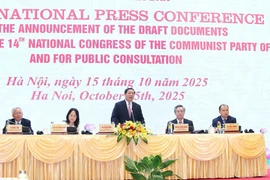
Hanoi (VNA) – As the Party Central Committee has released the full draft documents of the 14th National Party Congress for public feedback, scholars and experts have shown strong interest, offering practical proposals that focus on key issues such as sustainable development, environmental protection, human development, and institutional improvement which are seen as essential pillars for Vietnam’s rapid and sustainable growth in the new period.
Dr. Nguyen Song Tung, Director of the Institute of Geography and Human Studies under the Vietnam Academy of Social Sciences, said the draft documents should provide a more realistic assessment of the implementation of the 13th National Party Congress's Resolution, especially regarding the shift toward ecological, green, circular, and high-tech agriculture.
In practice, the transformation has been slow, and green or circular farming models remain small and scattered, she noted, adding that a more accurate evaluation will help shape policies that suit the conditions and resources of each locality.

She emphasised that environmental protection efforts must also address awareness and responsibility among public officials, as inconsistent understanding of environmental issues has limited the effectiveness of climate action and sustainability goals.
For the 2026–2030 period, Tung said the proposed development targets are generally reasonable but should place greater emphasis on sustainability. She suggested raising the forest coverage rate from 42% to about 45% in line with Vietnam’s Green Growth Strategy and net-zero emissions goal, while also increasing the proportion of trained workers with degrees or certificates to meet industrialisation and modernisation requirements.
Tung also called for stronger reaffirmation of the goal to “complete and synchronise the socialist-oriented market economy institutions,” describing it as a key breakthrough for sustainable development in the new era. She urged greater investment in education, science, technology, and innovation, as well as stronger support for private enterprises to grow into internationally competitive corporations contributing significantly to national growth.
In the cultural and human development sphere, she said the draft documents need to better reflect the goal of shaping Vietnamese people with core values such as patriotism, unity, self-reliance, compassion, integrity, responsibility, discipline, and creativity. It should also include a target to improve the happiness index of citizens - ensuring harmony between material and spiritual well-being, and between economic growth and social progress.
“Sustainable development can only be achieved when institutions, the economy, society, and environment are connected harmoniously. Humans must be both the centre and the subject of every policy. The culture, environment, and people form the foundation of sustainable development. When institutions are complete, sustainability policies can truly take root in real life,” she said.
Institutional improvement creates foundation for growth
Associate Professor, Dr. Vu Hung Cuong, Director of the Institute of Social Science Information, said the release of the draft documents for public comments reflects the Party’s openness, democratic spirit, and scientific approach in preparing for the upcoming congress.
He highlighted that the draft Political Report is more concise and effective, integrating the content of three previous documents into one, and offering a comprehensive, updated view of the country’s position amid a complex and unpredictable global context.
The draft identifies three new growth drivers - science and technology, innovation, and digital transformation - as key foundations to build value chains linked with green transition, energy transition, and high-quality human resource development.
According to Cuong, development targets for 2026–2030 should be realistic, achievable, and sustainable. While ambitious two-digit growth targets reflect strong aspirations, they can only be realised with solid institutions, sufficient resources, and effective implementation capacity. He recommended maintaining average annual GDP growth at around 6–8%, alongside macroeconomic stability, inflation control, and sustainable development—rather than pursuing growth at any cost.
The draft Political Report also demonstrates a clear determination to shift the growth model from the model based on public investment, exports, and consumption to the model driven by productivity, technology, and institutional efficiency. To ensure these new growth drivers are effective, mechanisms and policies that promote innovation, improve labour productivity, and unlock the private sector's potential must be further refined, he said.
Regarding the economic structure, Cuong welcomed the continued affirmation that the private sector is an important driving force of the national economy, while the state economic sector plays a leading and guiding role to ensure strategic balance and national interests. However, he said the draft Political Report should better clarify the distinction between the “leading role” of the state economic sector and the “most important driving role” of the private sector to avoid overlap and maximise the strengths of both sectors.
He recommended that the state sector should focus on strategic areas critical for defence, security, and science and technology, while encouraging the private sector to expand and become a pioneering force in production, business, and international integration.
Cuong also praised the draft’s candid acknowledgment that “implementation remains the weakest link.” Identifying this clearly, he said, is an important warning and direction for improvement in the next term.
As Vietnam has now transitioned to a two-tier local administration model, he stressed that streamlining the apparatus and enhancing administrative efficiency will be crucial to ensure Party policies and resolutions are effectively put into practice./.