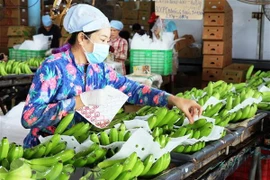
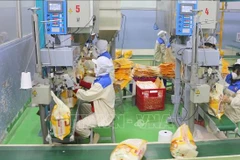
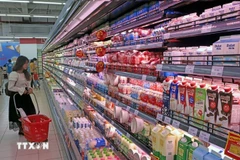
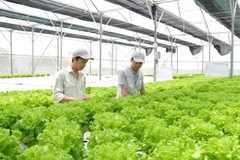
Vegetable and fruit exports were expected to post a growth of 10 percent this year (Photo: vneconomy.vn)
 Hanoi (VNS/VNA) - The growth of vegetable and fruit exports slowed downsignificantly this year but the target of reaching 10 billion USD in revenue in2025 was still within reach, according to the Ministry of Agriculture and RuralDevelopment (MARD).
TheMARD’s Agro Processing and Market Development Authority anticipated a growthrate of 10 percent for vegetable and fruit exports for the full year of 2018,much lower than the growth rate of more than 40 percent recorded in 2017.
Vietnamexported vegetables and fruits worth 3.5 billion USD between January andNovember, representing a rise of 11.6 percent over the same period last year.
China remainedthe largest importer of Vietnamese vegetables and fruits, accounting for 73.8 percentof Vietnam’s vegetable and fruit export revenue.
Vietnamexported vegetables and fruits worth 2.41 billion USD to China in the period,an increase of 11.3 percent over the same period in 2017.
Exportsto Australia, the US, Thailand and the Republic of Korea saw strong growthrates of between 28 and 36 percent.
The department said theexport of vegetables and fruits might struggle in the remaining month of thisyear due to the impact of weather conditions which might cause drops in theoutput of several farming products.
The department forecasta modest growth of just 10 percent for the export of vegetables and fruits forthe full year, compared to the whopping growth rate of 42.4 percent recordedlast year.
The country importedvegetables and fruits worth 1.57 billion USD in the 11-month period, up by 11.5percent, mainly from Thailand (accounting for 41.3 percent of the revenue) andChina (24.4 percent).
Experts said Vietnam’sparticipation in a number of free trade agreements (FTAs) was creatingopportunities to expand vegetable and fruit exports to new markets and reducethe reliance on a single market.
Vietnam had significant potential to boostexports, and the target revenue of 10 billion USD in 2025 was within reach ifthe country could make a breakthrough in processing to increase product values.The industry was still weak in processing and preservation, experts said.
Statistics showed that around 80 percent of Vietnam’sfruits output was sold in the domestic market, mostly in the form of freshproduce.
Nguyen Xuan Hong, former director of the AgroProcessing and Market Development Authority, said the export of vegetables andfruits faced two technical barriers: food safety and phytosanitationrequirements.
It was critical to pay special attention to foodsafety and phytosanitation to boost exports as import markets are now moredemanding, Hong said. Strengthening processing would help ensure stable exportprices of vegetables and fruits by preventing prices from tumbling when outputis abundant.
Hong said that organising production was animportant phase, adding that one solution would be to enhance cooperationbetween farmers and firms to apply standards such as VietGAP and GlobalGAP inproduction and ensure quality control for exports.
Hong suggested the Government createpreferential policies to create favourable conditions for firms to invest inprocessing vegetables and fruits.
Hong said investing in processing would increasethe added value of vegetables and fruits and boost exports.
According to Dinh Cao Khue, Chairman of DongGiao Foodstuff Export Company, the solution lies in developing large-scaleplantation areas with huge volumes which must be associated with the buildingof processing plants.
Khue said it was also critical to apply advancedprocessing technologies to diversify products and enhance quality.
Nguyen Van Viet, director of the ministry’sPlanning Department, said the ministry would continue to convert low-yieldfields into cultivation areas for more efficient crops, including vegetablesand fruits, and apply technologies that reduce costs while increasing output,quality, added value and competitiveness.-VNS/VNA
TheMARD’s Agro Processing and Market Development Authority anticipated a growthrate of 10 percent for vegetable and fruit exports for the full year of 2018,much lower than the growth rate of more than 40 percent recorded in 2017.
Vietnamexported vegetables and fruits worth 3.5 billion USD between January andNovember, representing a rise of 11.6 percent over the same period last year.
China remainedthe largest importer of Vietnamese vegetables and fruits, accounting for 73.8 percentof Vietnam’s vegetable and fruit export revenue.
Vietnamexported vegetables and fruits worth 2.41 billion USD to China in the period,an increase of 11.3 percent over the same period in 2017.
Exportsto Australia, the US, Thailand and the Republic of Korea saw strong growthrates of between 28 and 36 percent.
The department said theexport of vegetables and fruits might struggle in the remaining month of thisyear due to the impact of weather conditions which might cause drops in theoutput of several farming products.
The department forecasta modest growth of just 10 percent for the export of vegetables and fruits forthe full year, compared to the whopping growth rate of 42.4 percent recordedlast year.
The country importedvegetables and fruits worth 1.57 billion USD in the 11-month period, up by 11.5percent, mainly from Thailand (accounting for 41.3 percent of the revenue) andChina (24.4 percent).
Experts said Vietnam’sparticipation in a number of free trade agreements (FTAs) was creatingopportunities to expand vegetable and fruit exports to new markets and reducethe reliance on a single market.
Vietnam had significant potential to boostexports, and the target revenue of 10 billion USD in 2025 was within reach ifthe country could make a breakthrough in processing to increase product values.The industry was still weak in processing and preservation, experts said.
Statistics showed that around 80 percent of Vietnam’sfruits output was sold in the domestic market, mostly in the form of freshproduce.
Nguyen Xuan Hong, former director of the AgroProcessing and Market Development Authority, said the export of vegetables andfruits faced two technical barriers: food safety and phytosanitationrequirements.
It was critical to pay special attention to foodsafety and phytosanitation to boost exports as import markets are now moredemanding, Hong said. Strengthening processing would help ensure stable exportprices of vegetables and fruits by preventing prices from tumbling when outputis abundant.
Hong said that organising production was animportant phase, adding that one solution would be to enhance cooperationbetween farmers and firms to apply standards such as VietGAP and GlobalGAP inproduction and ensure quality control for exports.
Hong suggested the Government createpreferential policies to create favourable conditions for firms to invest inprocessing vegetables and fruits.
Hong said investing in processing would increasethe added value of vegetables and fruits and boost exports.
According to Dinh Cao Khue, Chairman of DongGiao Foodstuff Export Company, the solution lies in developing large-scaleplantation areas with huge volumes which must be associated with the buildingof processing plants.
Khue said it was also critical to apply advancedprocessing technologies to diversify products and enhance quality.
Nguyen Van Viet, director of the ministry’sPlanning Department, said the ministry would continue to convert low-yieldfields into cultivation areas for more efficient crops, including vegetablesand fruits, and apply technologies that reduce costs while increasing output,quality, added value and competitiveness.-VNS/VNA
VNA