Vietnam accelerates eradication of makeshift houses

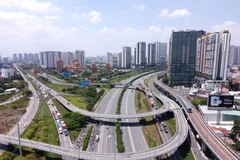
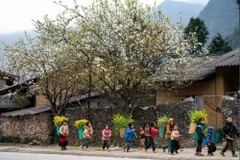
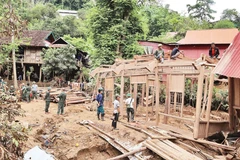
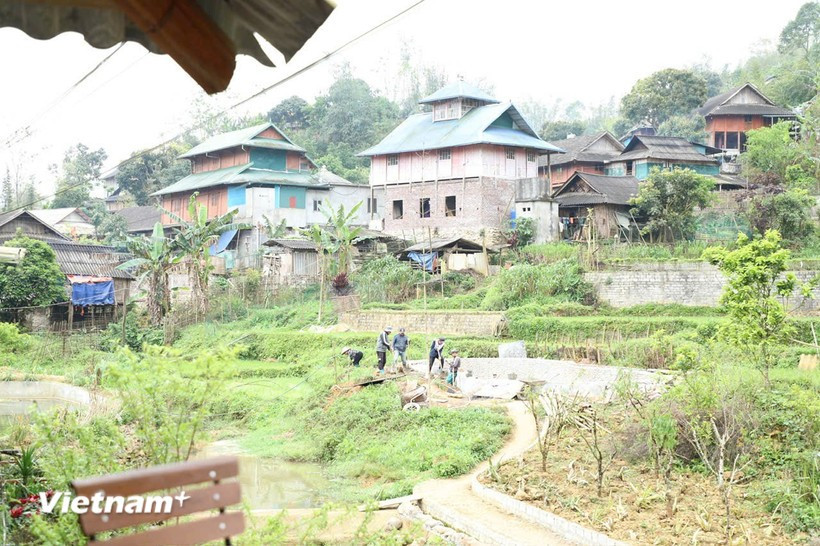
Vietnam is truly entering the final stretch towards the finish line of eliminating temporary and dilapidated houses, Deputy Minister of Ethnic and Religious Affairs Nong Thi Ha has affirmed.

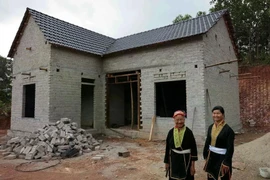
Heading towards the finish line of eliminating temporary and dilapidated houses. (Photo: VietnamPlus)

Hanoi (VNA) - Vietnam is truly entering the final stretch towards the finish line of eliminating temporary and dilapidated houses, Deputy Minister of Ethnic and Religious Affairs Nong Thi Ha has affirmed.

With the determination of “leaving no one behind,” promoting the spirit of solidarity, cooperation, proactivity, creativity, and through breakthrough approaches, the country has so far eradicated over 205,000 makeshift and substandard houses.

This result has created a vibrant competitive spirit among various levels, sectors, localities, business communities, and the people, Ha affirmed.

The official stated that to provide homes for the poor and vulnerable, and to implement the Party’s Resolution 42, in 2024, the Prime Minister launched a nationwide emulation movement to jointly do away with temporary and dilapidated houses by 2025.

Since the programme's launch, the country has supported over 125,000 houses for poor and near-poor households; more than 26,300 houses for people with meritorious services to the nation; and over 51,400 others through national target programmes.

To achieve these results, Ha noted that many organisations and localities have applied innovative methods and provided very practical and effective assistance in eliminating these kinds of houses nationwide.

She took the banking sector as an example, as it pledged support of 1.3 trillion VND (49.7 million USD) immediately after the Prime Minister’s launch and assigned specific banks to assist localities. To date, the banking sector has transferred approximately 1.2 trillion VND to localities.

The military has also identified the elimination of temporary and dilapidated houses as a mission, a political responsibility, and a heartfelt commitment of Party committees and commands at all levels, and officers and soldiers. So far, the military has contributed over 600 billion VND and mobilised more than 21,000 officers and soldiers with over 76,500 workdays to support this work.

As a result, as of June 9, 21 out of 63 localities nationwide had completely eliminated makeshift and substandard houses.

Sharing more about favourable factors, the Deputy Minister said that an important reason for strengthening confidence is that two major bottlenecks in the implementation process - funding and land - have been identified and solutions have been found.

To date, over 90% of the funds have been transferred as committed, with the remaining amounts still undergoing completion of payment procedures. Regarding land, at the first meeting of the Central Steering Committee for this work, the Prime Minister issued strong directions to solve issues in areas without disputes. Drawing on practical experience from localities facing land difficulties, valuable lessons have been learned and can be applied. Therefore, the two biggest “bottlenecks” have now been removed, Ha affirmed.

In June 8, the Prime Minister also issued an official dispatch urging ministries and localities to accelerate efforts and complete the national housing support goal by August 31, 2025, with priority given to families of war martyrs and national contributors by July 27.

Authorities have been requested to ensure transparency and effectiveness in implementation, while the Ministry of Construction has been tasked with monitoring progress and clearing obstacles.

The campaign is viewed as a significant social policy, reflecting the state’s care for the disadvantaged and affirming national solidarity and the humanitarian values of the Vietnamese people./.

VNA

See more

The Red River Scenic Boulevard Axis is designated as one of nine key development corridors of Hanoi. (Photo: VNA)

Hanoi details multi-billion-USD Red River scenic boulevard axis project

Under the capital’s master plan with a 100-year vision, the Red River Scenic Boulevard Axis is designated as one of nine key development corridors of Hanoi. It is envisioned as a central green spatial corridor, while also functioning as an economic, commercial, service, cultural, creative, and urban development axis along the Red River.

Defendants at the appellate trial in Hanoi on May 20 (Photo: VNA)

Appeal trial opens in food safety bribery case

The total amount of bribes received by the defendants in the case exceeded 94 billion VND, with former Director of the Vietnam Food Safety Authority (FSA) Nguyen Thanh Phong alone pocketing 43.9 billion VND.

Vietnamese Ambassador to the US Nguyen Quoc Dung speaks at the seminar. (Photo: VNA)

Vietnam – US partnership expands in culture preservation, promotion

The May 18 seminar, themed “Reframing Vietnam,” at the National Museum of Asian Art (NMAA) under Smithsonian Institution in Washington, D.C., is expected to generate fresh momentum and frameworks for cooperation among cultural agencies, museums, art funds and experts from the two countries, helping bring Vietnam’s cultural image closer to American and international public in the time to come.

Visitors to an exhibition and test-drive programme for electric vehicles organised in Cau Giay ward, Hanoi, on May 16 by the municipal People's Commitee and relevant agencies. (Photo: VNA)

Hanoi proposes subsidies to accelerate shift to electric vehicles

Under a draft resolution currently open for public feedback by the municipal People’s Committee, residents with permanent or temporary residence registration in Hanoi for at least two consecutive years, who own petrol-powered motorbikes registered before the resolution takes effect, will be eligible for support when purchasing electric motorbikes priced at 10 million VND or more.

The copyright crackdown is broadly viewed as an inevitable step in Vietnam’s cultural industry development. (Illustrative photo: VNA)

Healthy digital content market in the making

The sharper crackdown is rapidly redrawing how online entertainment is distributed and consumed, while gradually reshaping public awareness and responsibility toward copyright protection.

A view of Place Ho Chi Minh in Persan, France. (Photo: VNA)

Place preserving memories of President Ho Chi Minh in France

Although there is little publicly available documentation confirming exactly when Place Ho Chi Minh was established, French urban historians suggest that most streets and public spaces named after the Vietnamese leader in France emerged between the 1960s and 1980s, during the height of anti-war movements and solidarity campaigns supporting Vietnam across working-class towns and left-leaning suburbs around Paris.

Vietnamese Ambassador to Bangladesh Nguyen Manh Cuong speaks at the seminar. (Photo: VNA)

President Ho Chi Minh’s thought on national unity remains relevant today

President Ho Chi Minh's ideology of national unity continues to carry profound significance amid growing global challenges, including conflicts, social divisions and economic instability. His message of solidarity, consensus and placing national interests above sectional differences remains a valuable lesson for many developing nations.