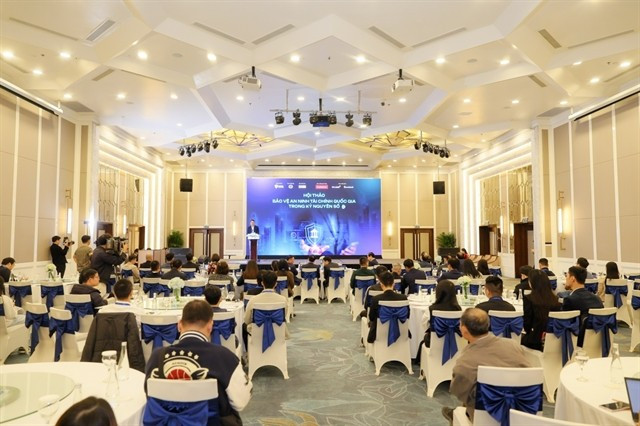
Hanoi (VNS/VNA) - Early detection, proactive action and close inter-agency coordination are key to protecting national financial security in the digital age, experts told a workshop on December 23.
At the event on protecting national financial security in the digital age, Lieutenant General Nguyen Minh Chinh, permanent deputy chairman of the National Cybersecurity Association, said that in the current digital age, financial security has become a direct and inseparable component of national security. The financial and banking system, digital payment infrastructure, financial data and related technology platforms are both drivers of economic development and frequent targets of high-tech crimes.
Chinh said: “In practice, cyberattacks, data theft and manipulation are becoming increasingly sophisticated, organised and cross-border, posing significant risks not only to the economy but also directly threatening social stability, public trust and national sovereignty in the digital space. If financial security is not well controlled, the risk of economic instability and security repercussions is imminent. Therefore, the requirement is to correctly identify threats and act early and proactively to absolutely avoid being caught off guard or unprepared.”
According to Chinh, the Party and Government have issued very clear, consistent, and comprehensive directives to form an important legal framework for protecting national financial security, such as Resolution No. 57-NQ/TW on identifying science, technology, innovation and digital transformation as key drivers of national development that emphasises cybersecurity, data security and digital sovereignty as prerequisites; Resolution No. 68-NQ/TW on the development of the private economy that requires building a safe and transparent digital environment and firmly protecting the financial and banking system during the development of the digital economy; the Law on Digital Technology Industry 2025 (effective from January 1, 2026); and the Law on Cybersecurity 2025.
Chinh said the current issue is not a lack of policies or laws, but how to implement the regulations in a synchronised and effective manner to help stay one step ahead of high-tech crime.
At the workshop, Phan Thai Dung, deputy director of the State Bank of Vietnam (SBV)’s Information Technology Department, said that in recent years, the banking sector has been one of the pioneers in digital transformation and technological and service innovation, which has helped the industry achieve significant results in its work.
He said that the banking sector has focused on information system security to ensure sustainable development. Specifically, the SBV has issued a system of policies on information security that are close to international standards and practices.
Under the close monitoring of the SBV, all credit institutions have developed their strategies and internal regulations on information security, as well as investing in and equipping technical solutions to ensure the security and safety of information technology systems. The information security and safety work of the banking sector has been carried out seriously, ensuring the safe and stable operation of the banking system.
However, Dung noted, in the context of strong digital transformation, the global cybersecurity environment is undergoing many complex developments, posing new risks and challenges to ensuring information security and safety, and potentially impacting the sustainable development of various sectors, including the banking sector. Therefore, ensuring cybersecurity and preventing high-tech crimes in the banking sector is a key and extremely important task for the banking industry.
To effectively combat threats from high-tech crime in the banking sector, he said that it is necessary to have active coordination and support from the Ministry of Public Security, the National Cybersecurity Association, and domestic and international cybersecurity organisations and experts.
Lieutenant Colonel Trieu Manh Tung, deputy director of the Ministry of Public Security’s Department for Cybersecurity and High-Tech Crime Prevention (A05), said that Vietnam has proactively made efforts in promoting, hosting and playing a central role in the formation of the United Nations Convention against Cybercrime, which clearly affirm the country's position, prestige, and international responsibility in protecting global cyberspace.
In the coming period, A05 will continue to closely coordinate with the National Cybersecurity Association, the SBV and relevant units in advising on policies, improving institutions, and enhancing the capacity to prevent, detect, and handle high-tech crimes in the financial and banking sector./.
VNA