Vietnam, Laos, Cambodia promote Buddhist harmony for peace, sustainable development

Vietnam values and stands ready to promote religious cooperation—including Buddhist exchanges—as an important channel of people-to-people diplomacy that contributes to solidarity, friendship, mutual understanding, peace, cooperation, stability, and development in the region and beyond, an official has said.

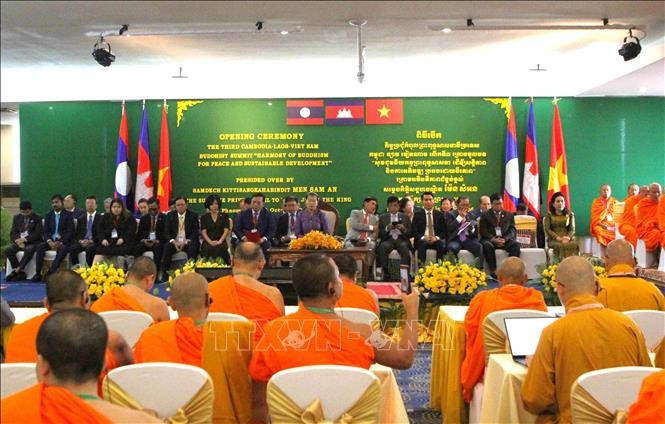
The opening ceremony of the third Cambodia – Laos – Vietnam Buddhist Summit took place in Phnom Penh (Photo: VNA)

Phnom Penh (VNA) – The third Cambodia – Laos – Vietnam Buddhist Summit took place in Phnom Penh from October 27 to 29, focusing on the promotion of Buddhist harmony for peace and sustainable development.

Hosted by Cambodia’s Ministry of Cult and Religion, the conference brought together more than 200 delegates, including officials for religious affairs, Buddhist dignitaries from the three countries, ambassadors and members of the diplomatic corps in Phnom Penh. The Vietnamese delegation was led by Nguyen Hai Trung, Deputy Minister of Ethnic and Religious Affairs.

Speaking at the opening ceremony, Cambodian Minister of Cult and Religion Chay Borin said the summit not only reflected the development of Buddhist practices in the three countries but also addressed the shared aspiration of Buddhists to promote peace and social harmony. He expressed his hope that the event would help to further strengthen solidarity, friendship, and cooperation among Cambodia, Laos and Vietnam, while spreading the Buddhist values across the region and the world.

In her remarks, Samdech Men Sam An, Supreme Advisor to the Cambodian King, highlighted the long-standing ties among the three Mekong nations, forged through the shared struggles for independence, freedom, and reunification. She noted that since Cambodia’s liberation from the Pol Pot regime, relations among the three countries have grown even stronger, fostering cooperation in various fields, particularly religion.

She underscored that the Buddhist values of compassion, tolerance, selflessness, and altruism have deeply influenced everyday life in all three nations, nurturing peaceful coexistence and social stability. Buddhism, she said, continues to serve as a moral and spiritual foundation for national harmony, patriotism, cooperation, and peaceful and prosperous society.

Men Sam An stressed that in a rapidly changing and uncertain world, religion plays an increasingly important role in upholding the shared principles and contributing to peace and sustainable global progress.

At the plenary session, delegates discussed ways to strengthen Buddhist cooperation and its role in promoting harmony and sustainable growth.

Deputy Minister Trung commended the summit’s theme, noting its relevance at a time when armed conflicts persist and peace remains a global aspiration. He emphasised that true harmony—between people and nature—remains a shared ideal, while unsustainable development continues to burden future generations.

He reaffirmed Vietnam’s consistent foreign policy of independence, self-reliance, peace, cooperation and development, diversification and multilateralisation of external relations, and being a friend, a reliable partner of all countries, and a responsible member of the international community. The country, he said, values and stands ready to promote religious cooperation—including Buddhist exchanges—as an important channel of people-to-people diplomacy that contributes to solidarity, friendship, mutual understanding, peace, cooperation, stability, and development in the region and beyond.

The State of Vietnam always respects and guarantees all people's right to freedom of religion or belief, he said, elaborating that it has consistently created conditions for religious organisations to operate in line with the Constitution and laws, fostered solidarity among religions, and brought into play the fine cultural and moral values, as well as resources, of religions for national development. Policies and laws on religious affairs have also been continuously fine-tuned to ensure the best possible conditions for all to practice their religious freedom.

According to Tran Thi Minh Nga, deputy head of the Government's Committee for Religious Affairs, over 95% of the Vietnamese population follow a belief or religion, with nearly 30,000 places of worship. Buddhism is the largest religion, accounting for 55% of all religious followers and 64% of worship sites.

At the summit, a joint declaration was signed, reaffirming the commitment to preserving and promoting Buddhist heritage, fostering regional Buddhist collaboration, promoting peace and harmony, supporting sustainable development, empowering the youth, and strengthening global solidarity and cooperation.

The summit agreed that the fourth event will be hosted by the Lao Buddhist Fellowship Organisation in 2027./.

VNA
See more

A working delegation from the Fire Prevention, Fighting and Rescue Police Department under the Ministry of Public Security pays a visit to Bratislava from March 9–12. (Photo: VNA)

Vietnam, Slovakia boost cooperation in firefighting and rescue

During the visit, the delegation led by Deputy Director of the department Colonel Hoang Ngoc Huynh worked with several Slovak institutions, including the command of the Fire and Rescue Force in Bratislava, an automobile installation and repair centre under the Ministry of Interior of Slovakia, and the Lest military training centre.

A transport infrastructure project in Ho Chi Minh City (Photo: VNA)

Ho Chi Minh City steps up actions to unlock private sector growth

Ho Chi Minh City’s authorities and businesses operating in the southern metropolis have stepped up strategic orientations and concrete action programmes to translate Resolution No.68-NQ-TW of the Politburo into practice and create conditions for the private sector to make breakthroughs and become a key growth driver.

Swiss Ambassador to Vietnam Thomas Gass (Photo: VNA)

Swiss ambassador hails Vietnam's 2026 election as milestone

The March 15 election is expected to be an important milestone for Vietnam. It is not only a constitutional exercise but also a means of ensuring that policies adopted at both national and local levels are enforced with a strong focus on citizens’ interests, said Swiss Ambassador to Vietnam Thomas Gass.

President of the Vietnamese Association in Mexico Nguyen Huu Dong (Photo: VNA)

Mexico-based scholar unveils ideas to optimise Vietnamese NA’s efficiency

Talking with Vietnam News Agency correspondents in Mexico City, Dong pointed to important strides in the NA’s outgoing tenure, including improvements to the institutional framework, operating methods and stronger oversight of major national issues. In his view, the NA has increasingly asserted its role as the highest representative body of the people and a central pillar in the process of building a socialist rule-of-law state.

The Cai Mep Ha free trade zone in Ho Chi Minh City currently has four seaports and four inland waterway ports in operation (Photo: VNA)

Strategic infrastructure – key driver for Ho Chi Minh City’s economic growth

Rapid population growth and urban expansion have exposed limitations in Ho Chi Minh City’s infrastructure, particularly traffic congestion at key gateways and in central areas. In response, the city is steeping up investment in major projects to improve connectivity, expand urban space and remove development bottlenecks.

Illustrative image: Authorities strengthen control at the Dinh Ba International Border Gate to prevent illegal entry and exit. (Photo: VNA)

Authorities warn against hiring foreign workers violating immigration rules

Investigations revealed that several foreign nationals had been sponsored by two companies headquartered in Ho Chi Minh City to apply for temporary residence cards under the category of investors. However, the individuals were not genuine investors but had completed procedures through intermediaries in order to remain in Vietnam.

Illustrative image (Photo: VNA)

Hanoi promotes family values to mark International Day of Happiness

The activities will take place from March 15 to 21, with the peak on March 20. The highlight will be a launch ceremony for the 2026 International Day of Happiness, calling on authorities at all levels, organisations and the community to join hands in building safe, equal and progressive family environments, while promoting love, sharing and responsibility among family members.

Delegates and students pose for a commemorative photo. (Photo: baocantho.com.vn)

Four more Can Tho schools earn French education accreditation

The recognition of six schools under the Label FrancEducation programme is expected to create momentum for expanding education cooperation between French and Can Tho institutions, contributing to human resources development and friendship between the two countries.

A seminar at the programme (Photo: VNA)

Event promotes inclusion, empowerment for youth with disabilities

A key feature of the programme will be the dialogue “The Inspirers – Family Support on the Journey of Resilience”, where exemplary families and inspirational figures will share stories of overcoming adversity and spread messages of compassion, understanding and community responsibility in building an inclusive and humane society.

UN Resident Coordinator in Vietnam Pauline Tamesis (Photo: VNA)

South–South cooperation promotes rights, justice for women and girls

UN Resident Coordinator in Vietnam Pauline Tamesis commended Vietnam’s sustained commitment to gender equality, noting advances in budgeting, land use, social insurance and domestic violence prevention under the recent review of the Convention on the Elimination of All Forms of Discrimination against Women (CEDAW).