Source: Vietnam+
VNA
Source: Vietnam+


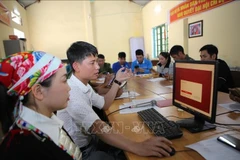
The rapid digital transformation has encouraged farmers in Lao Cai to adopt information technology, social media, and e-commerce in production and business activities, generating a stable source of income.
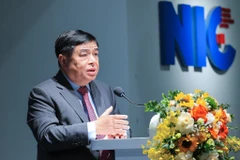
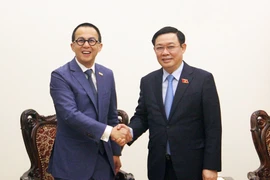
Deputy Prime Minister Nguyen Chi Dung called on Dassault Systèmes to continue expanding its R&D activities in Vietnam with the aim of having 1,000 high-quality engineers working at its R&D centre in the country by 2030.
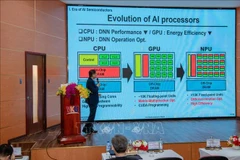
This was the first international, specialised semiconductor conference held in central Vietnam and the first time the country hosted a large-scale academic forum dedicated exclusively to this sector. Organised in line with international standards, it featured plenary sessions, technical presentations and industry forums, reflecting major research trends shaping the semiconductor sector.

Assessing the role of AI, Minister of Science and Technology Nguyen Manh Hung emphasised that it is an “intellectual infrastructure.” More than an applied technology, AI is increasingly becoming a form of national infrastructure, comparable to electricity, telecommunications or the Internet.

The Ministry of Science and Technology reported that by 2025, 5G had been commercialised nationwide, covering more than 90% of the population. Viettel alone has deployed 30,000 5G base stations, achieving 90% outdoor coverage and 70% indoor coverage, exceeding its commitments to the Government.

First enacted in 2008, the Law on High Technology laid the foundation for the establishment of high-tech parks, the attraction of investment into key technological fields, and the promotion of research and development (R&D).
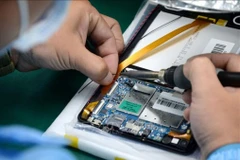
The centre will provide essential infrastructure and public services to support semiconductor design and prototyping as part of Vietnam’s broader industrial strategy.
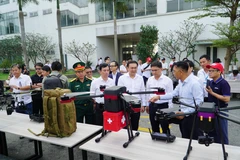
HCM City aims to promote UAV use in urban delivery - a promising field contributing to smart logistics and postal services for e-commerce, smart cities and high-tech public services, while fostering UAVs as a strategic technology sector underpinning the innovation ecosystem.

The accolade recognises the mastery of core technologies by the Viettel Artificial Intelligence and Data Services Centre (Viettel AI), while reaffirming the group’s capacity to successfully deploy “Make in Vietnam” artificial intelligence solutions in international markets.

The draft action programme of the Party Central Committee to implement the Resolution of the 14th National Party Congress identifies the shift to a new growth model, economic restructuring, and accelerated industrialisation and modernisation, with science, technology, innovation and digital transformation as the core engines, as key tasks.

The resolution has affirmed that in the digital era, science, technology and digital transformation are no longer optional but mandatory conditions, while innovation has evolved from a research activity into a core driver of national growth.
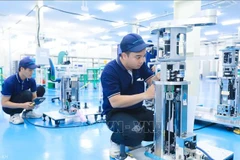
Vietnam is aiming to become a high-tech economy with the STI pillars identified as the enablers, and the local conditions enable their rapid development, said an Israeli expert.
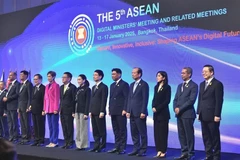
Held annually on a rotating basis among ASEAN member states, the meeting plays a key role in shaping strategic orientations, formulating policies and promoting digital cooperation within ASEAN, while strengthening collaboration with partners and international organisations amid rapid digital and digital-economy transformation globally.

The achievement, marked as Vietnam’s first 5G Advanced trial, was made possible by carrier aggregation (CA) technology, enabling mobile devices to operate across multiple frequency bands simultaneously instead of a single band.
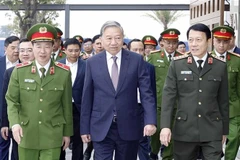
The National Data Centre No.1 has been positioned as a core and pivotal facility, serving as the “brain” and “heart” of the national digital transformation process, said Party General Secretary To Lam.

The cooperation framework is designed to be flexible, aligning with the capabilities and development orientations of both companies as well as legal regulations in different countries and territories.
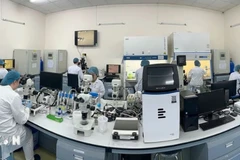
Prof. Dr. Tran Dai Lam, Director of the Institute of Materials Science at the Vietnam Academy of Science and Technology (VAST), emphasised that intellectuals should nurture national responsibility and ambition, be ready to take on challenges, evaluate research outcomes by international standards, and engage in collaboration across different sectors.
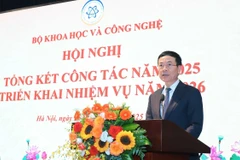
2025 represents a shift in development mindset, with the science and technology sector tasked to turn concepts into tangible capabilities, concrete results, and measurable value for the country.
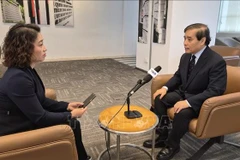
The resolution also seeks to create stronger mechanisms to mobilise social and private resources and support an innovation ecosystem; link digital transformation in the public sector with the modernisation of national governance; and prioritise the development of elite human resources and internationally-standard research infrastructure.
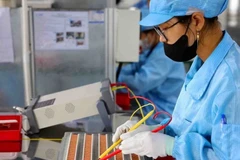
Assoc. Prof. Le Duc Anh from Tokyo University held that for fast and sustainable development, Vietnam should prioritise science – technology and innovation as the main driver of productivity, focusing on sectors with high spillover effects such as semiconductors, AI, data, new energy and materials, biomedical technology, automation – robotics, and cybersecurity.