Innovation – Driver for new development phase

The draft action programme of the Party Central Committee to implement the Resolution of the 14th National Party Congress identifies the shift to a new growth model, economic restructuring, and accelerated industrialisation and modernisation, with science, technology, innovation and digital transformation as the core engines, as key tasks.

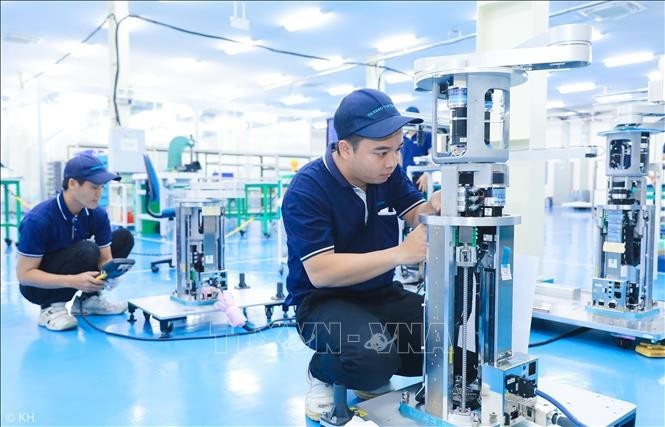
Workers are operating a robotic wafer conveyor assembly line in the semiconductor industry. (Illustrative image. Photo VNA)

Hanoi (VNA) – Innovation has been affirmed as a key driver and powerful strong lever for economic growth as Vietnam enters a new development phase marked by transformation.

The draft action programme of the Party Central Committee to implement the Resolution of the 14th National Party Congress identifies the shift to a new growth model, economic restructuring, and accelerated industrialisation and modernisation, with science, technology, innovation and digital transformation as the core engines, as key tasks.

Ambitious growth targets are intensifying the need to raise productivity and efficiency, pushing enterprises to embed innovation deep into their organisational culture and develop it as a core capability.

A recent survey by the Enterprise Development Institute (EDI) under the Vietnam Chamber of Commerce and Industry (VCCI) shows that cultural values promoting innovation in enterprises scored an average of 3.81 out of five. This suggests that an innovation culture has begun to take shape, especially amid rapid technological change, though its depth remains moderate and requires stronger promotion.

According to EDI Director Luong Minh Huan, private enterprises record the highest levels of innovation culture, followed by foreign-invested firms, while State-owned enterprises lag behind. Innovation is most pronounced among young businesses. Firms operating for under two years tend to focus on stabilisation and market access, resulting in lower scores, while those in the two-to-five-year development phase show the strongest emphasis on innovation-supportive cultural values.
9ed7d6171e5ef700ae4f.jpg
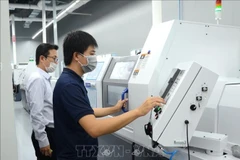
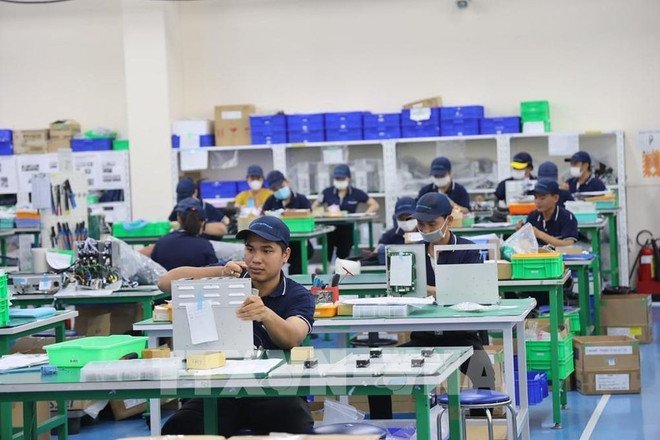
Workers at the Tazmo Vietnam factory assemble industrial robotic equipment (Photo: VNA)

In practice, many Vietnamese enterprises still associate innovation primarily with major breakthroughs or entirely new solutions, often implementing it through short-term programmes or initiatives. Yet innovation is not exclusive to large firms or high-tech sectors. It can emerge from incremental improvements in processes, coordination and ways of working that gradually reshape thinking and generate new value.

The VCCI survey also indicates that about 40.4% of enterprises prioritise fostering a learning mindset and transforming into learning organisations in their upcoming cultural strategies.

Globally, the World Economic Forum (WEF) forecasts that 39% of core workforce skills will change by 2030, while 63% of employers see skills gaps as the main obstacle to business transformation. Therefore, learning is no longer limited to skill upgrading but extends to redefining organisational behaviour and operating models.

Dr. Ngo Dac Thuan, Chairman of IPGroup, citing the WEF’s Future of Jobs 2025 report, noted that critical thinking and adaptability will be the most important skills in 2025, alongside leadership and social influence. AI, big data, cybersecurity and technological competence are also expected to dominate demand through 2030.

This combination requires workers to be proficient with digital tools while retaining sound judgement and accountability when working with AI.

If 2023–2025 marked the experimentation phase for AI adoption, 2026 is set to usher in standardisation, with AI becoming a routine component of work. As Vietnam refines its AI-related policies and legal frameworks to ensure safety and ethics, enterprises are increasingly required to establish internal AI standards while sustaining innovation as a growth driver.

Entering 2026, businesses must balance rapid adaptation with stability for employees. Building flexible learning systems, encouraging experimentation, setting clear internal rules on AI use, and reinforcing core organisational foundations will be essential to maintaining innovation momentum and long-term performance./.


VNA

See more

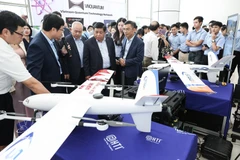
At a display of UAVs (Photo: VNA)

HCM City pilots UAVs for delivery services

HCM City aims to promote UAV use in urban delivery - a promising field contributing to smart logistics and postal services for e-commerce, smart cities and high-tech public services, while fostering UAVs as a strategic technology sector underpinning the innovation ecosystem.

Viettel's virtual assistant for searching administrative units helps shorten time and simplify searches for people. (Photo: Viettel)

Viettel’s virtual assistant among Top 10 technology products

The accolade recognises the mastery of core technologies by the Viettel Artificial Intelligence and Data Services Centre (Viettel AI), while reaffirming the group’s capacity to successfully deploy “Make in Vietnam” artificial intelligence solutions in international markets.

Participants at the 5th ASEAN Digital Ministers Meeting (ADGMIN) in Thailand. (Photo: VNA)

Hanoi to host 6th ASEAN Digital Ministers’ Meeting in January

Held annually on a rotating basis among ASEAN member states, the meeting plays a key role in shaping strategic orientations, formulating policies and promoting digital cooperation within ASEAN, while strengthening collaboration with partners and international organisations amid rapid digital and digital-economy transformation globally.

(Illustrative photo: Viettel)

Viettel records breakthrough in first 5G Advanced trial

The achievement, marked as Vietnam’s first 5G Advanced trial, was made possible by carrier aggregation (CA) technology, enabling mobile devices to operate across multiple frequency bands simultaneously instead of a single band.

A biotechnology laboratory of the International University at Vietnam National University-Ho Chi Minh City. (Photo: VNA)

Resolution 57: Role of intellectuals in advancing science and technology research

Prof. Dr. Tran Dai Lam, Director of the Institute of Materials Science at the Vietnam Academy of Science and Technology (VAST), emphasised that intellectuals should nurture national responsibility and ambition, be ready to take on challenges, evaluate research outcomes by international standards, and engage in collaboration across different sectors.

Professor Vu Minh Khuong, of the Lee Kuan Yew School of Public Policy (right), talks to a Vietnam News Agency correspondent in Singapore. (Photo: VNA)

Resolution 57 - catalyst for scientific and technological breakthroughs

The resolution also seeks to create stronger mechanisms to mobilise social and private resources and support an innovation ecosystem; link digital transformation in the public sector with the modernisation of national governance; and prioritise the development of elite human resources and internationally-standard research infrastructure.

Workers produce electronic components (Photo: VNA)

Science, technology drive Vietnam’s rising global profile: expert

Assoc. Prof. Le Duc Anh from Tokyo University held that for fast and sustainable development, Vietnam should prioritise science – technology and innovation as the main driver of productivity, focusing on sectors with high spillover effects such as semiconductors, AI, data, new energy and materials, biomedical technology, automation – robotics, and cybersecurity.

An overview of the workshop. (Photo: nafosted.gov.vn)

National portal expected to transform innovation into reality

The portal, which can be accessed at sangkien.gov.vn, was built to address the urgent need to mobilise collective intelligence and unlock the creativity of the entire population, in accordance with the directives of the steering committee for the implementation of the Politburo’s Resolution No. 57-NQ/TW on creating breakthroughs in science, technology, innovation and national digital transformation.

Sucker-mouthed minnow (Supradiscus varidiscus). (Photo: researchgate.net)

Vietnamese fish, bee named among 70 species newly identified in 2025

One of the most notable “hidden” finds is a small sucker-mouthed minnow endemic to Vietnam’s highlands, discovered in the Lo River. Scientifically named Supradiscus varidiscus, the specimen was collected and shelved some 25 years ago but has only now been studied and formally described.

The Ministry of Science and Technology launches a centralised one-stop-shop unit on December 19. (Photo: VNA)

Vietnam pushes sci-tech, innovation as growth drivers under Resolution 57

The Ministry of Science and Technology (MoST) bears the responsibility of “paving the way”, guided by a consistent spirit of transitioning from a management-oriented mindset to a facilitative one, from “input-based management” to “output-based evaluation”, and from fragmented investment to a focused approach centred on strategic technologies.