Vietnam remains world’s largest producer, exporter of cashew nuts

Vietnam has maintained its position as the world’s largest producer and exporter of cashew nuts in 2020, exporting an estimated 450,000 tonnes of cashew kernels worth 3.2 billion USD, according to the Vietnam Cashew Association (Vinacas).
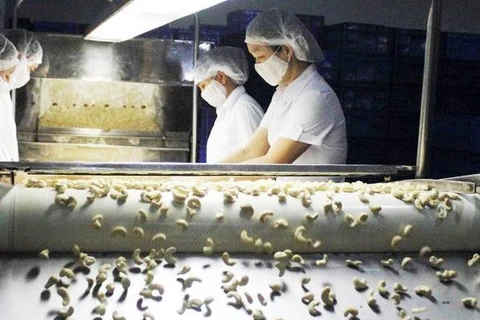
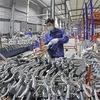
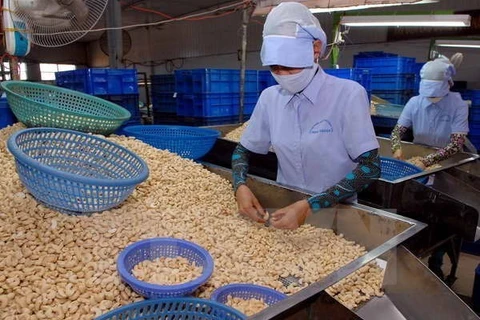
Vietnam remains world’s largest producer, exporter of cashew nuts ảnh 1Vietnam has maintained its position as the world’s largest producer and exporter of cashew nuts in 2020. (Photo: VNA)

Hanoi (VNA) – Vietnam has maintained its position as the world’s largest producer and exporter of cashew nuts in2020, exporting an estimated 450,000 tonnes of cashew kernelsworth 3.2 billion USD, according to the Vietnam Cashew Association (Vinacas).

The information was revealed by the association at a ceremony in Ho Chi Minh City on November 23 to mark its 30th foundinganniversary.

This year, Vietnam also remains the world’s biggestimporter of raw cashew nuts, purchasing about 1.3 million tonnes from overseas.

Data by Vinacas shows that Vietnam began to ship cashewkernels abroad in 1990 after the association was founded. The country exported286 tonnes of cashew kernels for 1.4 million USD that year. In 2004, the volumeincreased to 105,000 tonnes, worth approximately 436 million USD.

In 2006, Vietnam surpassed India for the first time asthe world’s top exporter of cashew kernels, with an export volume of 127,000tonnes worth 504 million USD.

Since 2017, Vietnam has retained its position as the world’s biggest hub for cashew processing and the largest exporter and importer of theproduct, accounting for over 50 percent of the global processed cashew nuts.

The industry has been hit by COVID-19 since the beginningof this year. Though cashew kernel exports reachedmore than 422,000 tonnes in the first 10 months of 2020, a year-on-yearincrease of 12 percent, the 10-month revenue dropped 3 percent to over 2.6billion USD.

Although holding the title of “the world’s No 1 exporter”, Vietnam has still mainly exported semi-processed cashew nuts, which are sold at an averageprice of 10 USD per kilogramme, while finished products sold at supermarketsglobally cost about 30 USD per kilogramme.

Vinacas Vice Chairman Nguyen Minh Hoa said the sector hasbeen under enormous pressure from new policies of major suppliers and importers.African countries, which have been key suppliers of raw cashew nuts to Vietnamfor years, are boosting the development of their domestic cashew processingindustry, he said.

India, one of the world’s largest cashew nut consumptionmarkets, is applying a tax policy to limit the amount of imported cashew nuts,mainly from Vietnam, he continued, adding that other key buyers such as the US and EU are also setting out additional foodsafety standards on cashew kernels from Vietnam.

Vinacas Chairman Pham Van Cong said these provide Vietnam with not only challenges but also opportunitieswhich would encourage domestic manufacturers to restructure, upgrade technologyand improve management capacity to climb up the global supply chain of cashew nuts.

It is important to develop a proper strategy for thecashew sector that facilitates shift from preliminary processing to productionof final products sold in supermarkets, he said.

Cong further noted that Vinacas is formulating a strategy forthe development of Vietnam’s cashew industry in the new context, to be proposedto the government in the near future./.
VNA
See more

Tran Ngoc Quan, Trade Counsellor and head of the Vietnam Trade Office in Belgium and the EU (Photo: VNA)

Belgian firms suggested to expand presence in Vietnamese market

Entering 2026 – the first year of implementing the Vietnam – EU Comprehensive Strategic Partnership, the Vietnam Trade Office in Belgium and the EU views this as a pivotal time to inject new momentum into trade ties, said Trade Counsellor Tran Ngoc Quan.

Saigon Marina IFC, an emerging landmark, reflects Ho Chi Minh City’s pioneering spirit.

Saigon Marina IFC – The light of Ho Chi Minh City’s new icon

Saigon Marina IFC, an emerging landmark, reflects Ho Chi Minh City’s pioneering spirit. Designed to become an International Financial Centre, this new architectural icon along the Saigon River is envisioned not only as a premium commercial complex, but as a central platform supporting financial institutions, international investors and cross-border capital flows in the years ahead.

Shoppers at a supermarket in Hung Yen (Photo: VNA)

Retailers see tax compliance, AI as key to survival in 2026 survey

The annual survey, conducted at the end of 2025 among retail and food and beverage (F&B) sellers nationwide, found that businesses are shifting their focus from rapid growth to operational efficiency, cost control and legal compliance amid increasingly stringent regulatory standards.

Visitors shop at Glorious Spring Fair 2026 (Photo: VNA)

Spring Fair 2026 opens broader prospects for Vietnam–UAE trade cooperation

For Vietnam, the UAE serves not only as a consumer market but also as a gateway to the Middle East and North Africa. Vietnamese agricultural products such as cashew nuts, pepper, cinnamon and rice have steadily gained market share, while aquatic products, including tra fish and tuna, are increasingly present in the UAE’s hospitality sector.

Bao Viet Bank's employee counts Vietnamese banknotes at a transaction counter in Hanoi. (Photo: VNA)

Credit quota reform, tighter capital rules may widen gap among banks

Yuanta Vietnam Securities estimates that to achieve GDP growth above 10%, credit growth would need to exceed 16%. This suggests bank credit is no longer expected to be the main growth driver, with greater reliance on fiscal policy, public investment and capital markets.

Commercial Counsellor Do Viet Phuong, Head of the Vietnam Trade Office in Cambodia. (Photo: VNA)

Spring Fair 2026 offers ample room to deepen Vietnam–Cambodia trade ties

Cambodia holds substantial potential for cooperation in agro-processing and exports, especially in key products such as rice, cashew nuts and rubber. In recent years, the country’s cultivation area and agricultural output have grown steadily, providing a stable raw material base for processing industries.

Vietnam is projected to have approximately 2.4 million SMEs, accounting for over 98% of the country’s total enterprises. (Photo: cafef.vn)

Banks offer diverse solutions to support SMEs

With an increasingly significant role in the economy, the small and medium-sized enterprise (SME) sector is becoming a key segment in the credit growth strategies of many banks and the banks have been taking diverse solutions to support the enterprises.