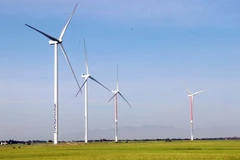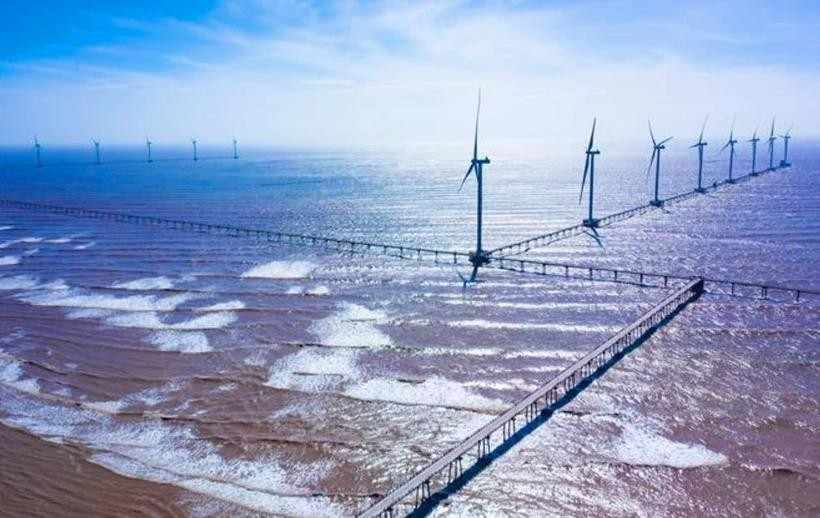
Hanoi (VNA) - Vietnam is laying the groundwork to unlock its vast offshore wind energy potential, which could serve as a cornerstone for its green growth strategy and long-term climate goals.
According to the National Centre for Hydro-Meteorological Forecasting, Vietnam’s Exclusive Economic Zone (EEZ) holds a technical offshore wind potential estimated at 1,068 GW at 100 meters above sea level, with nearly 900 GW concentrated in southern waters. These estimates far exceed previous assessments by international institutions, such as the World Bank's earlier figure of 599 GW.
These findings were presented in a newly released report on assessment of offshore wind energy potential in Vietnam, jointly conducted by the national weather agency, the United Nations Development Programme (UNDP), and the Norwegian Embassy. The report draws on 30 years of wind data (1991–2020), enhanced by satellite imagery and data from coastal weather stations and sea buoys. This dataset forms the most comprehensive and high-resolution (3x3 km) wind climate model ever compiled for Vietnam's seas.
Officials and experts suggest that Vietnam’s wind resources, particularly in the south, offer a solid scientific foundation for offshore wind development. If harnessed effectively, this potential could support the nation’s Net Zero target by 2050 and elevate Vietnam’s role in global renewable energy markets.
At the report’s launch, Deputy Director of the Hydro-Meteorological Administration Hoang Duc Cuong noted that Vietnam benefits from strong, stable monsoon winds, positioning it as a promising offshore wind hub in Asia. He emphasised that alongside investment opportunities, the country must also factor in the impact of severe weather events such as typhoons and strong currents when designing wind power systems. This makes comprehensive risk assessments and long-term forecasting crucial.
The study also breaks down seasonal variations. It identifies December as the peak month for offshore wind generation nationwide, with the northeast monsoon enhancing performance in the north and central regions from November through March. Conversely, wind speeds drop in May and June, posing operational challenges.
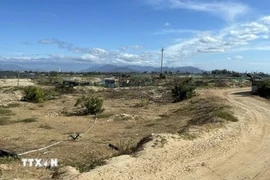
Nearshore areas up to six nautical miles from the coast were found to offer 57.8 GW of additional potential, especially in Bac Lieu–Ca Mau (over 16 GW) and Ninh Thuan–Binh Thuan (over 24 GW). The northern coast, by contrast, holds much less potential, at only 0.17 GW.
Norwegian Deputy Ambassador Mette Møglestue described the study as a model of international collaboration and underscored the importance of reliable data in marine spatial planning and wind energy policymaking. Drawing on Norway’s experience in the sector, she expressed his hope that the data would help guide Vietnam’s regulatory roadmap for offshore wind.
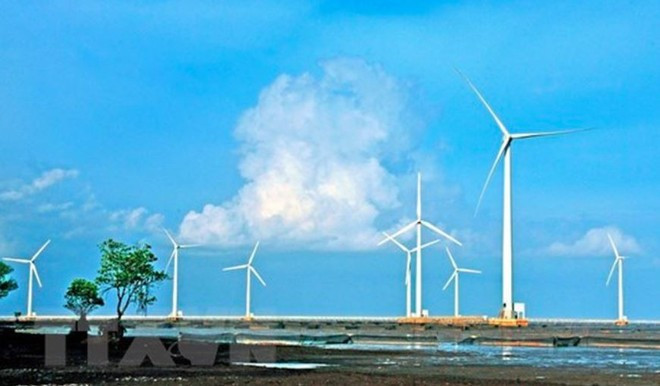
Beyond identifying capacity, the report delivers a wind energy atlas with 204 detailed maps showing wind speed, power density, and variability across various heights (10 to 250 meters). These tools are expected to help investors and policymakers select priority zones, design efficient turbines, and forecast energy output. The atlas is compatible with geographic information systems (GIS), further enhancing its practical utility.
Experts believe that this marks the first time Vietnam has had access to such a high-resolution marine wind dataset, providing vital support for infrastructure planning, project design, and technology selection. Importantly, it also maps areas prone to extreme marine weather, helping identify regions where wind projects may face greater risks.
To accelerate offshore wind development, the report recommends further investment in offshore wind measurement stations at heights above 100 meters, continued research into tidal and wave energy, and establishing transparent data-sharing mechanisms for meteorological and oceanographic data.
Patrick Haverman, UNDP’s Deputy Resident Representative in Vietnam, praised the report’s technical depth, noting that it delivers Vietnam’s most detailed offshore wind atlas to date. He said it would play a key role in advancing marine spatial planning, attracting investment, and implementing the country’s updated Power Development Plan (PDP VIII) and newly approved marine spatial plans.
With a strong technical foundation now in place, Vietnam appears to be taking meaningful steps toward positioning offshore wind as the pillar of its renewable energy strategy, offering both environmental benefits and long-term economic opportunities./.