Vietnam to halve required reserve ratio for select banks

Under Circular No. 23/2025/TT-NHNN dated August 12, 2025, which amends Circular No. 30/2019/TT-NHNN on the implementation of required reserves of credit institutions and foreign bank branches, credit institutions as mandatory transferees of commercial banks placed under special control will benefit from the policy.

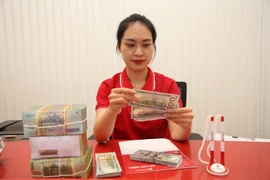
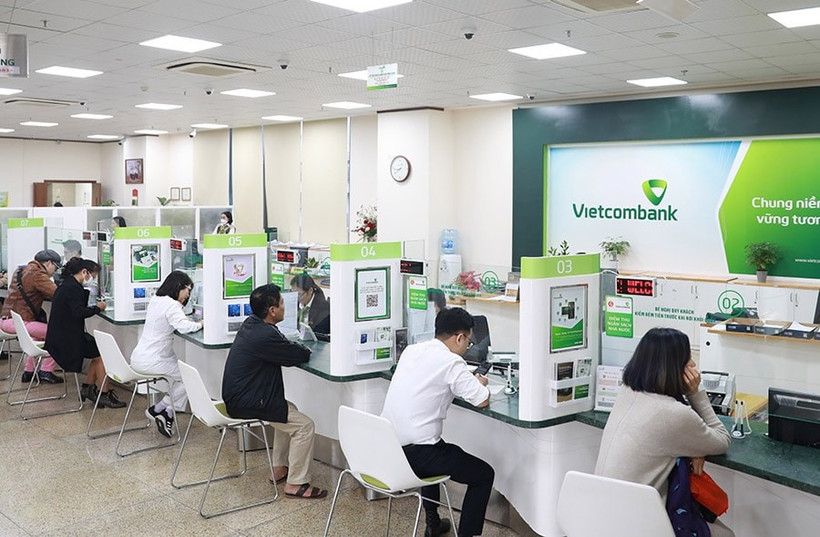
At a transaction branch of Vietcombank (Photo: VNA)

Hanoi (VNA) – The State Bank of Vietnam (SBV) has announced that from October 1, 2025, certain commercial banks will be entitled to a 50% reduction of the required reserve ratio, a move expected to inject dozens of trillions of dong into the economy.

Under Circular No. 23/2025/TT-NHNN dated August 12, 2025, which amends Circular No. 30/2019/TT-NHNN on the implementation of required reserves of credit institutions and foreign bank branches, credit institutions as mandatory transferees of commercial banks placed under special control will benefit from the policy.

Beneficiaries include the JSC Bank for Foreign Trade of Vietnam (Vietcombank), Military Commercial Joint Stock Bank (MB), the Vietnam Prosperity Joint Stock Commercial Bank (VPBank) and the Ho Chi Minh City Development Joint Stock Commercial Bank (HDBank), which have been active participants in the SBV’s restructuring programme.

Banking experts agree that the SBV’s decision to cut the ratio by 50% for credit institutions taking over weak banks is a strategic liquidity boost for the four receiving lenders. The policy not only eases funding costs but also strengthens liquidity, lowers capital expenses, and supports credit growth.

In practice, with their large deposit bases, each bank could free up trillions to dozens of trillions of dong. This extra capital can reinforce liquidity buffers, expand lending capacity, reduce pressure to mobilise new deposits, cut funding costs, and widen profit margins. With such resources, banks can grow credit without raising deposits, thereby stimulating the economy and aiding the restructuring of weaker lenders.

In October 2024 and early 2025, the SBV transferred four struggling lenders to stronger banks: CBBank to Vietcombank, OceanBank to MB, GPBank to VPBank and DongA Bank to HDBank.

These institutions had been under special control for years due to accumulated losses and bad debts. Following the transfer, they were renamed and rebranded, including VCBNeo (formerly CBBank), MBV (formerly OceanBank) and Vikki Bank (formerly DongA Bank).

From October 2025, the four banks are projected to release 17.2–51.7 trillion VND (662 million USD – 1.99 billion USD) depending on their deposit structures.

Vietcombank, with the largest deposit base in the sector, is expected to benefit the most from the circular. With customer deposits exceeding 1.58 quadrillion VND as of June 30, 2025, it could potentially unlock 7.9–23.8 trillion VND in required reserves to support lending, invest in government bonds, and enhance capital adequacy.

MB could free up 3.9–11.7 trillion VND, strengthening liquidity for small and medium-sized enterprise (SME) lending and providing a safety buffer for OceanBank’s balance sheet consolidation.

VPBank is forecast to release 3–9 trillion VND, which could bolster retail and SME lending, easing funding pressure during GPBank’s acquisition. Meanwhile, HDBank expects an extra 2.4–7.2 trillion VND to channel into high-yield sectors such as retail and aviation, supporting DongA Bank restructuring while sustaining growth and margins.

For the wider economy, the policy is expected to enhance liquidity, channel more capital into production and business, ease interest rate pressures and create momentum for growth. It is also seen as supporting public confidence in the banking system, accelerating the sector’s restructuring process and contributing to financial stability./.

VNA
See more

Phin Ho Tra – a national five-star OCOP product. (Illustrative photo: VNA)

Hanoi to host Vietnam OCOP Festival 2025

The festival is seen a practical activity celebrating the achievements made by the capital and the country in 2025, affirming OCOP’s role in rural economic development, contributing to realising Vietnam’s aspiration for strong economic growth in the context of deep integration.

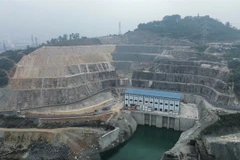
The expanded Hoa Binh Hydropower Plant (Photo baochinhphu.vn)

EVN launches major power projects

Among the flagship projects inaugurated was the expanded Hoa Binh Hydropower Plant with a total installed capacity of 480MW per year and average annual output of about 488 million kWh.

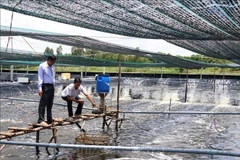
An ultra-intensive shrimp farming model linked with environmental protection in Ca Mau province. (Photo: VNA)

Fisheries take the lead in the Mekong Delta’s green transition

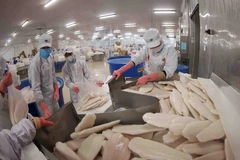
Across the Mekong Delta, leading aquaculture producers, processors and exporters, along with suppliers of inputs, are transitioning to circular, high-tech and clean production models that cut greenhouse gas emissions and comply with international certification standards.

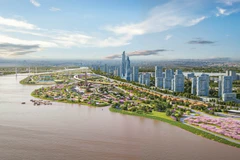
A perspective view of the Red River Landscape Boulevard project in Hanoi (Photo: VNA)

Works starts on Hanoi’s Red River Landscape Boulevard Axis project

The project is among the 234 key works and projects being launched, inaugurated or technically opened simultaneously across 34 cities and provinces nationwide to mark the 14th National Party Congress. Its launch contributes to implementing the country’s strategic development orientations while concretising Hanoi’s development goals in the new period.

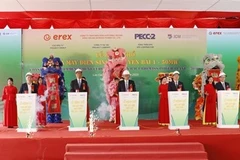
The ground-breaking ceremony of the Yen Bai 1 biomass power plant in Lao Cai province on December 19. (Photo: VNA)

Work starts on 114-million-USD biomass power plant in Lao Cai

The project, developed by Erex Yen Bai Biomass Power Co. Ltd. is located in Dong Cuong commune, Lao Cai province. It is backed by Japan’s Erex Group and falls under the Joint Crediting Mechanism, a bilateral initiative between Vietnam and Japan to reduce greenhouse gas emissions.

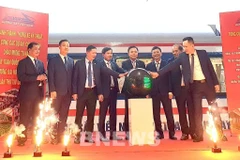
At the inauguration ceremony (Photo: VNA)

Vietnam Railways Corporation unveils upgraded coaches, digital tools

These moves reflect the VNR's commitment to fulfilling six priority tasks set by the Prime Minister, including leading in innovation and digital transformation, applying sci-tech in line with the Politburo’s Resolution No. 57-NQ/TW, and spearheading advances in digital, green and circular economy.

Producing MDF panels for export at Hai Duong MDF Construction and Manufacturing Co., Ltd., in Ho Chi Minh City (Photo: VNA)

HCM City targets 15 billion USD in wood exports by 2035

The merger of HCM City with Binh Duong and Ba Ria – Vung Tau is expected to give the local wood industry a strong boost into a phase of high-quality growth driven by linkages, innovation, sustainability, and deeper integration into global value chains.

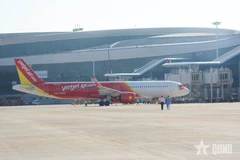
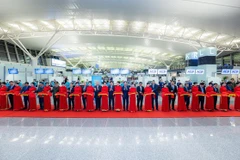
Delegates cut a ribbon to inaugurate the expanded Terminal T2 at Noi Bai International Airport in Hanoi on December 19, 2025. (Photo: VNA)

Expanded Terminal T2 at Noi Bai International Airport makes debut

The project expands the terminal’s floor area to over 200,000 sq.m, increases passenger capacity from 10 million to 15 million, even up to 18 million per year, and boosts operational capacity with boarding gates rising from 17 to 30 and jet bridges from 14 to 27, meeting strong growth in international travel demand.

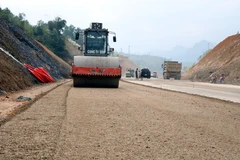
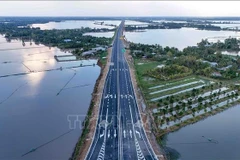
A section of Can Tho - Ca Mau Expressway (Photo: VNA)

Can Tho – Ca Mau travel time halves from December 19

Stretching more than 110 km with a total investment of over 27.5 trillion VND (1.04 billion USD), the project not only resolves long-standing traffic bottlenecks in the Mekong Delta, but also opens up new development opportunities for the entire region - especially Ca Mau, the last locality in the country to be directly connected to the eastern North–South expressway axis.