Vietnam underscores enduring values of UN Charter

Despite the immense pain and loss endured, Vietnam has consistently chosen the path of peace, cooperation, and reconciliation — principles that lie at the heart of the UN Charter.

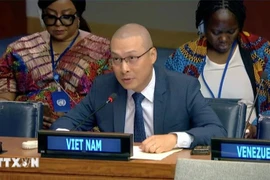
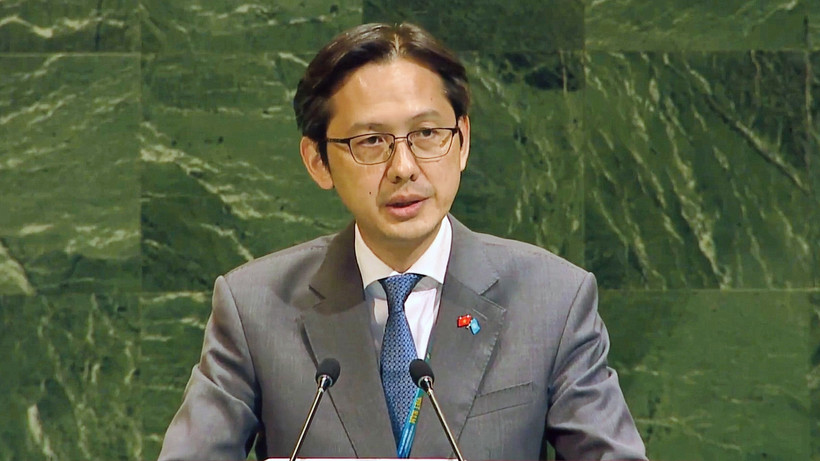
Ambassador Do Hung Viet, head of the Vietnamese Permanent Mission to the United Nations, speaks at the event (Photo: VNA)

New York (VNA) – Ambassador Do Hung Viet, head of the Vietnamese Permanent Mission to the United Nations, has underlined the historic significance and core values of the UN Charter in Vietnam’s struggle for independence and efforts to defend national sovereignty.

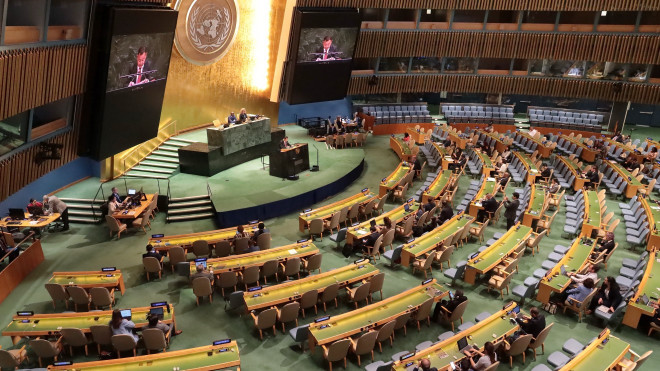
Viet made the statement while addressing the UN General Assembly’s plenary session marking the 80th anniversary of the signing of the UN Charter (1945–2025). The event took place in New York on June 26 (local time) with the participation of UN Secretary-General, the Presidents of the UN General Assembly, the UN Security Council, the UN Economic and Social Council, the International Court of Justice, and representatives of member states.

He noted that just two months after the Charter was signed in 1945, Vietnam declared its independence. However, the country was forced to endure decades of resistance to defend its right to self-determination and territorial integrity and fight against blatant violations of the Charter.

The ambassador stressed that Vietnam’s experience, along with that of many other nations, demonstrates that the use of force, aggression, and interference in internal affairs ultimately leads to failure, whereas the will of the people and the right to self-determination will always prevail.

He further emphasised that despite the immense pain and loss endured, Vietnam has consistently chosen the path of peace, cooperation, and reconciliation — principles that lie at the heart of the UN Charter. On this occasion, he called on the international community to reflect on the lessons of history, avoid repeating past mistakes, and together make efforts to fully implement the charter in pursuit of a world that is peaceful, just, and sustainably developed for all.
quang-canh.jpg
An overview of the UN General Assembly’s plenary session marking the 80th anniversary of the signing of the UN Charter (Photo: VNA)

In his remarks, UN Secretary-General António Guterres stated that the principles of the charter are facing serious threats and urged nations to reaffirm their commitment to the Charter and international law for the sake of global peace, justice, and progress.

The Presidents of the General Assembly, the Security Council, and the Economic and Social Council noted that amid mounting conflicts and increasing challenges to multilateralism, the anniversary serves not only as a moment of reflection on the achievements in global cooperation over the past eight decades, but also as an opportunity for member states to advance the Charter’s vision of peace, partnership, and development.

Countries expressed concern over the rise of unilateral actions and breaches of international law, calling on the global community to reaffirm its commitment to the Charter’s principles, particularly sovereign equality, non-interference, and the peaceful settlement of disputes.

As part of the celebration, the original UN Charter, signed in San Francisco in 1945 and preserved by the US National Archives, was brought back to UN Headquarters for the first time in decades. The historic document will be on display until September this year, serving as a powerful symbol of the enduring commitment to multilateralism, peace, and the shared goals of humanity./.
VNA

See more

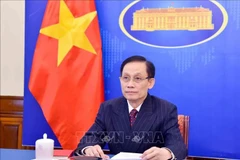
Vietnamese Minister of Foreign Affairs Le Hoai Trung (Photo: VNA)

Vietnamese, Lao foreign ministers hold online talks

The two ministers agreed to maintain close coordination in the time ahead and to expand cooperation under the new framework and orientation, underscoring the significance of the two countries’ “great friendship, special solidarity, comprehensive cooperation, strategic cohesion”.

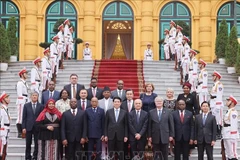
State President Luong Cuong (fourth from left, first row) and newly-appointed foreign ambassadors in Hanoi on December 12, 2025. (Photo: VNA)

State President receives newly-appointed foreign ambassadors

Receiving Egyptian Ambassador Hany Mostafa Mohamed Mostafa Hassan, President Cuong affirmed that Vietnam highly evaluates Egypt’s role, position, and contributions to regional peace and stability. He also congratulated the African country on its achievements in implementing the 2030 Vision.

An overview of the seminar on the Party’s leadership in ensuring macroeconomic stability, renewing the growth model, restructuring the economy and promoting international integration (Photo: VNA)

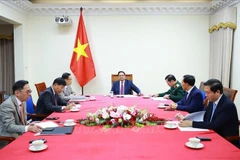
Vietnam, Cuba exchange theoretical views on Party’s leadership in macroeconomic stability

The two sides explored in depth the Party’s role in leadership, orientation, oversight and strategic coordination in economic management; approaches to implementing economic restructuring programmes alongside the renewal of the growth model; measures to respond to global economic volatility, inflationary pressures and shifts in global trade; and the building of effective strategic advisory bodies to ensure the Party’s comprehensive leadership in a changing context.

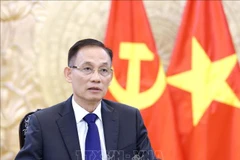
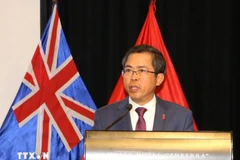
Vietnam’s Ambassador to Australia Pham Hung Tam (Photo: VNA)

Australia–Vietnam Policy Institute serves as bridge for bilateral relations

Established in 2022, AVPI serves as a forum for exchanging ideas among businesses, government agencies, non-profits, universities, and scholars in Australia on Vietnam. The institute acts as a platform for policy dialogue, focusing on research and insights on strategic relations and bilateral economic ties.

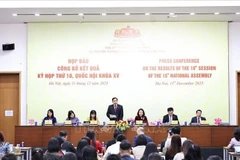
General Secretary and Chairman of the NA Office Le Quang Minh chairs the press conference announcing the results of the NA's 10th session (Photo: VNA)

10th session helps strengthen public trust in personnel work, NA’s supreme oversight

Personnel consolidation carried out at the NA's 10th session helps ensure continuous, unified, effective, and efficient leadership of the state apparatus; guarantee smooth and uninterrupted direction and governance; and prevent any leadership gaps in critical areas. All positions elected or approved by the legislature meet the key criteria required within the organisational structure.