Vietnam urged to unlock bottlenecks to boost logistics competitiveness

In recent years, the country’s logistics services industry has experienced strong expansion, gradually establishing a presence in regional and global markets. However, development still falls short of Vietnam’s potential and advantages.

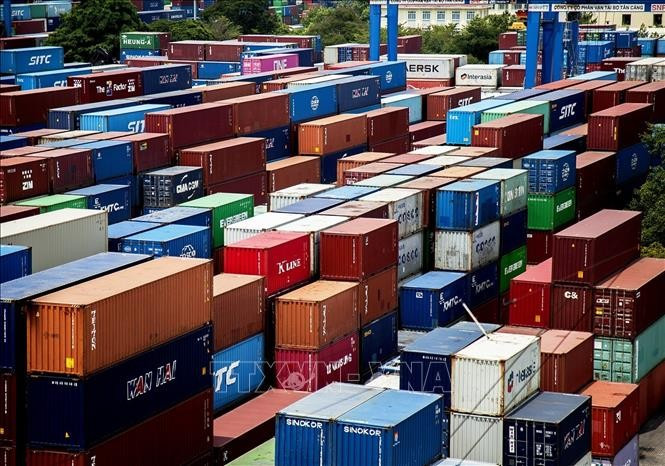
A container storage yard at Cat Lai Port in Ho Chi Minh City (Photo: VNA)

Hanoi (VNA) – Vietnam needs coordinated short- and long-term measures to secure rapid and sustainable growth in its logistics sector, experts have said.

In recent years, the country’s logistics services industry has experienced strong expansion, gradually establishing a presence in regional and global markets. However, development still falls short of Vietnam’s potential and advantages.

Major bottlenecks remain

Situated in one of the world’s most dynamic economic regions, Vietnam benefits from concentrated trade flows and a highly open economy, ranking third in ASEAN and 32nd globally. It is also among the world’s top 20 countries in terms of international trade scale and among the top 15 for foreign direct investment (FDI) attraction, offering significant opportunities for logistics development.

Recognising the sector’s importance, the Party and State have issued mechanisms and policies aimed at removing bottlenecks, cutting costs and improving competitiveness.

According to the Ministry of Industry and Trade, thanks to strong Government direction and active engagement from ministries and localities, Vietnam’s logistics sector has recorded annual growth of 14–16%, more than double the global average. The market is now valued at 45–50 billion USD, equivalent to around 10% of GDP. In 2025, Vietnam ranked among the world’s top 10 emerging logistics markets, top four in the region for logistics opportunity, top five in ASEAN and top 40 globally in logistics performance.

However, logistics costs remain high compared with regional peers, weakening competitiveness. Infrastructure and regional connectivity are uneven, while shortages of skilled workers persist. Digital transformation and green logistics are still at an early stage. Experts warn that these bottlenecks must be tackled through feasible, well-coordinated solutions.

Coordinated measures required

The Prime Minister on October 9 issued Decision No. 2229/QD-TTg approving the Strategy for the Development of Vietnam’s Logistics Services for 2025–2035, with a vision to 2050. It targets a sustainable, efficient and high-value-added sector with strong international competitiveness. By 2035, logistics is expected to contribute 5–7% of GDP, grow 12–15% annually and reduce logistics costs to 12–15% of GDP.

Deputy Director of the Agency of Foreign Trade Tran Thanh Hai said Vietnam must refine its legal framework, invest in modern infrastructure, enhance regional connectivity, develop supply sources and markets, promote innovation and digitalisation, advance green logistics and train high-quality human resources, while building a national logistics database.

At the 2025 Vietnam Logistics Forum, international experts proposed further measures. Professor Thomas Sim, President of the International Federation of Freight Forwarders Associations (FIATA), said global logistics is rapidly shifting towards smart logistics. Vietnam, he noted, should seize opportunities to become ASEAN’s smart multimodal hub, accelerate digital trade integration, develop future-ready logistics zones and tap cross-border e-commerce. FIATA is ready to support Vietnam in training, digital standards, multimodal connectivity and green logistics.

Vietnam Logistics Business Association (VLA) President Dao Trong Khoa proposed strengthening the national logistics coordination mechanism and establishing a national logistics office under the Ministry of Industry and Trade to consolidate policy inputs and act as a bridge with the business community./.
VNA

See more

Workers in the Du Long Industrial Park, Khanh Hoa province. (Photo: VNA)

Key economic policies taking effect in January 2026

A wide range of new economic policies and legal provisions will come into force in January 2026, covering taxation, advertising, land use, minimum wages, public finance, railways, technology transfer and statistics, among others.

From 4 billion USD in 2015, the size of the e-commerce market increases eightfold to reach 32 billion USD last year. (Photo: VNA)

Hanoi leads 2025 Vietnam eBusiness Index

​The average score of the rankings is 9.3 points. The gap in e-commerce development between the two major economic centres–Hanoi and HCM City–and the remaining provinces and cities is very large.

An aircraft of Vietnam Airlines - Illustrative image (Photo: VNA)

Vietnam Airlines adds 270 flights to during 2026 New Year holiday

Vietnam Airlines said the swift deployment of additional flights during the New Year holiday demonstrates the carrier’s proactive approach and readiness in mobilising resources to serve passengers during peak travel periods at the end of 2025 and the beginning of 2026.

Prime Minister Pham Minh Chinh (second from right) conducts an aerial inspection of the Ca Mau–Dat Mui expressway, the road leading to Hon Khoai, and the dual-use Hon Khoai port from a helicopter. (Photo: VNA)

PM urges faster progress on key infrastructure projects in Dat Mui, Ca Mau

During an aerial survey of Dat Mui commune, home to the five islands of Hon Khoai, Hon Sao, Hon Go, Hon Doi Moi and Hon Da Le, the Prime Minister underscored the area’s strategic importance for national defence, economic development and connectivity across the province, the Mekong Delta and the wider southern region.

Dao Ngoc Tien, Vice Rector of Foreign Trade University, speaks at the event. (Photo: doanhnghiepvn.vn)

High standards key for businesses to unlock VEFTA benefits

The EFTA bloc, comprising Switzerland, Norway, Iceland, and Liechtenstein, has a relatively small population but a combined GDP of about 1.3 trillion EUR (1.5 trillion USD), high living standards, and strong demand for high-quality products.

Workers make products for the Lunar New Year (Tet) in Hanoi's Bat Trang commune. (Photo: hanoimoi.vn)

Hanoi craft villages bustle as Lunar New Year approaches

Hanoi is home to the largest number of craft villages nationwide, with about 1,350 villages and craft-based communities, accounting for roughly 56% of rural villages in the capital. Of these, 318 are officially recognised as traditional craft villages.

Four seaports and four inland waterway ports are currently in operation within the Cai Mep Ha free trade zone. (Photo: VNA)

​ HCM City seeks new growth drivers as megacity takes shape

As traditional growth engines show signs of reaching their limits, HCM City is recalibrating its long-term development strategy in search of new drivers capable of sustaining momentum and reinforcing its role as the economic nucleus of the southern region.

Garment production for export at Hoa Tho Garment JS Corporation. (Photo: nhandan.vn)

Textile, garment industry secures role in global supply chain

By diversifying markets, products and customers, the sector has mitigated risks and responded proactively to market fluctuations, despite numerous challenges such as disrupted supply chains, rising shipping costs, and rapidly changing purchasing policies in many markets.

Visitors check a new car model of VinFast at the Vietnam Mobility Show 2025. (Photo: VNA)

Vietnam Mobility Show 2025 opens in Hanoi

Taking place at a time when Vietnam’s automobile industry is undergoing strong transformation towards electrification and emission reduction, the show aims to introduce advanced technologies, eco-friendly vehicles, and sustainable mobility models.