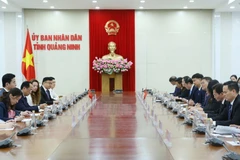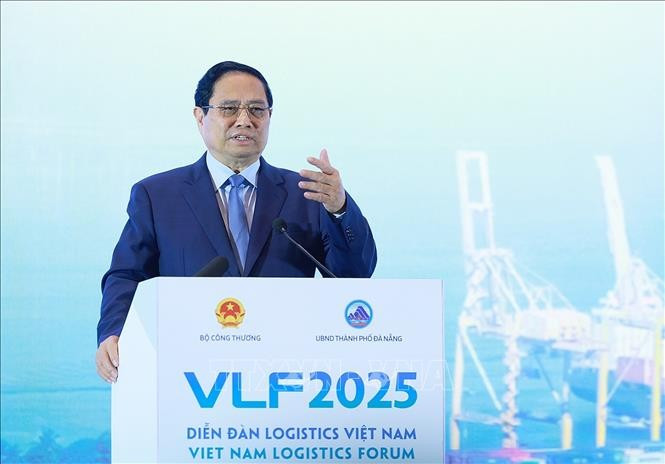
Hanoi (VNA) – Prime Minister Pham Minh Chinh attended the plenary session of the Vietnam Logistics Forum 2025 in the central city of Da Nang on November 29, reaffirming the Government’s commitment to building a national logistics ecosystem that is smart, modern, green, digital, competitive, and efficient.
In his remarks, Prime Minister Chinh emphasised the forum’s importance as a strategic platform for promoting the rapid and sustainable growth of the logistics sector - an industry that underpins the flow of goods and stands as a vital pillar driving the nation’s competitiveness.
Acknowledging and commending the contributions and proposals of delegates and speakers at the forum, the Government leader stated that the Party and State have placed strong focus on the logistics sector, implementing key policies and investing resources to support its development.
According to the PM, these efforts have yielded encouraging results, with logistics services growing steadily at an average rate of 14-16% per year and directly contributing 4.5-5% to annual GDP. Vietnam ranks 43rd out of 139 countries in the Logistics Performance Index (LPI) and is among the top five in ASEAN.
The industry has grown significantly, contributing to enhancing the competitiveness of goods, reducing import-export costs, and promoting both international trade growth and domestic goods circulation.
However, he candidly pointed out that Vietnam’s logistics sector still faces several challenges, including high costs compared to regional peers; uneven infrastructure and regional connectivity; weak competitiveness among enterprises and no national hub for international cargo; a shortage of well-trained and professional personnel; an underdeveloped regulatory framework; and slow progress in digital transformation and and green transition.
These challenges call for a shift from a fragmented, support-focused approach to one that fosters a modern and smart logistics sector, moving from a ‘management’ mindset to one of ‘creation and service,’ in line with the newly-issued Vietnam Logistics Service Development Strategy,” he said.
Highlighting Vietnam’s geopolitical and geo-economic advantages in logistics development, the PM stressed that the sector must grow in line with the country’s strategic goals, aiming for 12-15% annual growth, logistics value added at 5-7% of GDP, and costs reduced to 12-15% of GDP.
To achieve these targets, PM Chinh underlined the need to streamline policies and planning, develop green and digital logistics infrastructure, strengthen international cooperation on green and low-carbon logistics, train a skilled workforce, and promote multinational enterprises to integrate into global value chains, aiming to maintain a high value-added share of 20–25% by 2030.
He also called for mechanisms to mobilise resources for developing a modern, smart, green, and digital logistics sector; encouraging innovation and startups, particularly in digital technology, transport platforms, warehouse management, and e-commerce; expanding logistics-related services such as banking, insurance, finance, health care, and education; and connecting Vietnam’s logistics with international networks.
The PM asked the Ministry of Industry and Trade to urgently provide guidance and coordinate with other ministries, local authorities, associations, and logistics enterprises to implement the Vietnam Logistics Service Development Strategy for 2025–2035, with a vision toward 2050.
Other ministries were tasked with strengthening the organisation and operational mechanisms of the National Steering Committee of the ASEAN Single Window (ASW) mechanism, the National Single Window (NSW) mechanism and trade facilitation; enhancing the effectiveness of intersectoral coordination to promptly restructure international and domestic supply chains and logistics services, and shift growth models toward efficiency.
The PM also underlined the need to implement transport planning to ensure effective connections with logistics centres nationwide, aligning logistics centre plans with seaport, dry port, and bonded warehouse layouts; and complete infrastructure facilities across road, rail, inland waterways, maritime, and air transport networks.
He requested Ho Chi Minh City, Hai Phong, Da Nang, and other coastal localities to leverage and enhance the advantages of free trade zones and international financial centres; complete infrastructure; promote logistics services, and create opportunities for the country to keep pace with regional and global trends; proactively plan regional logistics hubs, attract investment, implement “smart logistics city” models, and maximise the benefits of free trade zones.
Relevant Relevant ministries, agencies, and localities were tasked with developing a national logistics database integrated with the NSW system, digital customs, smart ports, and digital multimodal transport, while logistics companies were encouraged to adopt AI, IoT, blockchain, supply chain and warehouse management, routing, and risk management, towards positioning logistics as one of the eight priority sectors in the National Digital Transformation Strategy.
The PM affirmed the Government’s commitment to ensuring political, social, and economic stability; addressing economic bottlenecks; promoting green supply chains; reducing costs; and building a stable, competitive, and transparent business environment with resilient, climate-adaptive infrastructure.
He stated that the Government remains committed to open institutions, seamless infrastructure, smart governance, practical methods, and effective cooperation , to develop logistics into a key economic sector, contributing to realising the goal of placing Vietnam among the world’s top 30 countries in the LPI by 2035.
The leader urged the logistics business community to continue innovating in management and chain linkage, advancing digital and green transformation, while upholding the spirit of self-reliance, resilience, innovation, creativity, unity, and cooperation to expand markets in the region and the world.
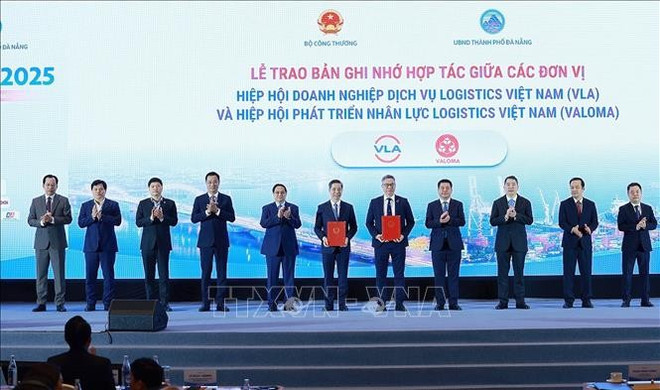
He said that the Vietnam Logistics Business Association (VLA), the Vietnam Logistics Human Resources Development Association (VALOMA)), and local logistics associations serve as key bridges, providing policy advice, supporting training, and promoting logistics services in international markets.
He reiterated that Vietnam has the potential for its logistics sector to achieve breakthroughs, integrate, and lead in the region by harnessing vision, innovation, and the strength of people and businesses, turning challenges into opportunities and potential into results through decisive actions.
The PM showed his belief that Vietnam will successfully build a smart, green, digital and modern national logistics ecosystem, positioning the country as a leading logistics hub in Southeast Asia and the world.
At the plenary session, PM Chinh and delegates joined a ceremony to raise funds for supporting residents in the central and Central Highlands regions affected by recent storms and floods.
The forum, organised annually by the MoIT, aims to promote the development of logistics services, strengthen the linkage between logistics and production as well as import-export industries, and serve as a platform for dialogue, exchange of views, and updates on key domestic and international logistic issues.
Themed “Vietnam Logistics – Rising into the New Era,” the 2025 forum serves not only as a continuation of the series of annual events but also as a reflection of the sector’s aspiration to elevate Vietnam’s logistics industry during a period of strong transformation./.