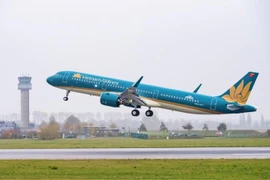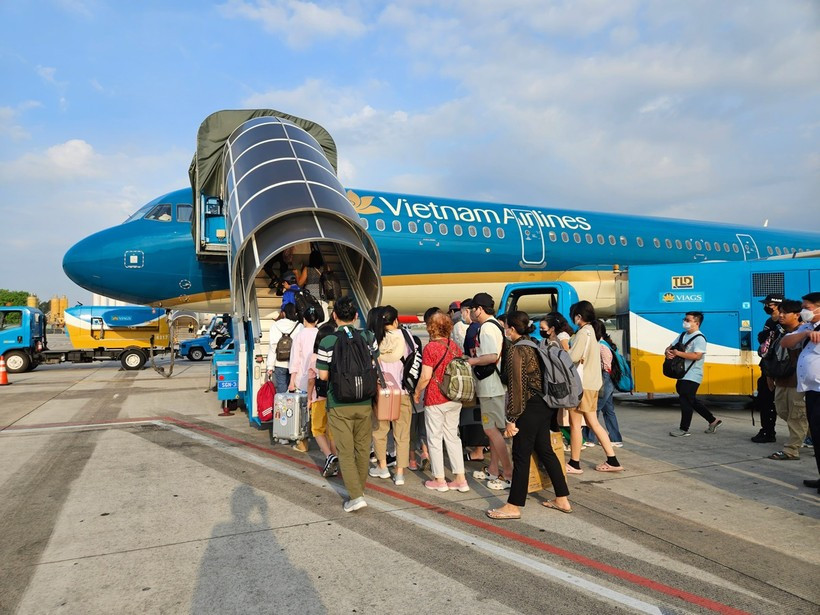
Hanoi (VNA) - Summer 2025 marks the peak season for Vietnam’s aviation sector, presenting a dynamic and more promising outlook than ever before.
Impressive recovery figures for international routes, along with newly launched strategic partnerships with foreign airlines, are gradually shifting Vietnam’s aviation industry away from an intensely competitive domestic market towards the more profitable international segment.
Stable growth
According to the Civil Aviation Authority of Vietnam (CAAV), in the first half of 2025, the entire market served 41.3 million passengers, representing a 10% increase compared to the same period in 2024. Notably, the international market accounted for 23 million passengers, up by 13%, while the domestic maintained a steady 7% growth with 18.4 million passengers.
Nguyen Van Nhung, Chief Accountant of the Airports Corporation of Vietnam (ACV), observed that the international segment has nearly fully recovered. Major markets such as China, Japan, the Republic of Korea, Taiwan (China), Southeast Asia, India, and Australia have all demonstrated stable growth.
This robust recovery provides a solid foundation for ACV to continue investing in infrastructure upgrades and improve service quality across 22 airports nationwide. ACV currently manages nine international airports and 13 domestic airports, delivering security, ground services, passenger assistance, and flight operations support for most domestic and international carriers.
The strong rebound in international travellers not only boosts ground service revenues but also generates vital investment resources to address infrastructure bottlenecks — from congestion at major airports like Noi Bai and Tan Son Nhat to upgrading facilities at popular tourist gateways such as Cam Ranh and Phu Quoc.
Although domestic fares are regulated by ceiling prices, intense competition compels airlines to offer frequent discounts and promotional fares to attract customers. Consequently, profit margins on domestic tickets are approaching their limits. Therefore, expanding international services and broadening flight networks is an inevitable strategy to open new profit channels, cater to high-spending passenger segments, and support Vietnam’s tourism industry in attracting direct foreign currency inflows.
Vietnam Airlines is leading this trend, having launched a direct Hanoi–Milan route earlier in July, bringing its total number of direct European routes to 10.
Simultaneously, the carrier announced a codeshare partnership with Saudia Airlines, the national carrier of Saudi Arabia. This agreement enables Vietnamese passengers to travel to Jeddah and Riyadh with a single ticket and check-in process, while accumulating SkyTeam alliance miles. A Vietnam Airlines representative stated that the codeshare deal opens a new connection between Vietnam and the Middle East — a market rich in tourism, pilgrimage, and commerce potential with strong spending power. This is a strategic move as Saudi Arabia attracts international tourists with its luxury services and unique culture, while also serving as a vital East-West transit hub.
Low-cost, foreign carriers join the race
Not only traditional airlines but also low-cost carrier Vietjet is aggressively expanding its international footprint, focusing on the Chinese market — the largest source of tourists before the COVID-19 pandemic, expected to rebound strongly with relaxed visa policies.
At the beginning of July, Vietjet inaugurated a direct Hanoi–Chengdu route, extending its dense network from Hanoi and Ho Chi Minh City to Beijing, Shanghai, Guangzhou, and Xi’an. Flights operate four times weekly with convenient night departures catering to both business travellers and tourists.
Nguyen Hung, a frequent traveller, commented that previously business trips required transiting through Guangzhou, which was time-consuming and costly. Now, the direct flight with convenient night timings and competitive fares makes travel much easier for both business and leisure.
Foreign carriers have also swiftly capitalised on Vietnam’s tourism potential. Scoot, the low-cost arm of Singapore Airlines, announced it will launch a direct Singapore–Cam Ranh route starting November 21, operating twice weekly, with plans to increase frequency to five times weekly from January 2026. This is the first direct flight connecting Singapore with Cam Ranh.
A representative of Cam Ranh International Terminal Joint Stock Company noted that Scoot’s choice of Cam Ranh, alongside Da Nang and Kota Bharu (Malaysia), to establish its Southeast Asia network highlights the appeal of Vietnam’s coastal tourism. The route will not only serve local residents of Khanh Hoa province but also attract Singaporean tourists and international travellers connecting via Changi Airport — one of the world’s leading transit hubs.
Scoot’s launch of flights to Cam Ranh is expected to give a significant boost to the local tourism sector, benefiting hotels, resorts, transport services, tour guides, and catering businesses, while helping Khanh Hoa affirm its position as Vietnam’s premier coastal tourism centre./.
VNA