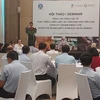
A host of Vietnamese and Thai small-and medium-sized enterprises gathered at an exchange in Ho Chi Minh City on November 2 to seek cooperation opportunities.
The event was jointly organised by the Vietnam Chamber of Commerce and Industry in HCM City (VCCI-HCMC), Thailand ’s Federation of Industries, and Centre for the Small-and Medium Scale Industries (SMI).
Nguyen The Hung, VCCI – HCMC Deputy Director said the event aims to promote economic ties between the two countries and offers trading and investment opportunities to businesses.
The participating Thai businesses are involved in food, beverages, garment, textile, pharmaceuticals, aquatic products, packaging and consumer goods.
Two-way between the two countries topped 8 billion USD last year, up 20.5 percent from 2010. In the first five months of this year alone, the figure reached 3.8 billion USD.
Vietnam mainly exports iron, steel, farm and aquatic products to Thailand while imports oil and gas, plastic materials, machinery, equipment and auto and motorbike spare parts from the neighbour country.
Thailand now invests in 257 projects worth nearly 6.7 billion USD in Vietnam , entering the list of top ten investors in the country.-VNA
The event was jointly organised by the Vietnam Chamber of Commerce and Industry in HCM City (VCCI-HCMC), Thailand ’s Federation of Industries, and Centre for the Small-and Medium Scale Industries (SMI).
Nguyen The Hung, VCCI – HCMC Deputy Director said the event aims to promote economic ties between the two countries and offers trading and investment opportunities to businesses.
The participating Thai businesses are involved in food, beverages, garment, textile, pharmaceuticals, aquatic products, packaging and consumer goods.
Two-way between the two countries topped 8 billion USD last year, up 20.5 percent from 2010. In the first five months of this year alone, the figure reached 3.8 billion USD.
Vietnam mainly exports iron, steel, farm and aquatic products to Thailand while imports oil and gas, plastic materials, machinery, equipment and auto and motorbike spare parts from the neighbour country.
Thailand now invests in 257 projects worth nearly 6.7 billion USD in Vietnam , entering the list of top ten investors in the country.-VNA