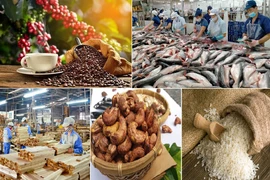
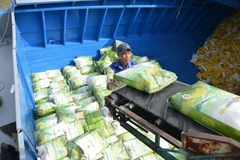
Loc Troi Group, a leading provider of agricultural services and products in Vietnam, exports rice to the European market. (Photo: VietnamPlus)
Hanoi (VNA) - Vietnam earned 15.66 billion USD from agro-forestry-aquatic product exports in the first four months of 2023, down 13.3%year-on-year, according to the Ministry of Agriculture and Rural Development (MARD).
The decrease in agro-forestry-aquatic product export revenue was attributable to impacts of the global economy which is forecast to slow down this year, the Russia-Ukraine conflict, and inflation surges in some countries, MARD said.
Moreover, many countries have stepped up exports, while imported inventory remains high in major markets like the US and the EU, making many domestic enterprises unable to earn new orders, the ministry said.
It added that the sector posted a trade surplus of 2.51 billion USD in the reviewed period, a yearly decrease of 37.7%.
Apart from Asia with a 2.7% rise to 7.58 billion USD, Vietnam’s agro-forestry-aquatic product exports to America, Europe, Africa, and Oceania contracted 39.6%, 13%, 21.2% and 31% to 3.28 billion USD, 1.93 billion USD, 223 million USD and 216 million USD, respectively.
China, the US, and Japan remained the biggest importers of these products from Vietnam during the reviewed period, accounting for 20.9%, 18.9%, and 8.1% of the country's total export turnover respectively.
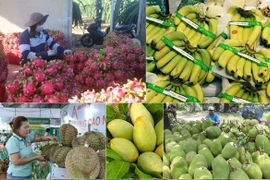
Items of products that saw higher export values include coffee with 1.7 billion USD, up 2.5%; rice (1.56 billion USD, up 55%); fruits and vegetables (1.39 billion USD, up 19.4%); cashew nuts (942 million USD, up 3.4%) and meat and by-products (45 million USD, up 64%).
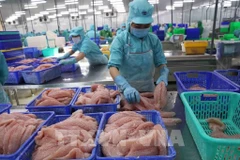
On the contrary, exports of rubber, tea, pepper, cassava and cassava products, wood and wooden products, rattan, bamboo and sedge mats, tra fish (pangasius), and shrimp experienced decreases between 6% and 40%.
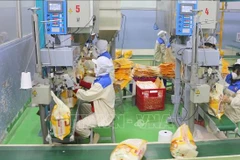
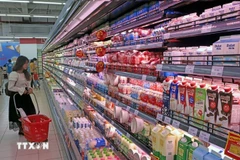
 Exports of husbandry products increase in the first four months of this year. (Photo: VietnamPlus)
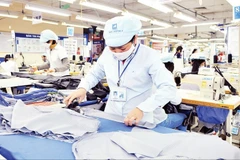
According to MARD, the export value of wood and wooden products decreased 25% year-on-year to an estimated 4 billion USD due to the high price of input fuel and global energy prices, which has impacted the production costs of wood enterprises.
Besides, customers in some key markets like the US and EU had a tendency to tighten spending on non-essential products. That has caused a sharp drop in import demand.
With the current growth rate, MARD forecasts that the export turnover of wood and wood products in the first half of 2023 would decrease between 28% and 32% compared to the same period last year.
The ministry said it would continue promoting market development and removing obstacles to domestic consumption and export in the time ahead.
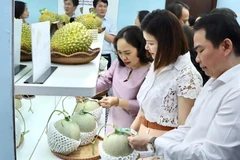
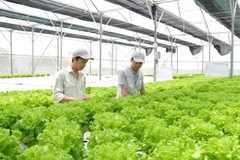
 Exports of vegetables and fruits have enjoyed rosy growth. (Photo: VietnamPlus)
It would utilise free trade agreements (FTAs), especially the Comprehensive and Progressive Agreement for Trans-Pacific Partnership (CPTPP) and the EU-Vietnam Free Trade Agreement (EVFTA) to promote the consumption of agro-forestry and fisheries products.
Also, it would send two delegations to Chinese provinces of Yunnan and Guangxi to promote the trade of agricultural products while organising a forum to facilitate the consumption of spices in the EU market.
A series of events to better advertise Vietnam's major agricultural products in the United Kingdom on the occasion of the 50th anniversary of Vietnam-UK relations would be also organised, the ministry noted.
As the world situation remained complicated, MARD suggested that businesses should actively expand markets and improve competitiveness with a focus on ensuring product prices and quality, a good after-sales policy, and choose products that can meet the tastes of customers.
The firms should also restructure and reorganise production with top priority given to technological innovation, perfecting the production management system, and improving the efficiency and quality of human resources.
Stepping up the production of products that use domestic raw materials to reduce costs and sharpening the competitiveness of products would be also included./.