Vietnam’s exporters gear up for recovery as new markets open

Phan Minh Thong, General Director of Phuc Sinh Group, said the firm expects revenue to rise by about 27% thanks to a stable order pipeline.

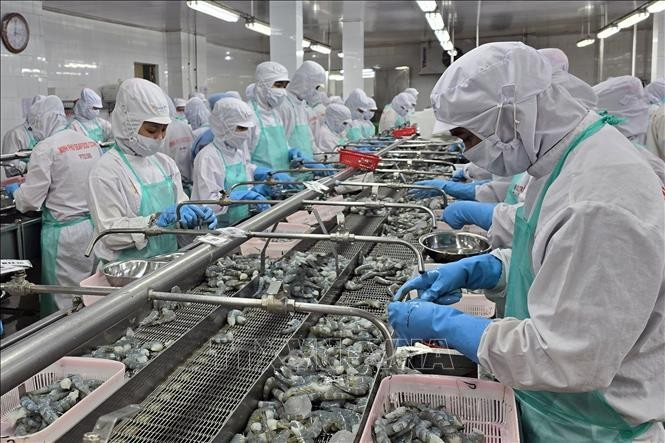
Workers process frozen shrimp for export at Minh Phu Seafood Corporation in the southern province of Ca Mau. (Photo: VNA)

Hanoi (VNA) – Vibrant trade flows in the closing months of 2025 have sent positive signals for Vietnam’s export outlook in 2026, indicating a shift into a phase of selective recovery. Of which, free trade agreements (FTAs) continue to act as a “lever”, opening new markets and improving the quality of growth.

Stable orders

Reviewing business performance in 2025, Phan Minh Thong, General Director of Phuc Sinh Group, said the firm’s export value in December alone reached around 50 million USD – its highest monthly figure to date. For the full year, export turnover totalled some 460 million USD. Looking ahead to 2026, the business expects revenue to rise by about 27% thanks to a stable order pipeline.

“Our pepper exports are mainly shipped to the Americas, while coffee goes largely to Europe. Middle Eastern partners prioritise Halal-certified products,” Thong was quoted by Sai Gon Giai Phong (Liberated Saigon) newspaper as saying, noting that this approach reduces reliance on any single market or product line while increasing the value of each shipment.

Other key export sectors have also reported a return of long-term, stable orders. According to Nguyen Dang Hien, General Director of the Tan Quang Minh Manufacture and Trading Co., Ltd. (Bidrico), the company secured Japanese orders for fruit juice, bird’s-nest drinks and salted lemon beverages right at the start of the year.

The early arrival of these orders enabled smooth production planning from the outset and strengthened Japanese partners’ confidence in Bidrico’s processed beverages, creating expectations of further growth ahead, he said.

In the wood industry, Nguyen Liem, Chairman of the Binh Duong Furniture Association (BIFA), said exports continue to grow steadily. Vietnamese wood products are now present in more than 160 countries and territories, and the return of orders despite stricter standards reflects improving business adaptability.

Expanding markets

Beyond traditional destinations, new growth opportunities are emerging in markets linked to FTAs and higher standards. A key example is the Halal market. According to Tran Phu Lu, Director of the Investment and Trade Promotion Centre (ITPC), the global Halal economy is valued at up to 2 trillion USD, with demand increasing not only across Muslim-majority nations but also in Europe and the US.

Ly Kim Chi, Chairwoman of the HCM City Food and Foodstuff Association, said orders are returning on the basis of fully controlled supply chains, covering raw materials, processing and logistics. This places greater compliance demands on exporters but also opens the door to building higher-value production networks, she continued.

“At the policy level, FTAs remain a pillar supporting enterprises to expand and diversify markets, enhancing resilience against external shocks. Vietnam has now joined 20 FTAs, 17 of which are in force, covering more than 60 countries and territories,” said Vu Ba Phu, Director of the Vietnam Trade Promotion Agency.

New-generation FTAs, he added, go beyond tariff preferences to promote institutional reform, higher standards and deeper integration into global value chains.

Vietnamese trade offices abroad also report continued positive signals. In the Nordic region, importers are seeking Vietnamese partners to produce confectionery and processed foods under their own brands, prioritising long-term cooperation and strict adherence to EU food-safety regulations. In the US, demand remains stable, with new orders focusing on consumer and light-industrial goods, alongside tougher traceability requirements.

Economists believe export prospects in FTA markets remain favourable heading into 2026, especially in sectors where Vietnam holds competitive advantages such as agriculture, processed foods, seafood, textiles, footwear and wood products. The early return of orders, together with longer-term cooperation trends, is helping businesses plan production and exports from the start of the year./.
VNA

See more

Processing pangasius for export at Caseamex Joint Stock Company, Tra Noc Industrial Park, Can Tho city. (Photo: VNA)

Seafood sector targets 11.5 billion USD in exports in 2026

In 2026, the sector aims for total seafood output of more than 10 million tonnes, up 0.6% from 2025. Of the total, capture fisheries are expected to reach about 3.75 million tonnes, down 2.1%, while aquaculture output is projected at 6.25 million tonnes, up 2.2%. Seafood export turnover is targeted at around 11.5 billion USD.

Vietnam's GDP expands by more than 8% in 2025. (Photo: VNA)

International financial institutions optimistic about Vietnam’s 2026 growth

As Vietnam enters 2026 - the first year of the 2026–2030 socio-economic development plan, international organisations stress that maintaining macroeconomic stability, improving growth quality and staying the course on fundamental reforms will be crucial in turning positive assessments into tangible outcomes and shaping a more sustainable development cycle ahead.

The application of Israeli technology in melon cultivation has delivered high economic efficiency (Photo: VNA)

VIFTA provides impetus for Vietnamese exports to Israel

The greatest benefit generated by the VIFTA lies in the immediate removal or phased deep reduction of many tariffs, significantly improving the price competitiveness of Vietnamese goods. At the same time, clearer provisions on rules of origin, customs procedures and trade remedies are helping foster long-term business partnerships.

Vegetables with a green tick at a supermarket in Ho Chi Minh City. (Photo: VNA)

“Green tick” products ready for Tet holiday

Products bearing the city’s “green tick of responsibility” label, which indicates clear origin and verified quality, are increasingly visible on shelves and drawing strong consumer attention.

Imports and exports at Lach Huyen container port in Hai Phong city (Photo: VNA)

2026 Economic Census kicks off on January 7

The 2026 census aims to fully, comprehensively and objectively assess the current situation of economic establishments nationwide, including enterprises, public service units, associations, religious institutions and individual business households.​

A booth at the VietAGROS 2025 (Source: Organiser)

Int’l agricultural, environmental technology fair set for Can Tho

The organisers aim to strengthen links between suppliers of modern agricultural inputs and machinery and farmers, thereby helping producers access technologies in crop cultivation, livestock farming and aquaculture, adopt sustainable production processes and reduce greenhouse gas emissions.

At a supermarket in HCM City (Photo: VNA)

National retail strategy lays foundation for new growth phase

A key focus of the strategy is encouraging enterprises from all economic sectors to participate in retail development in forms and at scales suited to their capacity. It highlights the formation of a strong domestic distribution backbone through initial incentives in mechanisms, financial policies and land access, while gradually fostering large corporations and enterprises in the distribution sector.

Illustrative photo (Photo: VNA)

Vietnam, ASEAN emerge as major export markets for RoK

ASEAN, particularly Vietnam and Thailand, has also stood out. The RoK’s exports to ASEAN rose 12.5% over the period, reaching 122.4 billion USD in 2025, while exports to Vietnam climbed 10.8% to 62.8 billion USD.

Prime Minister Pham Minh Chinh chairs the fifth meeting of the steering committee for key national railway projects. (Photo: VNA)

PM calls for concentrated leadership, resources for railway projects

Prime Minister Pham Minh Chinh on January 6 stressed the need to focus leadership, manpower and resources on key railway projects, so that they can be put into operation soon, thereby contributing to socio-economic development and better living standards for the people.