Vietnam’s five-year HFCs production, consumption baselines announced
The Ministry of Natural Resources and Environment (MoNRE) has issued a decision announcing Vietnam's Hydrofluorocarbons (HFCs) production and consumption baselines and total national consumption for the 2024 - 2028 period.
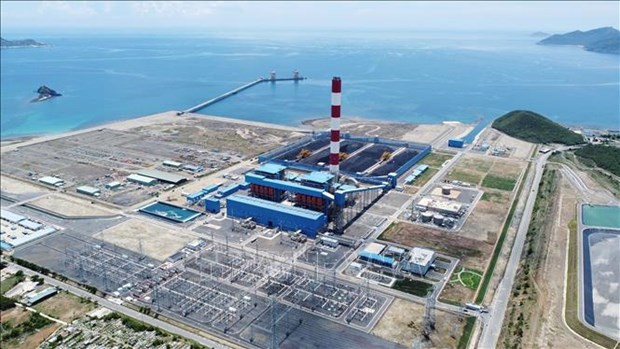 A view of Van Phong 1 thermal power plant (Photo: VNA)
Under Decision 4134 /QD-BTNMT, the HFCs production baseline will be 0 tonne of CO2 equivalents, while the HFCs consumption baseline will be 13,991,360 tonnes of CO2 equivalents. Total national consumption in the period from January 1, 2024 to December 31, 2028 will be 13,991,360 tonnes of CO2 equivalents, it said.
The ministry has assigned the Department of Climate Change to sum up and report the total annual HFCs consumption to the Ozone Secretariat, while submitting to the MoNRE Minister a proposal on the total HFCs consumption of Vietnam in each period.
In Vietnam, one of the strong steps forward in the management and protection of the ozone layer is the legalisation of regulations on ozone layer protection in Article 92 of the 2020 Law on Environmental Protection.
Documents guiding the implementation of the law have clarified contents of the roadmap for management and elimination of HFCs according to Vietnam's responsibilities and obligations to implement the Montreal Protocol, along with sanctions for violations in the field.
The country has joined hands with the international community in protecting the ozone layer, controlling and eliminating substances that deplete the ozone layer, including CFC, Halon, CTC, HCFC, and Methyl bromide, and HFCs which are fluorinated greenhouse gases (GHGs). Vietnam has completely eliminated the consumption of CFC, Halon, and CTC substances since January 1, 2010, and limited the import of Methyl bromide substances which were only used for disinfection purposes.
In the 2020-2025 period, Vietnam will eliminate 35% of baseline consumption of hydrochlorofluorocarbons (HCFCs). Vietnam’s import quota of HCFCs is only 2,600 tonnes, which will gradually decrease in the following periods towards an end of importing HCFCs by 2040.
Vietnam has implemented a roadmap to eliminate HFCs with the goal of not increasing the consumption of HFCs in the 2024-2028 period, eliminating 10% of HFC consumption from 2029 to 2034 and moving towards eliminating 80% of HFC consumption by 2045./.



You should also see

10th anniversary of UNESCO's recognition of Trang An as world natural and cultural heritage marked
A ceremony was held in the northern province of Ninh Binh on April 26 evening to celebrate the 10th anniversary of UNESCO's recognition of Trang An Landscape Complex as a World Cultural and Natural Heritage Site.

See more
 Environment
Drought at peak dry season impacts over 20,000ha of farmland
About 20,090ha of farmland and over 2,600 households have been hit by drought and water scarcity in the central region, Central Highlands, and southeastern region, which are now in the peak period of the 2023 - 2024 dry season.
 Environment
Hoa Phat steel products certified to meet greenhouse gas inventory standard
Vietnamese steel giant Hoa Phat Group has announced that BSI - the UK's leading international certification organisation - certified ISO 14064-1:2018 standard and ISO 14067:2018 on greenhouse gas inventory for steel products of its subsidiary - Hoa Phat Dung Quat Steel JSC.
 Environment
Vietnam supports global agreement on plastic pollution
A delegation of Vietnamese negotiators joined those from 176 countries worldwide at the fourth session of the Intergovernmental Negotiating Committee (INC-4) on plastic waste in Ottawa, Canada, on April 23.
 Environment
Consultation workshop on Cambodia’s Funan-Techo canal held in Can Tho
The Vietnam National Mekong Committee (VNMC) on April 23 held a consultation workshop on Cambodia’s proposed Funan-Techo canal project which has raised concerns about potential impacts on the Mekong river.
 Environment
Up to 1,000 ban flowers planted at Dien Bien Phu battlefield relic sites
About 1,000 ban (Bauhinia variegate) flower trees were planted at relic sites such as A1 Hill, Him Lam resistance centre and De Castries Bunker at Dien Bien Phu battlefield relic complex in the northern province of Dien Bien on April 21.
